Dihexa Technical Overview
Dihexa is a modified tripeptide built on the Nle-Tyr-Ile core of norleucine1-angiotensin IV (Nle1-AngIV). The N-terminal norleucine is replaced by a hexanoyl group, and the C-terminus carries a 6-aminohexanoic amide, giving the structure hexanoyl-Tyr-Ile-Ahx-NH2.
These end-group changes were designed to raise hydrophobicity, reduce hydrogen bonding and limit metabolic breakdown of the parent fragment. Dihexa carries PubChem CID 129010512 and appears in the literature under the research designation PNB-0408.
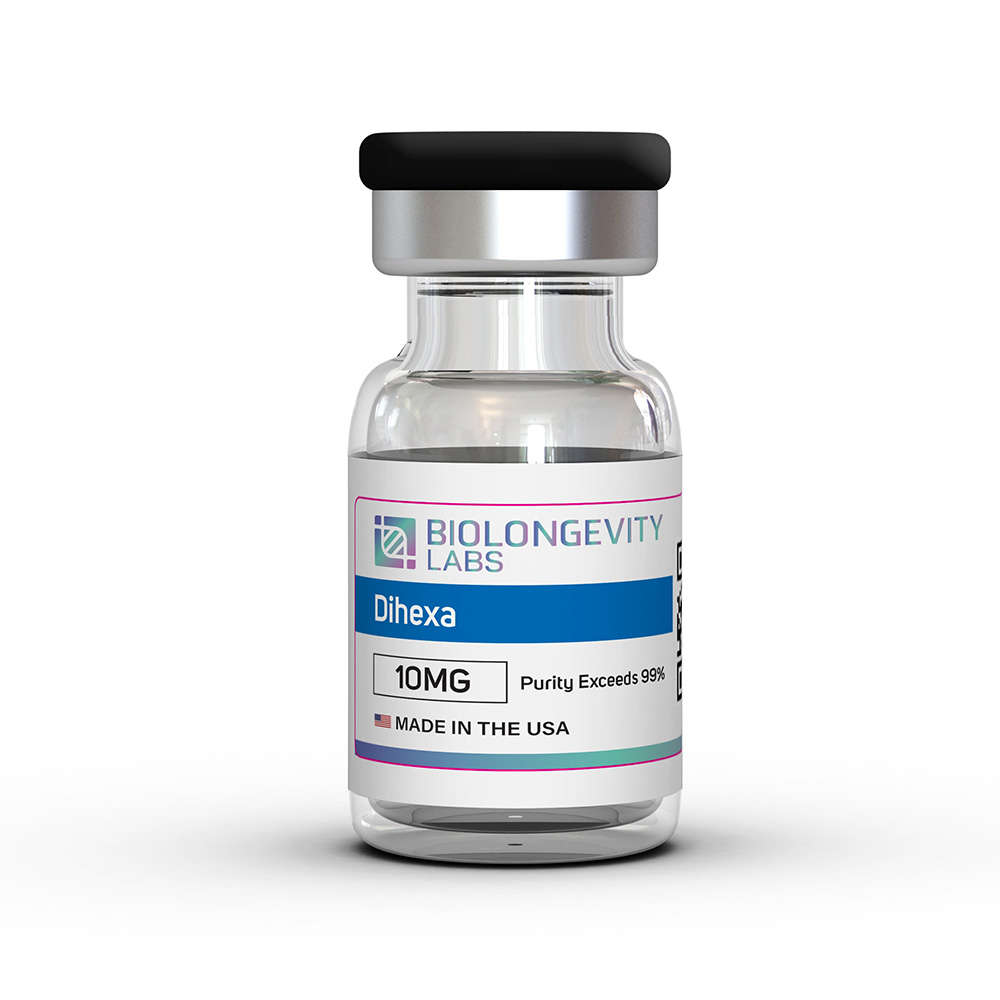
Laboratory work with this compound centers on HGF/c-Met signaling, dendritic spine and synapse formation assays, hair cell models and growth-factor-free hepatic differentiation. BioLongevity Labs offers Dihexa for sale strictly as a research peptide.
Compound Specifications
| Property |
Value |
| CAS Number |
1401708-83-5 |
| PubChem CID |
129010512 |
| Chemical Name (IUPAC) |
(2S,3S)-N-(6-amino-6-oxohexyl)-2-[[(2S)-2-(hexanoylamino)-3-(4-hydroxyphenyl)propanoyl]amino]-3-methylpentanamide |
| Compound Class |
Synthetic oligopeptide derivative (angiotensin IV analog, HGF mimetic) |
| Structure Notation |
Hexanoyl-Tyr-Ile-Ahx-NH2 |
| Molecular Formula |
C₂₇H₄₄N₄O₅ |
| Molecular Weight |
504.7 g/mol |
| Monoisotopic Mass |
504.3312 Da |
| InChIKey |
XEUVNVNAVKZSPT-JTJYXVOQSA-N |
| Isomeric SMILES |
CCCCCC(=O)N[C@@H](CC1=CC=C(C=C1)O)C(=O)N[C@@H]([C@@H](C)CC)C(=O)NCCCCCC(=O)N |
| UNII |
9WYX65A5C2 |
| Synonyms |
PNB-0408, N-hexanoic-Tyr-Ile-(6) aminohexanoic amide, Hexanoyl-Tyr-Ile-Ahx-NH2, N-(1-oxohexyl)-L-tyrosyl-N-(6-amino-6-oxohexyl)-L-isoleucinamide, ATH-1001 |
| Strength |
10mg per vial |
| Purity |
≥99% (HPLC) |
| Appearance |
Lyophilized white to off-white powder |
| Solubility |
Soluble in DMSO |
| Storage |
-20°C, protect from light and moisture |
Storage and Handling
- Store the lyophilized compound at -20°C, sealed and protected from light and moisture.
- After reconstitution, store at 2 to 8°C and use promptly.
- Maintain aseptic handling to preserve compound integrity.
Lyophilized Format
This compound ships in lyophilized (freeze-dried) form. Freeze-drying supports long-term storage stability and preserves compound integrity. No fillers are added.
Research Use Disclaimer
Dihexa is supplied for research use only. It is not a drug, food, cosmetic, or dietary supplement and has not been evaluated by the FDA. By purchasing, the buyer confirms the compound will be used solely for in vitro research.
Frequently Asked Questions
What Is Dihexa?
Dihexa (PNB-0408) is a synthetic oligopeptide derivative developed from the angiotensin IV analog Nle1-AngIV and characterized in laboratory research as a hepatocyte growth factor (HGF) mimetic. BioLongevity Labs supplies it as a 10mg lyophilized powder for research use only.
Is Dihexa a Peptide?
Yes. Dihexa is a synthetic oligopeptide derivative of angiotensin IV, built on a Tyr-Ile core with a hexanoyl group at the N-terminus and a 6-aminohexanoic amide at the C-terminus. These end groups were added to improve metabolic stability over the parent angiotensin IV fragment.
What Is the CAS Number and Molecular Weight of Dihexa?
Dihexa is listed under CAS number 1401708-83-5 and PubChem CID 129010512. Its molecular formula is C27H44N4O5, with a molecular weight of 504.7 g/mol.
What Is Dihexa Studied for in Laboratory Research?
Dihexa is studied in HGF/c-Met signaling research, including c-Met phosphorylation, cell scattering and dendritic spine formation assays. It has also been used in zebrafish hair cell models and as a synthetic replacement for HGF in hepatic differentiation protocols for pluripotent stem cells.
How Is Dihexa Purity Verified?
Each Dihexa batch is tested by an independent third-party laboratory to a ≥99% purity specification. The Certificate of Analysis for each batch is published online and can be reviewed before purchase.
Research Overview
Dihexa came out of a program to stabilize Nle-Tyr-Ile, the three N-terminal residues identified as the active core of Nle1-AngIV. N- and C-terminal modifications improved metabolic stability, and further changes to raise hydrophobicity and cut hydrogen bonding produced N-hexanoic-Tyr-Ile-(6) aminohexanoic amide [1].
In that work, Dihexa was associated with marked hippocampal synaptogenic activity and was examined in scopolamine-challenged and aged rat models using the Morris water maze task [1].
Later studies identified the receptor system behind these observations and carried the compound into several other research models.
HGF and c-Met Signaling
Dihexa binds HGF with high affinity. In the presence of subthreshold HGF concentrations, both Dihexa and Nle1-AngIV induced c-Met phosphorylation and augmented HGF-dependent cell scattering [2].
Both compounds also induced hippocampal spinogenesis and synaptogenesis similar to HGF itself, and these actions were blocked by an HGF antagonist and by short hairpin RNA directed at c-Met [2]. In rats, an HGF antagonist delivered intracerebroventricularly blocked Dihexa’s activity in the Morris water maze spatial learning task [2].
A 2021 transgenic mouse study linked Dihexa to PI3K/AKT pathway activation, higher synaptophysin expression, reduced astrocyte and microglia activation, lower IL-1β and TNF-α levels and higher IL-10 levels [3]. Co-treatment with the PI3K inhibitor wortmannin reversed these changes [3].
Hair Cell Models
In the larval zebrafish lateral line, Dihexa at 1 µM gave the strongest protection of hair cells from acute neomycin and gentamicin exposure [4]. Pretreatment did not change how much fluorescently tagged gentamicin entered the hair cells, which points to intracellular signaling rather than blocked uptake [4].
The protective response was attenuated by the HGF antagonist 6-AH and partly attenuated by inhibitors of Akt, TOR and MEK [4]. Adding an amino group to the N-terminus of Dihexa also weakened the response, showing how sensitive the compound is to small structural changes [4].
Stem Cell Differentiation
Dihexa is used as a synthetic stand-in for HGF in growth-factor-free hepatic differentiation protocols. In one published protocol, hepatoblast-like cells derived from pluripotent stem cells were matured into hepatocyte-like cells with Dihexa and dexamethasone [5].
A later protocol found that a combination of vitamin C, Dihexa and forskolin could replace growth factors during hepatic specification, as part of a stepwise method built entirely on small molecules [6].
| Research Area |
In Vitro Application |
| HGF Binding |
High-affinity binding assays between Dihexa and HGF |
| c-Met Activation |
c-Met phosphorylation in the presence of subthreshold HGF |
| Cell Scattering |
HGF-dependent cell scattering assays |
| Synapse Formation |
Dendritic spine and synapse counts in hippocampal neuron preparations |
| Pathway Mapping |
PI3K/AKT, MEK and TOR inhibitor co-treatment studies |
| Hair Cell Models |
Neomycin and gentamicin exposure assays in zebrafish lateral line hair cells |
| Hepatic Differentiation |
Growth-factor-free maturation of hepatocyte-like cells from pluripotent stem cells |
References
- McCoy AT, Benoist CC, Wright JW, et al. (2013). Evaluation of metabolically stabilized angiotensin IV analogs as procognitive/antidementia agents. The Journal of Pharmacology and Experimental Therapeutics. https://doi.org/10.1124/jpet.112.199497
- Benoist CC, Kawas LH, Zhu M, et al. (2014). The procognitive and synaptogenic effects of angiotensin IV-derived peptides are dependent on activation of the hepatocyte growth factor/c-met system. The Journal of Pharmacology and Experimental Therapeutics. https://doi.org/10.1124/jpet.114.218735
- Sun X, Deng Y, Fu X, et al. (2021). AngIV-Analog Dihexa Rescues Cognitive Impairment and Recovers Memory in the APP/PS1 Mouse via the PI3K/AKT Signaling Pathway. Brain Sciences. https://doi.org/10.3390/brainsci11111487
- Uribe PM, Kawas LH, Harding JW, Coffin AB. (2015). Hepatocyte growth factor mimetic protects lateral line hair cells from aminoglycoside exposure. Frontiers in Cellular Neuroscience. https://doi.org/10.3389/fncel.2015.00003
- Mathapati S, Siller R, Impellizzeri AA, et al. (2016). Small-Molecule-Directed Hepatocyte-Like Cell Differentiation of Human Pluripotent Stem Cells. Current Protocols in Stem Cell Biology. https://doi.org/10.1002/cpsc.13
- Pan T, Wang N, Zhang J, et al. (2022). Efficiently generate functional hepatic cells from human pluripotent stem cells by complete small-molecule strategy. Stem Cell Research & Therapy. https://doi.org/10.1186/s13287-022-02831-1
Certificate of Analysis (COA)
No COAs available for this product.
A Certificate of Analysis (COA) is a document that verifies a compound’s identity, purity and quality through independent laboratory testing. Every compound from BioLongevity Labs is third-party tested, and its COA is published here, so researchers can review the testing record before a compound enters a protocol.
Each COA reports results from third-party laboratory analysis, including:
- Ultra-high-performance liquid chromatography with mass spectrometry (UHPLC-MS) for purity, measured against a 98% or 99% specification depending on the compound
- Mass identification for molecular confirmation and content quantitation
- Endotoxin testing by Limulus amebocyte lysate (LAL) or recombinant Factor C (rFC) assay, depending on the laboratory
- Visual and physical characterization of the finished material
How to Verify a COA Independently
You can check every certificate against the issuing laboratory’s own records, not just the copy hosted here. Verification does not depend on BioLongevity Labs.
- AV Analytics certificates carry a search code. Scan the QR code on the certificate to open the laboratory’s verification page, or enter the search code at avanalytical.com/coa-search to pull the official record.
- BioRegen reports of analysis carry a Report ID and a Validation Key. Scan the QR code on the certificate to open the official record, or quote both identifiers when you contact the laboratory at the address printed on the report.
- SafeCert Labs issued a number of earlier certificates. Each one carries a COA number and the signature of the reporting chemist. Quote that number when you ask the laboratory to confirm it.
- Older certificates from other laboratories list their own verification details on the document.
When a batch is sent to more than one laboratory, each certificate resolves at its own issuing laboratory. A researcher can then check the results against two unrelated sources.
These COAs come from independent certified laboratories, not in-house testing. That gives researchers a verifiable record of molecular integrity for each compound. All compounds are supplied for research use only.
Review the latest COAs for this product below, or browse the full COA library.