GHRP-2 Technical Overview
GHRP-2 is a six-residue synthetic peptide with a C-terminal amide. Its sequence carries three D-amino acids and the non-coded residue D-2-naphthylalanine (D-2-Nal) in position 2, which sets it apart from other members of the GHRP family.
It appears in the literature under the research designations pralmorelin and KP-102, and carries CAS number 158861-67-7 and PubChem CID 6918245.
GHRP-2 is a growth hormone secretagogue studied at the ghrelin receptor GHS-R1a, a receptor distinct from the one used by growth hormone releasing hormone. Laboratory work centers on primary pituitary cell cultures, second messenger assays and analytical method development. BioLongevity Labs offers GHRP-2 for sale strictly as a research peptide.
Compound Specifications
| Property |
Value |
| CAS Number |
158861-67-7 |
| PubChem CID |
6918245 |
| Molecular Formula |
C₄₅H₅₅N₉O₆ |
| Molecular Weight |
818.0 g/mol |
| Monoisotopic Mass |
817.4275 Da |
| Amino Acid Sequence |
D-Ala-D-2-Nal-Ala-Trp-D-Phe-Lys-NH₂ |
| Sequence Length |
6 residues (hexapeptide, C-terminal amide) |
| Source |
Synthetic (controlled peptide synthesis) |
| InChIKey |
HRNLPPBUBKMZMT-RDRUQFPZSA-N |
| ChEMBL ID |
CHEMBL106593 |
| UNII |
E6S6E1F19M |
| Synonyms |
Pralmorelin, KP-102, GHRP 2, Growth Hormone Releasing Peptide-2, GPA-748 |
| Strength |
10mg per vial |
| Purity |
≥99% (HPLC) |
| Appearance |
Lyophilized white powder |
| Solubility |
Soluble in water |
| Storage |
-20°C, protect from light and moisture |
Storage and Handling
- Store the lyophilized compound at -20°C, sealed and protected from light and moisture.
- After reconstitution, store at 2 to 8°C and use promptly.
- Maintain aseptic handling to preserve compound integrity.
Lyophilized Format
This compound ships in lyophilized (freeze-dried) form. Freeze-drying supports long-term storage stability and preserves compound integrity. No fillers are added.
Research Use Disclaimer
GHRP-2 is supplied for research use only. It is not a drug, food, cosmetic, or dietary supplement and has not been evaluated by the FDA. By purchasing, the buyer confirms the compound will be used solely for in vitro research.
Frequently Asked Questions
What Is GHRP-2 Peptide?
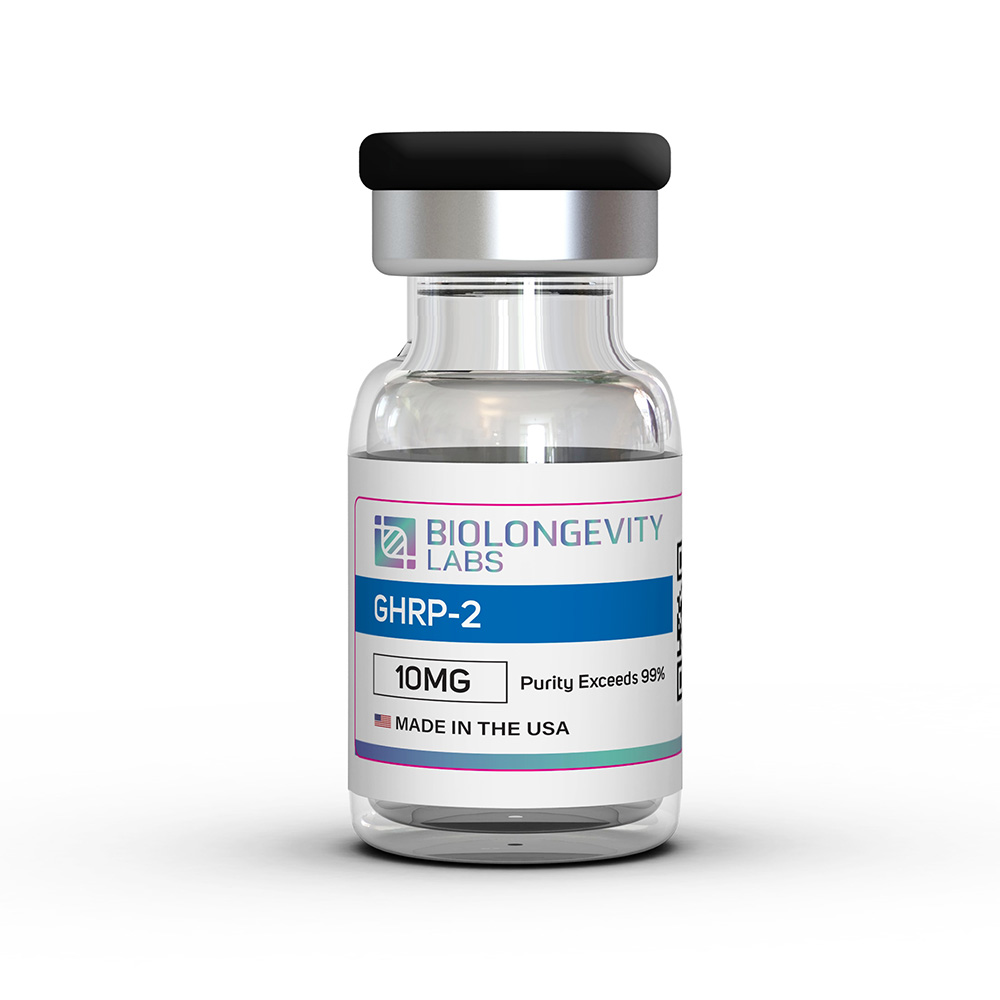
GHRP-2 (pralmorelin) is a synthetic hexapeptide growth hormone secretagogue characterized in laboratory research as an agonist of the ghrelin receptor GHS-R1a. BioLongevity Labs supplies it as a 10mg lyophilized powder for research use only.
How Is GHRP-2 Different From GHRP-6?
GHRP-2 and GHRP-6 are separate synthetic hexapeptides from the same secretagogue family, and GHRP-2 carries D-2-naphthylalanine in position 2. In ovine pituitary cell studies, GHRP-2 raised intracellular cAMP while GHRP-6 did not.
How Is GHRP-2 Different From Growth Hormone?
GHRP-2 is a six-residue synthetic peptide studied as a secretagogue, a compound that prompts pituitary somatotroph cells to release growth hormone. Growth hormone itself is a much larger protein made by those cells.
What Is the CAS Number and Molecular Weight of GHRP-2?
GHRP-2 is listed under CAS number 158861-67-7 and PubChem CID 6918245. Its molecular formula is C45H55N9O6, with a molecular weight of 818.0 g/mol.
How Is GHRP-2 Purity Verified?
Each GHRP-2 batch is tested by an independent third-party laboratory to a ≥99% purity specification. The Certificate of Analysis for each batch is published online and can be reviewed before purchase.
Research Overview
GHS-R1a, the ghrelin receptor, is a G protein-coupled receptor expressed in the pituitary and hypothalamus. Depending on cell type, its activation has been linked to Gαq/11, phospholipase C and calcium signaling as well as cAMP-dependent pathways [1].
In a perifusion system of primary cultured ovine anterior pituitary cells, GHRP-2 (then coded KP 102) produced a concentration-dependent rise in GH secretion. Its potency was similar to GRF and about tenfold above GHRP-6 and GHRP-1 in the same system [2].
That response was abolished by a GRF receptor antagonist and by calcium channel blockade with cadmium. A second application within one hour produced a smaller response, with no cross-desensitization between GHRP-2 and GRF [2].
Later cell studies examined the second messengers and gene expression behind that response.
Second Messenger Signaling
In ovine somatotrophs, GHRP-2 raised intracellular cAMP in a concentration-dependent manner while GHRP-6 did not, and an adenylyl cyclase inhibitor blocked GHRP-2-induced GH release [3]. The same work found no cAMP rise in rat pituitary cells, pointing to species differences in receptor subtype [3].
In bovine anterior pituitary cultures, GHRP-2 increased GH secretion across 10⁻¹³ to 10⁻⁷ M. The response was inhibited by the voltage-dependent calcium channel blocker nifedipine and was further raised by a protein kinase C activator or forskolin [4].
Receptor and Gene Expression Studies
Over 0.5 to 2 hours, GHRP-2 at 100 nM increased GH, Pit-1, GHRH receptor and GHS-R mRNA in ovine somatotropes, while sst-1 and sst-2 somatostatin receptor mRNA fell [5].
In cultured rat anterior pituitary cells, GHRP-2 stimulated GH secretion directly, though with lower in vitro potency than GHRH. In rat models, its GH-releasing activity was absent after hypophysectomy [6].
Research outside the pituitary has focused on a second binding partner.
CD36 and Oxidative Stress Models
GHRP-2 binds CD36, a scavenger receptor for oxidized low-density lipoprotein (OxLDL) [7]. In cultured aortic smooth muscle cells it prevented OxLDL-induced peroxide generation, IGF-I receptor down-regulation and apoptosis, and in macrophages it reduced lipid accumulation with OxLDL exposure [7].
Analytical screening methods using liquid chromatography with ion mobility time-of-flight mass spectrometry detect GHRP-2 within a panel of small peptides, with limits of detection between 50 and 500 pg/mL [8].
| Research Area |
In Vitro Application |
| GH Secretagogue Signaling |
GH release assays in primary ovine, bovine and rat pituitary cell cultures |
| Second Messenger Pathways |
cAMP, calcium influx and protein kinase C studies in somatotrophs |
| Receptor Pharmacology |
GRF receptor antagonist and somatostatin interaction studies |
| Gene Expression |
GH, Pit-1, GHRH-R, GHS-R and somatostatin receptor mRNA analysis |
| Oxidative Stress |
OxLDL and CD36 studies in aortic smooth muscle cells and macrophages |
| Analytical Methods |
Liquid chromatography and ion mobility mass spectrometry reference work |
References
- Yin Y, Li Y, Zhang W. (2014). The growth hormone secretagogue receptor: its intracellular signaling and regulation. International Journal of Molecular Sciences. https://doi.org/10.3390/ijms15034837
- Wu D, Chen C, Katoh K, Zhang J, Clarke IJ. (1994). The effect of GH-releasing peptide-2 (GHRP-2 or KP 102) on GH secretion from primary cultured ovine pituitary cells can be abolished by a specific GH-releasing factor (GRF) receptor antagonist. Journal of Endocrinology. https://doi.org/10.1677/joe.0.140r009
- Wu D, Chen C, Zhang J, Bowers CY, Clarke IJ. (1996). The effects of GH-releasing peptide-6 (GHRP-6) and GHRP-2 on intracellular adenosine 3′,5′-monophosphate (cAMP) levels and GH secretion in ovine and rat somatotrophs. Journal of Endocrinology. https://doi.org/10.1677/joe.0.1480197
- Roh SG, He ML, Matsunaga N, Hidaka S, Hidari H. (1997). Mechanisms of action of growth hormone-releasing peptide-2 in bovine pituitary cells. Journal of Animal Science. https://doi.org/10.2527/1997.75102744x
- Yan M, Hernandez M, Xu R, Chen C. (2004). Effect of GHRH and GHRP-2 treatment in vitro on GH secretion and levels of GH, pituitary transcription factor-1, GHRH-receptor, GH-secretagogue-receptor and somatostatin receptor mRNAs in ovine pituitary cells. European Journal of Endocrinology. https://doi.org/10.1530/eje.0.1500235
- Doi N, Hirotani C, Ukai K, et al. (2004). Pharmacological characteristics of KP-102 (GHRP-2), a potent growth hormone-releasing peptide. Arzneimittel-Forschung. https://doi.org/10.1055/s-0031-1297041
- Titterington JS, Sukhanov S, Higashi Y, et al. (2009). Growth hormone-releasing peptide-2 suppresses vascular oxidative stress in ApoE-/- mice but does not reduce atherosclerosis. Endocrinology. https://doi.org/10.1210/en.2009-0283
- Thomas A, Görgens C, Guddat S, et al. (2015). Simplifying and expanding the screening for peptides <2 kDa by direct urine injection, liquid chromatography, and ion mobility mass spectrometry. Journal of Separation Science. https://doi.org/10.1002/jssc.201501060
Certificate of Analysis (COA)
No COAs available for this product.
A Certificate of Analysis (COA) is a document that verifies a compound’s identity, purity and quality through independent laboratory testing. Every compound from BioLongevity Labs is third-party tested, and its COA is published here, so researchers can review the testing record before a compound enters a protocol.
Each COA reports results from third-party laboratory analysis, including:
- Ultra-high-performance liquid chromatography with mass spectrometry (UHPLC-MS) for purity, measured against a 98% or 99% specification depending on the compound
- Mass identification for molecular confirmation and content quantitation
- Endotoxin testing by Limulus amebocyte lysate (LAL) or recombinant Factor C (rFC) assay, depending on the laboratory
- Visual and physical characterization of the finished material
How to Verify a COA Independently
You can check every certificate against the issuing laboratory’s own records, not just the copy hosted here. Verification does not depend on BioLongevity Labs.
- AV Analytics certificates carry a search code. Scan the QR code on the certificate to open the laboratory’s verification page, or enter the search code at avanalytical.com/coa-search to pull the official record.
- BioRegen reports of analysis carry a Report ID and a Validation Key. Scan the QR code on the certificate to open the official record, or quote both identifiers when you contact the laboratory at the address printed on the report.
- SafeCert Labs issued a number of earlier certificates. Each one carries a COA number and the signature of the reporting chemist. Quote that number when you ask the laboratory to confirm it.
- Older certificates from other laboratories list their own verification details on the document.
When a batch is sent to more than one laboratory, each certificate resolves at its own issuing laboratory. A researcher can then check the results against two unrelated sources.
These COAs come from independent certified laboratories, not in-house testing. That gives researchers a verifiable record of molecular integrity for each compound. All compounds are supplied for research use only.
Review the latest COAs for this product below, or browse the full COA library.