GHRP-6 Technical Overview
GHRP-6 is a six-residue synthetic peptide in the growth hormone releasing peptide (GHRP) family. Its sequence carries two D-amino acids, D-tryptophan at position 2 and D-phenylalanine at position 5, and ends in a C-terminal lysine amide.
These D-residues and the amidated C-terminus set GHRP-6 apart from naturally occurring peptide sequences. It carries PubChem CID 9919153 and appears in the literature as [His1,Lys6]-GHRP, SK&F 110679 and Hexapeptide-2.
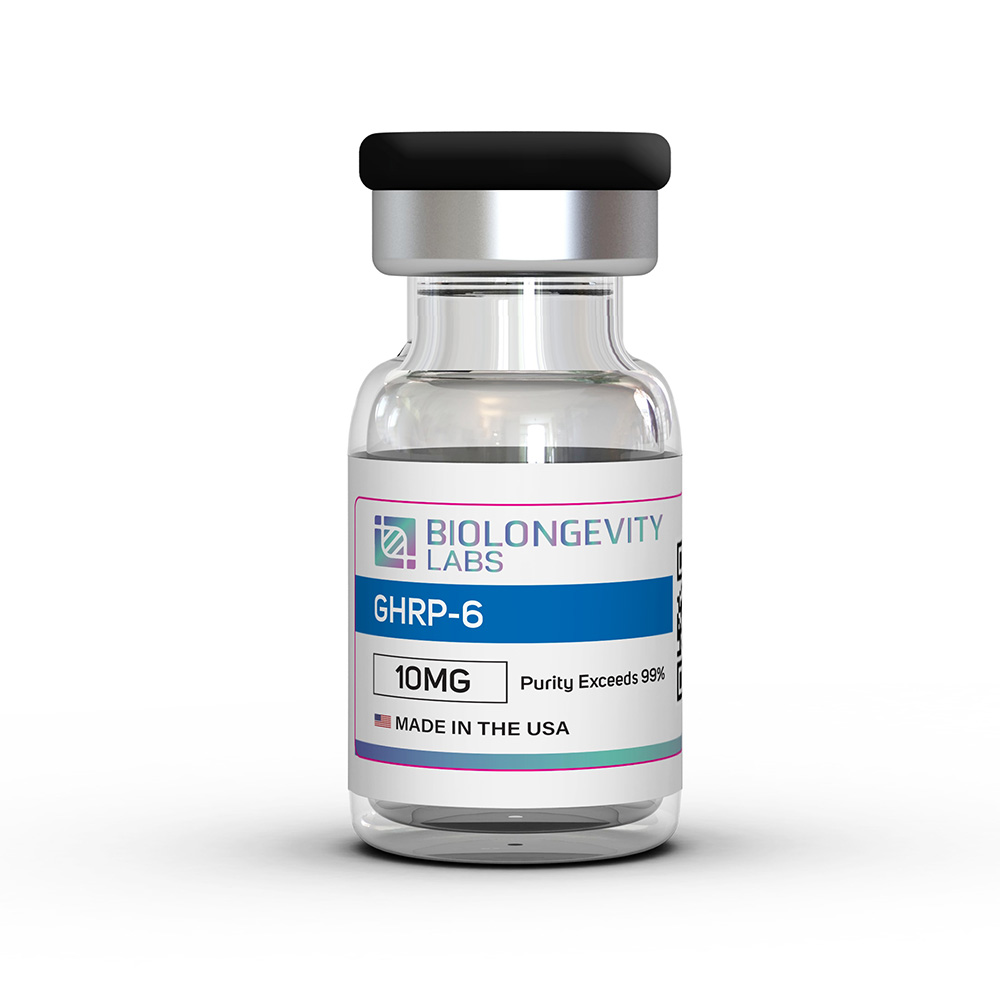
In the laboratory, the GHRP-6 peptide is used in receptor binding, pituitary cell secretion and intracellular signaling studies. BioLongevity Labs offers GHRP-6 for sale strictly as a research peptide, USA manufactured and supplied in 10mg vials.
Compound Specifications
| Property |
Value |
| CAS Number |
87616-84-0 |
| PubChem CID |
9919153 |
| Molecular Formula |
C₄₆H₅₆N₁₂O₆ |
| Molecular Weight |
873.0 g/mol |
| Monoisotopic Mass |
872.4446 Da |
| Amino Acid Sequence (Three-Letter) |
His-D-Trp-Ala-Trp-D-Phe-Lys-NH₂ |
| Amino Acid Sequence (One-Letter) |
HwAWfK-NH₂ (lowercase = D-amino acid) |
| Sequence Length |
6 residues, C-terminal amide |
| Source |
Synthetic |
| InChIKey |
WZHKXNSOCOQYQX-FUAFALNISA-N |
| ChEMBL ID |
CHEMBL105462 |
| UNII |
4H7N4I6X6A |
| Synonyms |
Growth Hormone Releasing Peptide 6, GH-Releasing Hexapeptide, [His1,Lys6]-GHRP, SK&F 110679, SKF-110679, Hexapeptide-2 |
| Strength |
10mg per vial |
| Purity |
≥99% (HPLC) |
| Appearance |
Lyophilized white powder |
| Solubility |
Soluble in aqueous buffer (about 10 mg/mL in PBS, pH 7.2) |
| Storage |
-20°C, protect from light and moisture |
Storage and Handling
- Store the lyophilized compound at -20°C, sealed and protected from light and moisture.
- After reconstitution, store at 2-8°C and use promptly.
- Maintain aseptic handling to preserve compound integrity.
Lyophilized Format
This compound ships in lyophilized (freeze-dried) form. Freeze-drying supports long-term storage stability and preserves compound integrity. No fillers are added.
Research Use Disclaimer
GHRP-6 is supplied for research use only. It is not a drug, food, cosmetic, or dietary supplement and has not been evaluated by the FDA. By purchasing, the buyer confirms the compound will be used solely for in vitro research.
Frequently Asked Questions
What Is GHRP-6 10mg?
GHRP-6 10mg is a vial containing 10mg of growth hormone releasing peptide 6, a synthetic hexapeptide with the sequence His-D-Trp-Ala-Trp-D-Phe-Lys-NH2. BioLongevity Labs supplies it as a lyophilized powder for research use only.
Is GHRP-6 a Steroid?
No. GHRP-6 is a synthetic peptide built from six amino acids, while steroids are lipid compounds built on a four-ring carbon framework. In research models GHRP-6 acts through peptide receptors such as GHS-R1a rather than steroid receptors.
Which Receptor Does GHRP-6 Act On?
GHRP-6 is characterized in laboratory research as an agonist of the growth hormone secretagogue receptor type 1a (GHS-R1a), also called the ghrelin receptor. Studies have also examined CD36, a scavenger receptor found on cardiac cells and in skin granulation tissue, as a second binding site for GHRP-family peptides.
What Is the CAS Number and Molecular Weight of GHRP-6?
GHRP-6 is listed under CAS number 87616-84-0 and PubChem CID 9919153. Its molecular formula is C46H56N12O6, with a molecular weight of 873.0 g/mol.
How Is GHRP-6 Purity Verified?
Each GHRP-6 batch is tested by an independent third-party laboratory to a ≥99% purity specification. The Certificate of Analysis for each batch is published online and can be reviewed before purchase.
Research Overview
GHRP-6 came out of a structure-activity program that paired conformational energy calculations with in vitro and in vivo testing of small synthetic peptides. In that work, both a pentapeptide and the hexapeptide His-D-Trp-Ala-Trp-D-Phe-Lys-NH2 released growth hormone at 1 to 10 ng/mL in vitro [1].
In incubated rat pituitary preparations, the hexapeptide released growth hormone in a concentration-related way without a matching release of LH, FSH, TSH or prolactin [2]. Somatostatin-14 and somatostatin-28 both inhibited this response, with somatostatin-28 about four times more active in vitro [2].
Perifused anterior pituitary cells from adult male rats responded to hourly GHRP-6 pulses with consistent growth hormone secretion, while continuous infusion led to desensitization [3]. The secretion pattern differed from that of the larger hypothalamic peptide GRF-44, which pointed to a separate mechanism of action [3].
Two receptor threads account for much of the later work on this peptide.
GHS-R1a Signaling
In 1996, a G protein-coupled receptor cloned from pituitary and hypothalamic tissue was identified as the target of synthetic growth hormone secretagogues [4]. Its pharmacological profile defined a neuroendocrine pathway for pulsatile growth hormone release, and this receptor, GHS-R1a, is the main site of action studied for GHRP-family peptides in pituitary models [4].
CD36 and Cytoprotection Models
Photoaffinity labeling of rat cardiac membranes with a GHRP-family hexapeptide identified CD36, a multifunctional glycoprotein on cardiomyocytes and microvascular endothelial cells, as a second binding protein [5]. The coronary perfusion response seen in isolated hearts was absent in hearts from CD36-null mice [5].
CD36 is abundant in the granulation tissue of excisional skin injury models. In rats, topical GHRP-6 was associated with lower levels of immunoinflammatory mediators and reduced expression of fibrotic cytokines [6].
In a rabbit ear model of excess extracellular matrix deposition, GHRP-6 was associated with PPARγ activation and lower fibrogenic cytokine expression [6]. A follow-up proteome study linked the early tissue response to pathways in lipid metabolism, cytoskeleton arrangement and extracellular matrix dynamics [7].
In a rat doxorubicin exposure model, GHRP-6 given alongside doxorubicin was associated with preserved cardiomyocyte mitochondrial integrity, upregulation of the prosurvival gene Bcl-2 and sustained antioxidant defense markers [8].
| Research Area |
In Vitro Application |
| GHS-R1a Agonism |
Receptor binding and signaling assays in GHS-R1a-expressing cell systems |
| Growth Hormone Secretion |
Static incubation and perifusion assays with anterior pituitary cells |
| Somatostatin Interaction |
Co-incubation with somatostatin-14 and somatostatin-28 |
| Receptor Desensitization |
Pulsed versus continuous exposure in perifused pituitary cells |
| CD36 Binding |
Photoaffinity labeling of cardiac membrane preparations |
| Cytoprotection |
Mitochondrial integrity, Bcl-2 expression and redox balance studies |
| Extracellular Matrix Dynamics |
Fibrogenic cytokine, PPARγ and proteome profiling in tissue models |
References
- Momany FA, Bowers CY, Reynolds GA, Hong A, Newlander K. (1984). Conformational energy studies and in vitro and in vivo activity data on growth hormone-releasing peptides. Endocrinology. https://doi.org/10.1210/endo-114-5-1531
- Bowers CY, Momany FA, Reynolds GA, Hong A. (1984). On the in vitro and in vivo activity of a new synthetic hexapeptide that acts on the pituitary to specifically release growth hormone. Endocrinology. https://doi.org/10.1210/endo-114-5-1537
- Badger TM, Millard WJ, McCormick GF, Bowers CY, Martin JB. (1984). The effects of growth hormone (GH)-releasing peptides on GH secretion in perifused pituitary cells of adult male rats. Endocrinology. https://doi.org/10.1210/endo-115-4-1432
- Howard AD, Feighner SD, Cully DF, et al. (1996). A receptor in pituitary and hypothalamus that functions in growth hormone release. Science. https://doi.org/10.1126/science.273.5277.974
- Bodart V, Febbraio M, Demers A, et al. (2002). CD36 mediates the cardiovascular action of growth hormone-releasing peptides in the heart. Circulation Research. https://doi.org/10.1161/01.res.0000016164.02525.b4
- Mendoza Marí Y, Fernández Mayola M, Aguilera Barreto A, et al. (2016). Growth Hormone-Releasing Peptide 6 Enhances the Healing Process and Improves the Esthetic Outcome of the Wounds. Plastic Surgery International. https://doi.org/10.1155/2016/4361702
- Fernández-Mayola M, Betancourt L, Molina-Kautzman A, et al. (2018). Growth hormone-releasing peptide 6 prevents cutaneous hypertrophic scarring: early mechanistic data from a proteome study. International Wound Journal. https://doi.org/10.1111/iwj.12895
- Berlanga-Acosta J, Cibrian D, Valiente-Mustelier J, et al. (2024). Growth hormone releasing peptide-6 (GHRP-6) prevents doxorubicin-induced myocardial and extra-myocardial damages by activating prosurvival mechanisms. Frontiers in Pharmacology. https://doi.org/10.3389/fphar.2024.1402138
Certificate of Analysis (COA)
No COAs available for this product.
A Certificate of Analysis (COA) is a document that verifies a compound’s identity, purity and quality through independent laboratory testing. Every compound from BioLongevity Labs is third-party tested, and its COA is published here, so researchers can review the testing record before a compound enters a protocol.
Each COA reports results from third-party laboratory analysis, including:
- Ultra-high-performance liquid chromatography with mass spectrometry (UHPLC-MS) for purity, measured against a 98% or 99% specification depending on the compound
- Mass identification for molecular confirmation and content quantitation
- Endotoxin testing by Limulus amebocyte lysate (LAL) or recombinant Factor C (rFC) assay, depending on the laboratory
- Visual and physical characterization of the finished material
How to Verify a COA Independently
You can check every certificate against the issuing laboratory’s own records, not just the copy hosted here. Verification does not depend on BioLongevity Labs.
- AV Analytics certificates carry a search code. Scan the QR code on the certificate to open the laboratory’s verification page, or enter the search code at avanalytical.com/coa-search to pull the official record.
- BioRegen reports of analysis carry a Report ID and a Validation Key. Scan the QR code on the certificate to open the official record, or quote both identifiers when you contact the laboratory at the address printed on the report.
- SafeCert Labs issued a number of earlier certificates. Each one carries a COA number and the signature of the reporting chemist. Quote that number when you ask the laboratory to confirm it.
- Older certificates from other laboratories list their own verification details on the document.
When a batch is sent to more than one laboratory, each certificate resolves at its own issuing laboratory. A researcher can then check the results against two unrelated sources.
These COAs come from independent certified laboratories, not in-house testing. That gives researchers a verifiable record of molecular integrity for each compound. All compounds are supplied for research use only.
Review the latest COAs for this product below, or browse the full COA library.