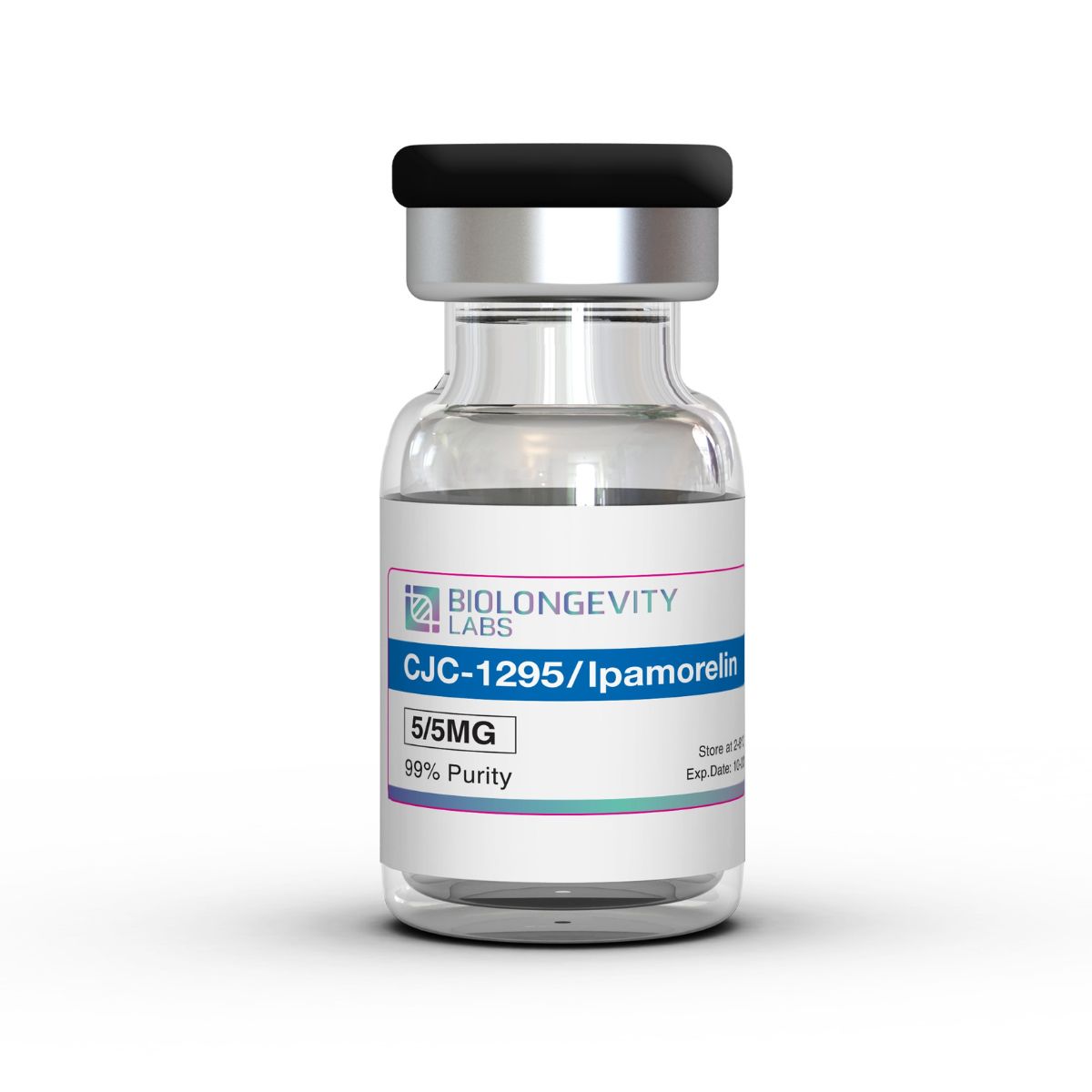
CJC-1295 & Ipamorelin Blend Product Description
CJC-1295 is a long-acting GHRH analog that binds to endogenous albumin, significantly prolonging half-life. CJC-1295 without DAC (often called Modified GRF 1-29 or CJC-1295 no DAC) retains 29 amino acids from natural GHRH but includes four substitutions to enhance stability and receptor binding. This potentially mimics a more natural pulsatile GH release pattern.
Ipamorelin is a synthetic pentapeptide (Aib-His-D-2-Nal-D-Phe-Lys-NH2) and a selective growth hormone secretagogue (GHS) that mimics ghrelin, a hormone that stimulates the release of growth hormone from the pituitary gland. It is known for its high potency and efficacy in releasing GH without significantly affecting other hormones like ACTH or cortisol, making it a unique candidate among growth hormone secretagogues.
The peptide blend may amplify GH release by targeting both GHRH and ghrelin receptors.
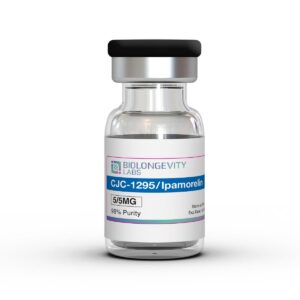
This is a (10mg) blend each of CJC-1295 (No DAC) (5mg) and Ipamorelin (5mg).
CJC 1295 Ipamorelin Research
CJC-1295 and ipamorelin have both been researched for their potential to stimulate growth hormone production.
Ipamorelin is a potent and selective GH secretagogue with unique properties that differentiate it from other GH-releasing peptides. Its ability to selectively stimulate GH release without affecting other hormones, along with its potential applications in body composition, make it a promising candidate for further clinical development.
Growth Hormone Release
In GHRH knockout mice, CJC-1295 administration normalized body weight and length, demonstrating its potential in treating growth deficiencies. Daily administration was more effective than less frequent dosing.1
In healthy subjects, CJC-1295 led to dose-dependent increases in GH and IGF-I levels, with effects lasting up to 28 days. In the study, CJC-1295 was well-tolerated with no serious adverse reactions reported, suggesting its potential utility as a therapeutic agent.2
Ipamorelin mimics the action of ghrelin by binding to the ghrelin receptor (GHSR) in the brain, which leads to the selective stimulation of GH release from the pituitary gland. This mechanism is similar to that of GHRH, but ipamorelin does not significantly affect the release of other hormones such as ACTH or cortisol.3
In animal studies, ipamorelin has been shown to increase longitudinal bone growth and body weight gain in a dose-dependent manner. It enhances GH release without affecting other growth factors like IGF-I, suggesting a direct effect on growth processes.4
In vivo, ipamorelin shows dose-proportional pharmacokinetics with a short half-life and effectively stimulated GH release across various doses.5
References
- Alba, M., Fintini, D., Sagazio, A., Lawrence, B., Castaigne, J., Frohman, L., & Salvatori, R. (2006). Once-daily administration of CJC-1295, a long-acting growth hormone-releasing hormone (GHRH) analog, normalizes growth in the GHRH knockout mouse.. American journal of physiology. Endocrinology and metabolism, 291 6, E1290-4 . https://doi.org/10.1152/AJPENDO.00201.2006.
- Teichman, S., Neale, A., Lawrence, B., Gagnon, C., Castaigne, J., & Frohman, L. (2006). Prolonged stimulation of growth hormone (GH) and insulin-like growth factor I secretion by CJC-1295, a long-acting analog of GH-releasing hormone, in healthy adults.. The Journal of clinical endocrinology and metabolism, 91 3, 799-805 . https://doi.org/10.1210/JC.2005-1536.
- Raun, K., Hansen, B., Johansen, N., Thøgersen, H., Madsen, K., Ankersen, M., & Andersen, P. (1998). Ipamorelin, the first selective growth hormone secretagogue.. European journal of endocrinology, 139 5, 552-61 . https://doi.org/10.1530/EJE.0.1390552.
- Johansen, P., Nowak, J., Skjaerbaek, C., Flyvbjerg, A., Andreassen, T., Wilken, M., & Orskov, H. (1999). Ipamorelin, a new growth-hormone-releasing peptide, induces longitudinal bone growth in rats.. Growth hormone & IGF research : official journal of the Growth Hormone Research Society and the International IGF Research Society, 9 2, 106-13 . https://doi.org/10.1054/GHIR.1999.9998.
- Gobburu, J., Agersø, H., Jusko, W., & Ynddal, L. (1999). Pharmacokinetic-Pharmacodynamic Modeling of Ipamorelin, a Growth Hormone Releasing Peptide, in Human Volunteers. Pharmaceutical Research, 16, 1412-1416. https://doi.org/10.1023/A:1018955126402.
Certificate of Analysis (COA) for Every Batch
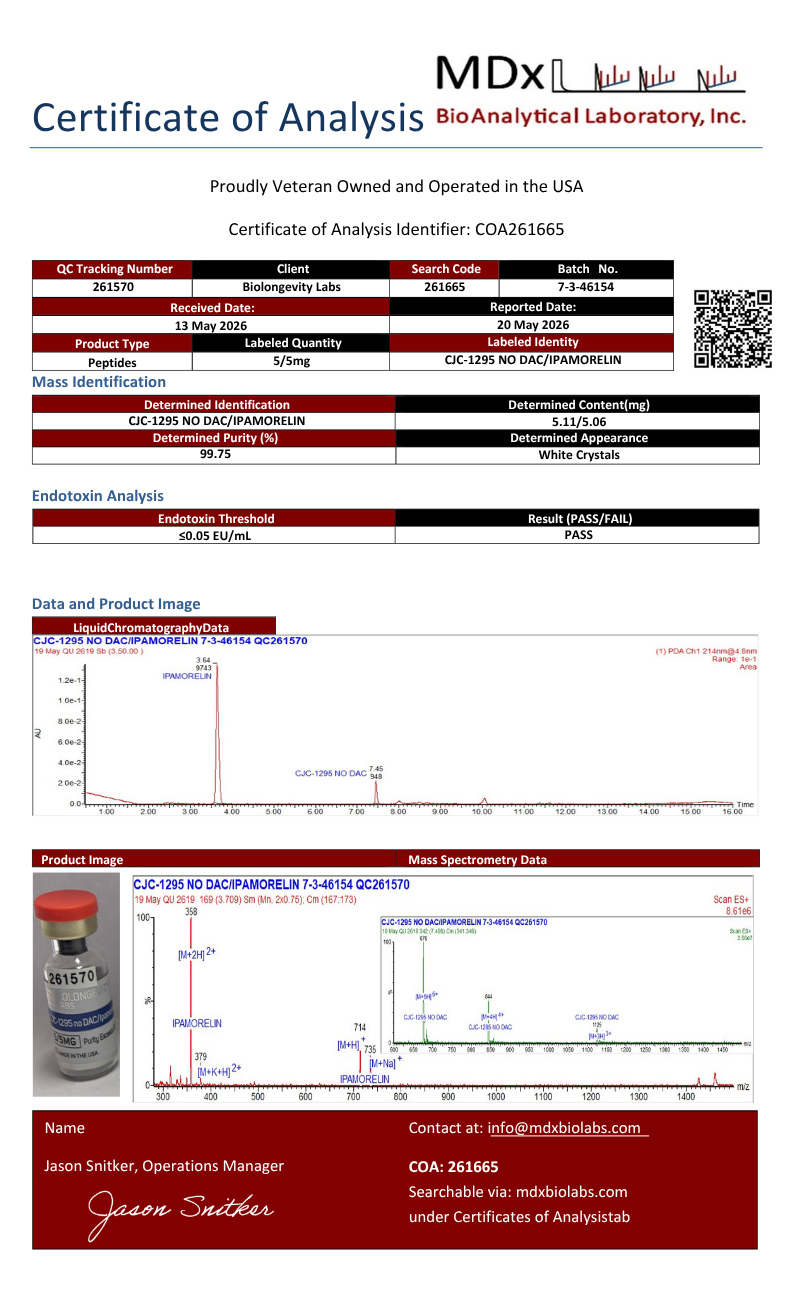
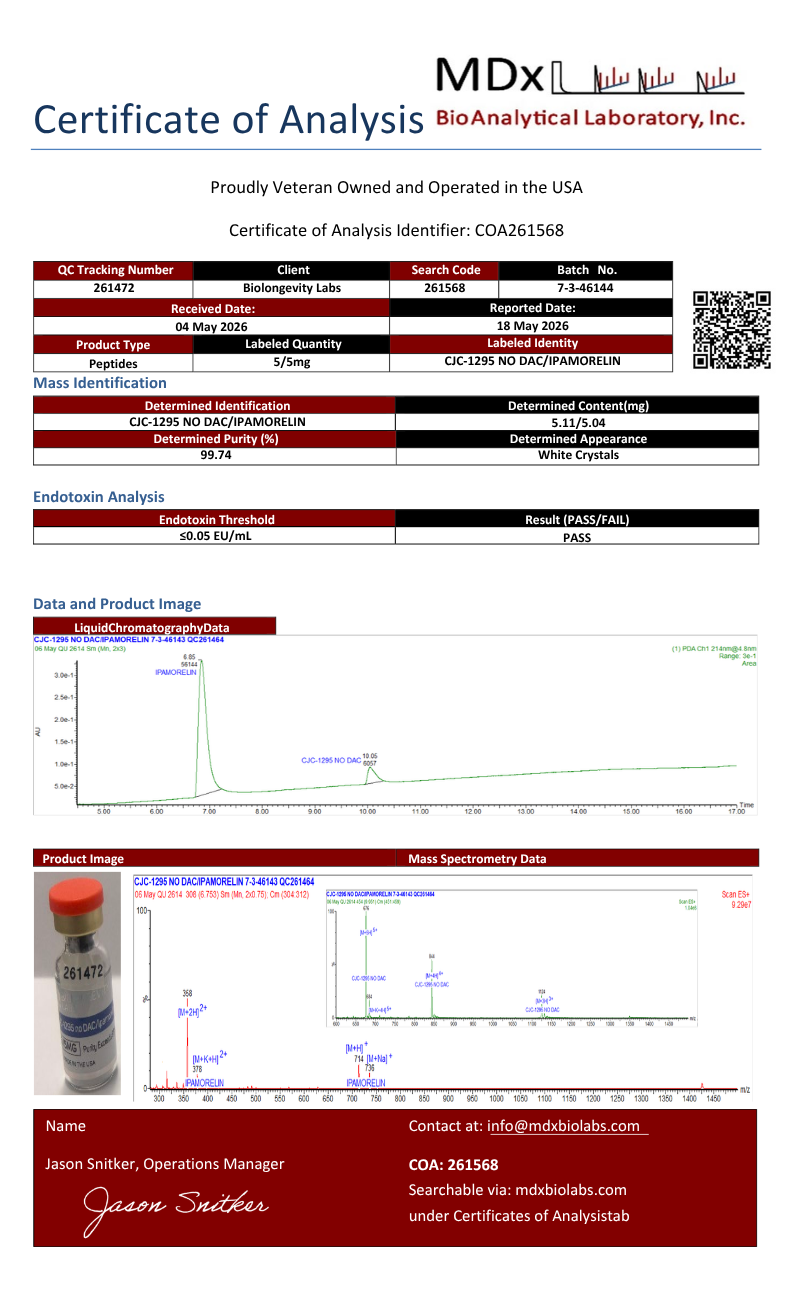
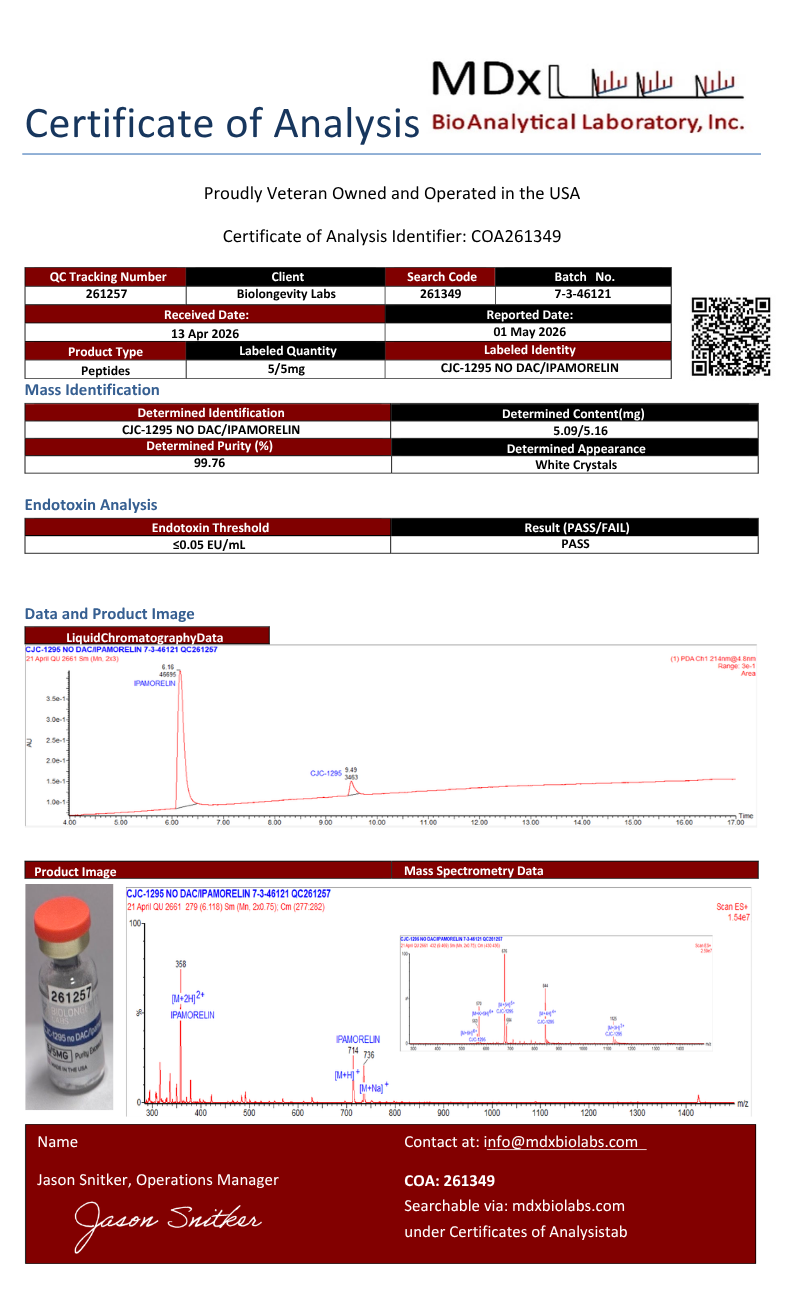
A Certificate of Analysis (COA) is a document that verifies a compound’s identity, purity, and batch quality through independent laboratory testing. Every compound from BioLongevity Labs ships with a COA tied to its specific batch, so researchers can confirm exactly what they received before it enters a protocol.
Each COA reports results from third-party laboratory analysis, including:
- Ultra-high-performance liquid chromatography with mass spectrometry (UHPLC-MS) for purity, typically confirmed at 99% or higher
- Mass identification for molecular confirmation and content quantitation
- Endotoxin quantitation by Limulus amebocyte lysate (LAL) assay where applicable
- Visual and physical characterization of the finished material
How to verify a COA independently
Every certificate can be checked against the issuing laboratory’s own records, not just the copy hosted here. Verification does not depend on BioLongevity Labs.
- MDx BioAnalytical Laboratory certificates carry a QC tracking number and a search code. Newer certificates also carry a QR code. Scan the code, or enter the search code at mdxbiolabs.com, to pull the official record.
- BioRegen reports of analysis carry a Report ID and a Validation Key. Scan the QR code on the certificate to open the official record, or reference both identifiers when contacting the laboratory at the address printed on the report.
- SafeCert Labs certificates, which appear on a number of earlier batches, carry a COA number and the signature of the reporting chemist. Reference that number when requesting confirmation from the laboratory directly.
Batches are frequently tested by both laboratories independently. When two certificates exist for the same lot, each one resolves at its own issuing laboratory, which lets a researcher confirm the same material twice through two unrelated sources.
COAs are sourced from independent certified labs rather than in-house testing alone, giving researchers a verifiable record of molecular integrity for each batch. All compounds are supplied for research use only.
Review the COAs for this batch below, or browse the full COA library.
CJC-1295 NO DAC/IPAMORELIN (261570)
CJC-1295 NO DAC/IPAMORELIN (261472)
CJC-1295 NO DAC IPAMORELIN (261257)
CJC-1295 No DAC Ipamorelin (260403)

CJC-1295 No DAC / Ipamorelin (260257)

Endotoxin Ipamorelin

CJC-1295 Ipamorelin (11383)

CJC-1295 Ipamorelin (11383)

CJC-1295 no DAC / Ipamorelin

CJC-1295 no DAC / Ipamorelin

CJC-1295 no DAC & Ipamorelin (251527)

CJC-1295 no DAC & Ipamorelin (251527E)

CJC-1295/IPAMORELIN(251432)

CJC-1295/Ipamorelin (250971)

CJC-1295 no DAC/Ipamorelin Blend BL-ENDO-250409-001

Ipamorelin(10181)

CJC1295(10181)

×
![]()