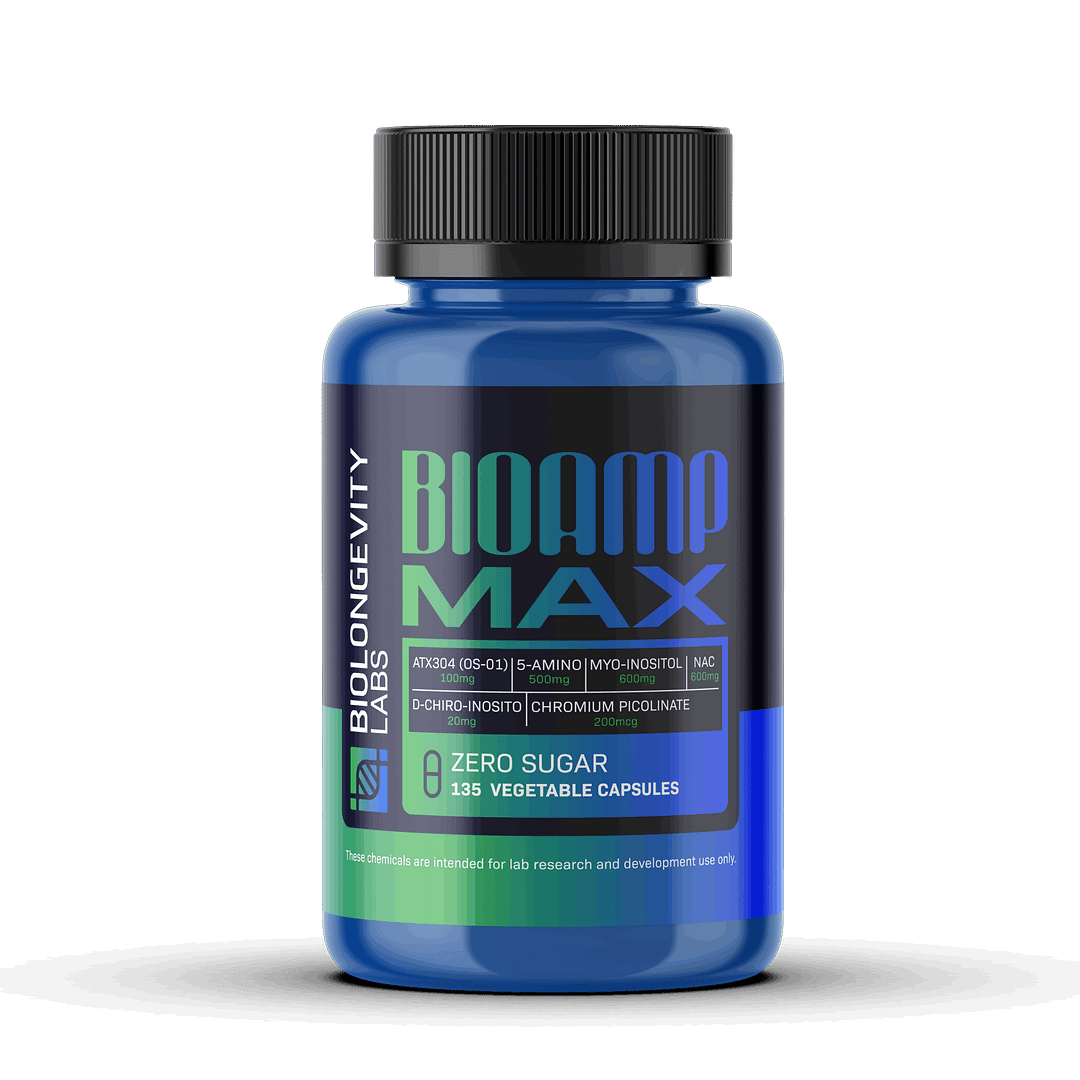
BioAmpMax
Together they are designed to:
- Amplify glucose disposal & insulin sensitivity through direct AMPK activation (ATX-304) and NNMT inhibition (5-Amino-1MQ), plus enhanced insulin signaling via myo- and D-chiro-inositol.
- Improve lipid & endothelial health by reducing adiposity, supporting healthy LDL-C, lowering blood pressure, and boosting nitric-oxide–mediated vascular function.
- Enhance mitochondrial energy metabolism via AMPK-driven biogenesis (ATX-304) and NAD⁺ preservation (5-Amino-1MQ), fostering efficient fuel utilization.
- Support inositol-mediated insulin signaling & glycogen synthesis with myo-inositol and D-chiro-inositol in a physiological ratio for optimized glucose handling.
- Restore redox balance & quell inflammation through glutathione replenishment and antioxidant activity (N-acetylcysteine).
These complementary mechanisms make BioAmpMax a promising research candidate for studies of metabolic syndrome, cardiometabolic wellness, and healthy aging.
BioAmpMax Structure
| Ingredient |
Dose |
Key Actions |
| ATX-304 (OS-01) |
100 mg |
Pan-AMPK activation; mimics exercise to improve insulin sensitivity & glucose uptake [1] |
| 5-Amino-1MQ |
75 mg |
NNMT inhibition; raises NAD⁺, enhances fat oxidation & insulin responsiveness [2] |
| Myo-Inositol |
1000 mg |
Insulin-signaling mediator; lowers fasting insulin & HOMA-IR in humans [3][6] |
| D-Chiro-Inositol |
20 mg |
Insulin-mimetic isomer; promotes glycogen synthesis & post-prandial glucose disposal [5] |
| Chromium Picolinate |
200 µg |
Insulin-receptor cofactor; modestly improves glycemic control & lipid parameters [7][8] |
| N-Acetylcysteine (NAC) |
600 mg |
Glutathione precursor; reduces oxidative stress & inflammation, enhances endothelial NO [9] |
Research Areas
- Glucose Disposal & Insulin Sensitivity
- Lipid & Endothelial Support
- Mitochondrial & Energy Metabolism
- Inositol Signaling & Glycogen Synthesis
- Redox Balance & Anti-inflammatory Support
Glucose Disposal & Insulin Sensitivity
ATX-304 directly activates AMPK in liver and muscle, suppressing gluconeogenesis and potentiating insulin-stimulated glucose uptake—demonstrated by reduced fasting glucose and HOMA-IR in type 2 diabetic patients on metformin [1]. 5-Amino-1MQ, an NNMT inhibitor, boosted NAD⁺ in obese mice, leading to a ~50 % reduction in fasting insulin and improved glucose tolerance [2]. Myo-inositol supplementation (2 g/day) in humans lowers fasting insulin and HOMA-IR by ~2 points, with significant reductions in post-OGTT glucose excursions [3][6].
Lipid & Endothelial Support
5-Amino-1MQ–treated obese mice saw a ~30 % decrease in fat mass and normalization of cholesterol to lean levels without altering food intake, indicating enhanced fat oxidation [2]. Chromium picolinate (200–1000 µg) yields modest triglyceride and LDL-C reductions in insulin-resistant individuals [7][8]. NAC supplementation (1.2 g/day) in metabolic syndrome patients lowered hsCRP by ~13 %, reduced systolic blood pressure by 5 mmHg, and improved HDL levels, highlighting anti-inflammatory and endothelial benefits [9].
Mitochondrial & Energy Metabolism
ATX-304 functions as an exercise mimetic: in aged mice it enhanced cardiac output, microvascular perfusion, and exercise capacity—effects attributed to AMPK-driven mitochondrial biogenesis [1][2]. By inhibiting NNMT, 5-Amino-1MQ preserves NAD⁺ pools, activating sirtuin pathways that support mitochondrial function [2]. NAC’s antioxidative action protects mitochondrial integrity under metabolic stress, evidenced by normalized mitochondrial respiration in diabetic rodent models [9].
Inositol Signaling & Glycogen Synthesis
Myo-inositol acts as a secondary messenger in insulin pathways, improving insulin sensitivity across trials with fasting insulin and HOMA-IR reductions [3][6]. D-chiro-inositol at 1,200 mg/day for 6 weeks in insulin-resistant women lowered insulin AUC by ~60 % and restored ovulation in 86 % of subjects, demonstrating potent glycogen-synthesis and insulin-mimetic actions [5].
Redox Balance & Anti-inflammatory Support
NAC replenishes glutathione, mitigating oxidative stress underlying insulin resistance. In metabolic syndrome patients, 6 weeks of NAC (1,200 mg/day) reduced HOMA-IR by ~18 % and hsCRP by ~13 % [9].
References
- AMPK activated protein kinase in T2D: https://pubmed.ncbi.nlm.nih.gov/29925691/
- Age-related effects & obesity in mice: https://www.nature.com/articles/s41598-021-85051-6
- JCI insight on liver disease & AMPK: https://insight.jci.org/articles/view/179990/
- Obesity & ATX-304 in diet-induced obese mice: https://www.nature.com/articles/s42003-021-02837-0
- D-chiro-inositol PCOS trial: https://pubmed.ncbi.nlm.nih.gov/10219066/
- Myo-inositol glycemic effects: https://pmc.ncbi.nlm.nih.gov/articles/PMC8896029/
- Chromium review (LPI): https://lpi.oregonstate.edu/mic/minerals/chromium
- Chromium meta-analysis: https://pubmed.ncbi.nlm.nih.gov/32730903/
- NAC in metabolic syndrome & inflammation:https://pubmed.ncbi.nlm.nih.gov/32552298/
Note: BioAmpMax is supplied strictly for investigational research use only.
No COAs available for this product.