Product Description
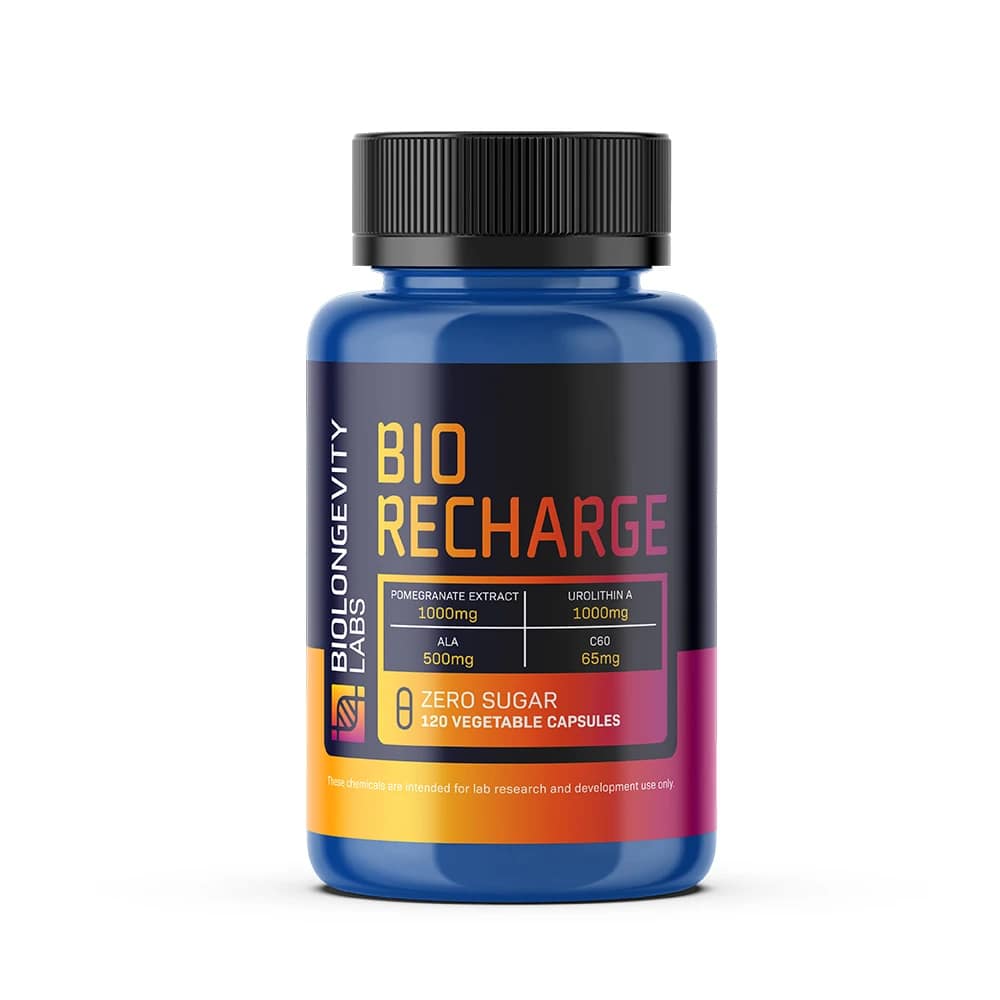
BioRecharge combines four mechanistically distinct mitochondrial antioxidant compounds in a single daily capsule targeting oxidative stress, mitophagy, and cellular energy metabolism.
Compounds that increase mitochondrial output also increase reactive oxygen species (ROS) production — a well-documented tradeoff in bioenergetics research. BioRecharge addresses this directly, pairing mitophagy-inducing agents with multi-site radical scavengers to support both mitochondrial clearance and ROS neutralization.
Pomegranate Extract (1,000mg)
Delivers a concentrated polyphenol profile, including punicalagin and ellagic acid — the primary urolithin precursors studied in gut microbiome and metabolite conversion research. In vitro studies have examined these compounds for their cellular redox activity and ability to modulate antioxidant signaling cascades.
Urolithin A (1,000mg)
Urolithin A is a mitochondria-targeted polyphenolic metabolite studied for its activity through the PINK1-Parkin mitophagy pathway — the selective clearance mechanism responsible for removing dysfunctional mitochondria and accumulated cellular waste. Cell model research has also examined Urolithin A’s activity against pro-inflammatory signaling pathways, making it a compound of interest in studies linking mitochondrial dysfunction to cellular inflammation.
C60 Fullerene (65mg)
C60 operates as a multi-site radical scavenger with six documented free radical binding sites per molecule. Unlike conventional antioxidants that are consumed after a single reaction, C60 retains its molecular structure after neutralizing ROS — functioning as a catalytic species rather than a consumed substrate. Research has examined C60’s preferential accumulation in mitochondria and its proposed capacity to attenuate ROS production at the point of generation, rather than only downstream.
Alpha-Lipoic Acid (500mg)
ALA is active in both aqueous and lipid environments, positioning it as a versatile redox compound for in vitro models. In its reduced form (dihydrolipoic acid/DHLA), it donates electrons directly to neutralize ROS. Preclinical research has studied ALA’s role in glutathione biosynthesis via cysteine uptake, as well as its capacity to regenerate vitamins C and E and CoQ10 — placing it at the center of the cellular antioxidant network.
Ingredients
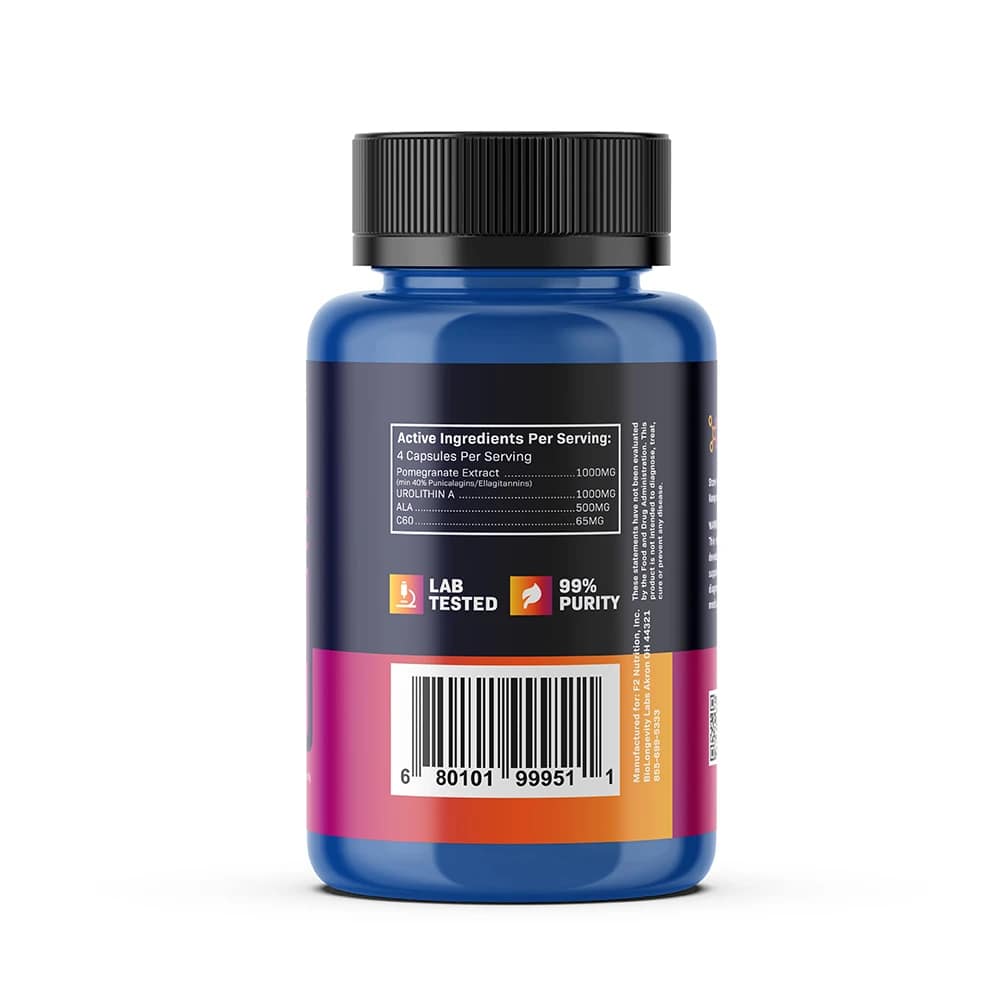
| Ingredient |
Amount |
| Pomengranate Extract |
1000mg |
| Urolithin A |
1000mg |
| C60 (Fullerene) |
65mg |
| Alpha-Lipoic Acid |
500mg |
Research Overview
The four compounds in BioRecharge — Pomegranate Extract, Urolithin A, Carbon 60 (C60 Fullerene), and Alpha-Lipoic Acid — have each attracted substantial peer-reviewed attention for their distinct antioxidant mechanisms in laboratory models.
Pomegranate Extract
Pomegranate (Punica granatum L.) contains a dense matrix of polyphenols, with punicalagin being the dominant ellagitannin responsible for the majority of measurable antioxidant activity.[1]
The phenolic hydroxyl groups in these compounds donate hydrogen atoms or electrons to neutralize reactive oxygen species (ROS), with the resulting phenoxyl radical stabilized through resonance delocalization across aromatic ring structures.[2]
In LPS-stimulated macrophage models, punicalagin suppressed NF-κB nuclear translocation and simultaneously inhibited p38, JNK, and ERK MAPK phosphorylation, dampening two major pro-inflammatory cascades. Punicalagin also promoted Nrf2 nuclear translocation and HO-1 upregulation in retinal pigment epithelial cells under oxidative stress conditions.[1][3]
Research has identified cell-type-dependent pro- and antioxidant behavior in the same extract at the same concentration — pointing to a role as a redox signaling modulator rather than a simple radical scavenger.[4]
The Urolithin Connection
Intact punicalagin and ellagic acid have limited bioavailability. Gut microbiota convert ellagic acid into urolithins A, B, C, and D through sequential decarboxylation and dehydroxylation — the primary circulating bioactive species after pomegranate extract exposure.[5]
Urolithin A
Urolithin A (UA) is a dibenzopyranone metabolite produced by gut microbiota from ellagitannins found in pomegranates, walnuts, and berries. Only approximately 30–40% of the population naturally produces UA at biologically meaningful levels.[5]
The defining mechanism of UA in research models is selective mitophagy induction via the PINK1-Parkin pathway. PINK1 stabilizes on depolarized mitochondria, recruiting Parkin to ubiquitinate outer membrane proteins and flag the organelle for autophagic clearance.[6]
UA also engages AMPK, SIRT1, and PGC-1α signaling, connecting mitophagy induction to broader mitochondrial biogenesis and metabolic regulation. A 2025 Autophagy study identified calcium release from the endoplasmic reticulum as an upstream mediator, with ER calcium driving lysosomal activity and DRP-1-mediated mitochondrial fission prior to autophagic clearance.[5][7]
Beyond mitochondria, UA has been shown to promote SQSTM1/p62-dependent lysophagy in retinal pigment epithelial models, restoring full autophagy flux independently of its mitophagy activity.[8]
Model Organism Results
| Model |
Key Findings |
| C. elegans |
Extended lifespan; improved motility; required PINK-1 and SKN-1 |
| Aged mice (23 months) |
9% increase in grip strength; 57% increase in spontaneous running |
| mdx dystrophic mice |
Restored PINK1/Parkin in muscle stem cells; reduced fibrosis |
| C. elegans oocytes |
Extended reproductive span; maintained mitochondrial quality with age |
| APP/PS1 Alzheimer’s mice |
Reduced Aβ plaque area; shifted microglia toward phagocytic state |
| DSS-induced colitis mice |
4-fold increase in mitophagic flux in intestinal epithelium |
Carbon 60 (C60 Fullerene)
C60 is a closed-cage carbon allotrope with a highly conjugated π-electron system, giving it strong affinity for radical species. Its ability to react with multiple radical equivalents per molecule has led researchers to characterize it as a “free radical sponge.”[9]
Hydroxylated C60 derivatives (fullerenols) operate through two parallel mechanisms: radical addition across C=C double bonds and H-abstraction from hydroxyl groups. C60-poly(2-oxazoline) nanoformulations have demonstrated neuronal cell permeability and intracellular superoxide scavenging in neural cell models.[10][11]
A computational hypothesis proposes that C60 can absorb protons into its interior cavity, accumulate in lipid bilayers, and enter mitochondria driven by transmembrane potential — delivering protons that mildly uncouple respiration and reduce superoxide production at source. This proposed mechanism may help explain why observed effects in some models exceed what conventional radical scavenging would predict.[9]
Research on fullerenol C60(OH)36 in erythrocyte models found interaction with endogenous redox enzymes including superoxide dismutase, catalase, and the glutathione system, suggesting amplification through existing cellular antioxidant machinery rather than purely stoichiometric scavenging.[12]
Alpha-Lipoic Acid
Alpha-lipoic acid (ALA) is an endogenous organosulfur compound existing in oxidized (ALA) and reduced (DHLA) forms, constituting one of the most potent biological redox couples with a standard reduction potential of −0.32 V. Its amphiphilicity allows activity across both aqueous and lipid cellular compartments.[13]
Direct ROS Scavenging by the ALA/DHLA Redox Couple
| Reactive Species |
ALA |
DHLA |
| Hydroxyl radical |
Yes |
Yes |
| Peroxynitrite |
Yes |
Yes |
| Singlet oxygen |
Yes |
No |
| Peroxyl radical |
Yes |
Yes |
| Superoxide |
No |
Yes |
| Nitric oxide |
No |
Yes |
| Hypochlorous acid |
Yes |
Yes |
ALA has been described as the “antioxidant of antioxidants” for its capacity to regenerate other endogenous antioxidants. DHLA directly recycles ascorbate from dehydroascorbic acid, regenerates α-tocopherol through the ascorbate pathway, and reduces oxidized glutathione back to GSH. In vivo studies have documented up to 70% increases in intracellular glutathione following ALA administration.[14][13]
ALA activates Nrf2 via Keap1 cysteine modification, driving transcription of Phase II detoxification and antioxidant genes. In aged rat liver, R-ALA administration restored nuclear Nrf2 levels and GSH concentrations to levels comparable with young control animals.[13]
ALA and DHLA also chelate transition metals through coordination involving sulfur atoms and a carboxyl group, preventing metal-catalyzed Fenton-type radical generation.
Comparative Mechanism Overview
| Mechanism |
Pomegranate Extract |
Urolithin A |
C60 Fullerene |
Alpha-Lipoic Acid |
| Direct radical scavenging |
Polyphenol H-atom/electron donation |
Modest |
“Radical sponge” via C=C addition |
ALA/DHLA couple; species-specific |
| Nrf2 activation |
Via punicalagin and urolithin metabolites |
SKN-1/Nrf2 required for lifespan effects |
Not established |
Keap1 cysteine modification |
| NF-κB suppression |
Direct inhibition of NF-κB and MAPK |
AMPK-SIRT1-mediated reduction |
Not established |
IκB stabilization |
| Mitophagy induction |
Indirect (via urolithin conversion) |
Primary mechanism — PINK1-Parkin |
Not established |
Not primary |
| Metal chelation |
Tannin-metal binding |
Not primary |
Not established |
ALA/DHLA chelate Cu²⁺, Fe³⁺, Zn²⁺ |
| Antioxidant network recycling |
Not applicable |
Not applicable |
Cooperates with endogenous enzymes |
Core function — regenerates vitamins C, E, CoQ10, GSH |
| Mitochondrial targeting |
Not direct |
Enhances mitochondrial quality control |
Proposed proton-loaded entry and mild uncoupling |
Cofactor for mitochondrial dehydrogenases |
| Microbiome dependence |
Low |
High (gut conversion required) |
None |
None |
References
- Venusova E, Kolesarova A, Horky P, Slama P. Physiological and Immune Functions of Punicalagin. MDPI AG; 2021. https://doi.org/10.3390/nu13072150
- Kostka T, Ostberg-Potthoff JJ, Briviba K, Matsugo S, Winterhalter P, Esatbeyoglu T. Pomegranate (Punica granatum L.) Extract and Its Anthocyanin and Copigment Fractions—Free Radical Scavenging Activity and Influence on Cellular Oxidative Stress. MDPI AG; 2020. https://doi.org/10.3390/foods9111617
- Clementi ME, Sampaolese B, Sciandra F, Tringali G. Punicalagin Protects Human Retinal Pigment Epithelium Cells from Ultraviolet Radiation-Induced Oxidative Damage by Activating Nrf2/HO-1 Signaling Pathway and Reducing Apoptosis. MDPI AG; 2020. https://doi.org/10.3390/antiox9060473
- Olchowik-Grabarek E, Sekowski S, Mierzwinska I, Zukowska I, Abdulladjanova N, Shlyonsky V, et al. Cell Type-Specific Anti- and Pro-Oxidative Effects of Punica granatum L. Ellagitannins. MDPI AG; 2024. https://doi.org/10.3390/membranes14100218
- Tow WK, Chee PY, Sundralingam U, Palanisamy UD. The Therapeutic Relevance of Urolithins, Intestinal Metabolites of Ellagitannin-Rich Food: A Systematic Review of In Vivo Studies. MDPI AG; 2022. https://doi.org/10.3390/nu14173494
- Faitg J, D’Amico D, Rinsch C, Singh A. Mitophagy Activation by Urolithin A to Target Muscle Aging. Springer Science and Business Media LLC; 2023. https://doi.org/10.1007/s00223-023-01145-5
- Roussos A, Kitopoulou K, Borbolis F, Ploumi C, Gianniou DD, Li Z, et al. Urolithin Α modulates inter-organellar communication via calcium-dependent mitophagy to promote healthy ageing. Informa UK Limited; 2025. https://doi.org/10.1080/15548627.2025.2561073
- Jiménez-Loygorri JI, Boya P. Recycling the recyclers: lysophagy emerges as a new pharmacological target for retinal degeneration. Informa UK Limited; 2024. https://doi.org/10.1080/15548627.2024.2391726
- Chistyakov VA, Smirnova YuO, Prazdnova EV, Soldatov AV. Possible Mechanisms of Fullerene C60Antioxidant Action. Hindawi Limited; 2013. https://doi.org/10.1155/2013/821498
- Ueno H, Yamakura S, Arastoo RS, Oshima T, Kokubo K. Systematic Evaluation and Mechanistic Investigation of Antioxidant Activity of Fullerenols Using β-Carotene Bleaching Assay. Wiley; 2014. https://doi.org/10.1155/2014/802596
- Tong J, Zimmerman MC, Li S, Yi X, Luxenhofer R, Jordan R, et al. Neuronal uptake and intracellular superoxide scavenging of a fullerene (C60)-poly(2-oxazoline)s nanoformulation. Elsevier BV; 2011. https://doi.org/10.1016/j.biomaterials.2011.01.068
- Grebowski J, Kazmierska-Grebowska P, Cichon N, Piotrowski P, Litwinienko G. The Effect of Fullerenol C60(OH)36 on the Antioxidant Defense System in Erythrocytes. MDPI AG; 2021. https://doi.org/10.3390/ijms23010119
- Shay KP, Moreau RF, Smith EJ, Smith AR, Hagen TM. Alpha-lipoic acid as a dietary supplement: Molecular mechanisms and therapeutic potential. Elsevier BV; 2009. https://doi.org/10.1016/j.bbagen.2009.07.026
- Superti F, Russo R. Alpha-Lipoic Acid: Biological Mechanisms and Health Benefits. MDPI AG; 2024. https://doi.org/10.3390/antiox13101228
No COAs available for this product.