
The information presented in this article is for educational and research purposes only, intended for laboratory professionals, researchers and collaborators. This content does not constitute medical or clinical advice.
Peptides and amino acids are the fundamental building blocks of life. These molecules work together to create proteins and control countless biological processes in living organisms. Understanding these essential components opens the door to exciting research opportunities in laboratories worldwide.
What Are Amino Acids?
The Basic Structure
Amino acids are simple chemical molecules that serve as the foundation for all peptides and proteins. Each amino acid contains three key parts: an amino group (-NH₂), a carboxyl group (-COOH), and a unique side chain called an R group. These parts connect to a central carbon atom, creating the basic amino acid structure.
The side chain makes each amino acid special. Some side chains are small and simple, while others are large and complex. This variety gives amino acids different chemical properties and behaviors.
General structure of an amino acid, showing the amine, carboxyl, and variable R groups.
The 20 Standard Amino Acids
Scientists recognize twenty standard amino acids that appear in natural proteins. These amino acids fall into several groups based on their chemical properties:
| Name | Three Letter | One Letter | Molecular Weight | Side Chain Type | pKa Side_Chain | Essential |
|---|---|---|---|---|---|---|
| Alanine | Ala | A | 89.1 | Hydrophobic (aliphatic) | N/A | No |
| Arginine | Arg | R | 174.2 | Positively charged | 12.48 | Yes |
| Asparagine | Asn | N | 132.1 | Polar neutral | N/A | No |
| Aspartic acid | Asp | D | 133.1 | Negatively charged | 3.86 | No |
| Cysteine | Cys | C | 121.0 | Polar neutral (sulfur) | 8.33 | No |
| Glutamic acid | Glu | E | 147.1 | Negatively charged | 4.25 | No |
| Glutamine | Gln | Q | 146.1 | Polar neutral | N/A | No |
| Glycine | Gly | G | 75.1 | Unique (simple) | N/A | No |
| Histidine | His | H | 155.2 | Positively charged | 6.0 | Yes |
| Isoleucine | Ile | I | 131.2 | Hydrophobic (aliphatic) | N/A | Yes |
| Leucine | Leu | L | 131.2 | Hydrophobic (aliphatic) | N/A | Yes |
| Lysine | Lys | K | 146.2 | Positively charged | 10.53 | Yes |
| Methionine | Met | M | 149.2 | Hydrophobic (aliphatic) | N/A | Yes |
| Phenylalanine | Phe | F | 165.2 | Hydrophobic (aromatic) | N/A | Yes |
| Proline | Pro | P | 115.1 | Unique (cyclic) | N/A | No |
| Serine | Ser | S | 105.1 | Polar neutral | N/A | No |
| Threonine | Thr | T | 119.1 | Polar neutral | N/A | Yes |
| Tryptophan | Trp | W | 204.2 | Hydrophobic (aromatic) | N/A | Yes |
| Tyrosine | Tyr | Y | 181.2 | Hydrophobic (aromatic) | 10.07 | No |
| Valine | Val | V | 117.1 | Hydrophobic (aliphatic) | N/A | Yes |
Amino Acid Notation
Researchers use two main systems to represent amino acids in scientific work. The single-letter code assigns each amino acid one letter (like A for alanine or G for glycine). The three-letter system uses abbreviations (like Ala for alanine or Gly for glycine). Both systems help scientists communicate clearly about protein sequences.
Understanding Peptides
What Makes a Peptide?
A peptide forms when two or more amino acids link together through special connections called peptide bonds. These bonds create chains of amino acids that can be short or long. The process removes water molecules as the amino acids connect, forming stable links between them.
All peptides have two distinct ends. The N-terminal end has a free amino group, while the C-terminal end has a free carboxyl group. This directional nature is important for how peptides function in biological systems.
Peptide Classification by Size
Scientists classify peptides based on how many amino acids they contain:
- Dipeptides: 2 amino acids
- Tripeptides: 3 amino acids
- Oligopeptides: Up to 20 amino acids
- Polypeptide: More than 20 amino acids
- Proteins: Generally over 50 amino acids
Short peptides often have specific biological functions. For example, some act as hormones or signaling molecules that tell cells what to do.
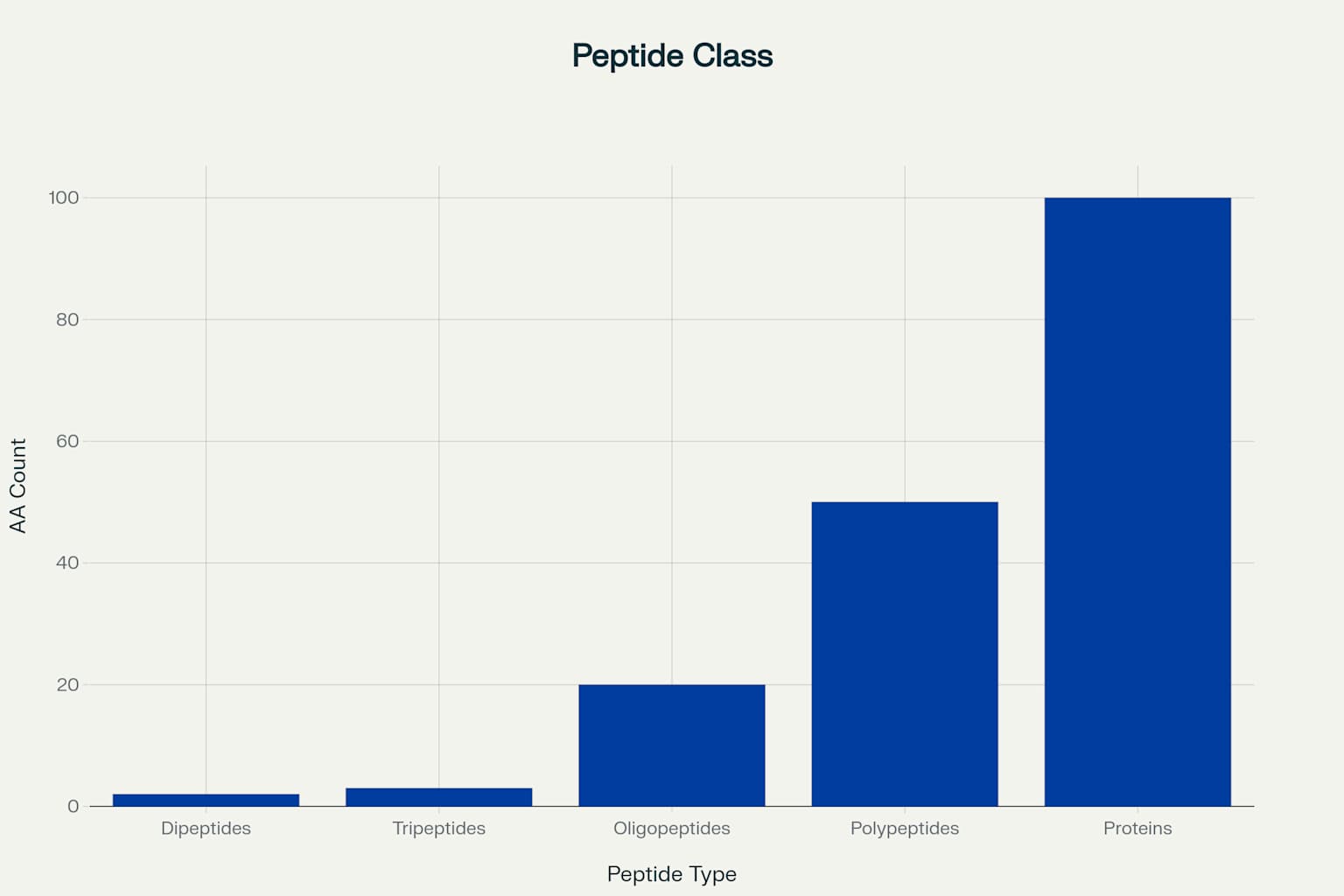
Classification of peptides by size
Differences Between Proteins and Peptides
While both peptides and proteins consist of amino acid chains connected by peptide bonds, several key differences distinguish these molecules. Size represents the most obvious difference, with peptides typically containing fewer than 50 amino acids while proteins contain hundreds or thousands of residues.
Structural complexity also varies significantly between the two. Proteins fold into complex three-dimensional shapes with multiple structural levels, including secondary structures like alpha helices and beta sheets, plus tertiary and quaternary arrangements. Peptides usually have simpler structures and more flexible conformations.
| Characteristic | Peptides | Proteins |
|---|---|---|
| Size | 2-50 amino acids | 50+ amino acids |
| Structure | Simple, flexible | Complex, rigid folding |
| Stability | Less stable | More stable |
| Synthesis | Easier to make artificially | Requires biological systems |
Functional roles differ as well. Peptides often serve as signaling molecules, hormones, or antimicrobial agents. Proteins perform structural, enzymatic, and transport functions that require their larger size and complex folding patterns.
How Peptide Bonds Form
The Chemical Process
Peptide bond formation happens through a condensation reaction. The carboxyl group of one amino acid combines with the amino group of another amino acid. This process releases a water molecule and creates a strong amide bond between the amino acids.
In nature, enzymes help speed up this process during protein synthesis. In laboratories, scientists use special chemical methods to create peptide bonds artificially. This allows researchers to make custom peptides for their experiments.
Why Peptide Bonds Matter
Peptide bonds have special properties that affect how peptides behave. These bonds have partial double-bond character, which makes them rigid and planar. This rigidity helps determine the overall shape and function of peptides and proteins.
Biological Importance of Peptides
Cellular Functions
Peptides serve many critical roles in living organisms. They act as messengers that carry information between cells and tissues. Many peptide hormone molecules, like insulin, control important body functions such as blood sugar levels.
Some peptides help defend against harmful bacteria and viruses. Others participate in growth and development processes. The nervous system uses special peptides called neuropeptides to transmit signals between nerve cells.
Research Applications
Laboratory researchers use peptides in many different ways:
- Studying how proteins fold and function
- Developing new medicines and treatments
- Creating materials with special properties
- Understanding disease mechanisms
- Testing biological interactions
Peptides offer advantages for research because they are smaller and simpler than full proteins, making them easier to synthesize and study.
How Structure Affects Function
Side Chain Influence
The amino acid sequence in a peptide determines its three-dimensional shape and biological activity. Hydrophobic amino acids tend to cluster together, while hydrophilic amino acids prefer to stay near water molecules. This behavior drives peptide folding patterns.
Charged amino acids create electrostatic interactions that can stabilize certain shapes or help peptides bind to specific targets. The precise arrangement of different amino acid types creates unique binding sites and functional regions.
Chemical Modifications
Scientists can modify amino acids to create derivatives with new properties. These modifications might change how a peptide interacts with other molecules or improve its stability in biological systems.
Common modifications include adding chemical groups to side chains or changing the peptide backbone structure. These changes allow researchers to fine-tune peptide properties for specific applications.
Synthesis Methods
Solid-Phase Peptide Synthesis
The most common method for making peptides in laboratories is solid-phase peptide synthesis (SPPS). This technique attaches the growing peptide chain to a solid support material. Researchers add amino acids one by one, building the peptide from the C-terminal end toward the N-terminal end.
Modern automated synthesizers can produce high-quality peptides quickly with minimal human involvement. This automation makes peptide synthesis more reliable and efficient for research applications.
Advanced Techniques
Scientists continue developing new synthesis methods to improve peptide production:
- Microwave-assisted synthesis reduces reaction times
- Flow chemistry enables continuous processing
- Green chemistry methods reduce environmental impact
- Native chemical ligation allows creation of longer peptides
These advances help researchers access more complex peptides for their studies.
Analytical Methods
Mass Spectrometry
Mass spectrometry is essential for analyzing peptides. This technique measures the exact mass of peptide molecules and can provide information about their structure and purity. Different types of mass spectrometry offer various advantages for peptide analysis.
| Technique | Best For |
|---|---|
| MALDI-TOF MS | Quick molecular weight determination |
| ESI-MS | Online coupling with separation methods |
| MS/MS | Detailed sequence information |
Other Analytical Tools
Researchers use several other methods to study peptides:
- High-performance liquid chromatography (HPLC) for purification and quality control
- Circular dichroism spectroscopy for structure analysis
- NMR spectroscopy for detailed structural information
- UV-visible spectroscopy for concentration measurements
These techniques work together to provide complete characterization of peptide samples.
Research Applications
Proteomics Studies
Peptides play crucial roles in proteomics research, where scientists study all the proteins in cells or tissues. Researchers often break down proteins into smaller peptides for easier analysis. This bottom-up approach helps identify and quantify proteins in complex biological samples.
Drug Development
Pharmaceutical researchers use peptides to develop new medicines. Peptides can target specific proteins involved in diseases, potentially offering more precise treatments with fewer side effects than traditional drugs.
The unique properties of peptides make them attractive for therapeutic applications. They are biodegradable, biocompatible, and can be designed to interact with specific biological targets.
Structural Biology
Scientists use peptide models to understand how larger proteins fold and function. Short peptides can mimic important regions of proteins, helping researchers study structure-function relationships in simpler systems.
This approach provides valuable insights into protein stability, folding mechanisms, and design principles that guide the development of new proteins with desired properties.
Future Directions for Amino Acids and Peptides
Emerging Technologies
New technologies continue to expand peptide research possibilities. Advanced computational methods help predict peptide behavior and design new sequences. Improved synthesis techniques enable access to previously challenging peptide structures.
Growing Applications
The applications of peptide research continue to grow across multiple fields:
- Materials science uses peptides to create new biomaterials
- Nanotechnology employs peptides as building blocks for tiny structures
- Food science explores bioactive peptides for functional ingredients
- Environmental science investigates peptides for sustainable solutions
Summary
Peptides and amino acids represent fundamental components of biological systems that offer tremendous opportunities for laboratory research. Understanding their structure, synthesis, and analysis provides researchers with powerful tools for studying life processes and developing new applications.
The field continues evolving rapidly, with new synthesis methods, analytical techniques, and computational approaches expanding research possibilities. As these tools become more sophisticated and accessible, peptides will likely play increasingly important roles in advancing scientific knowledge and developing solutions to complex challenges.
For laboratory professionals, mastering peptide and amino acid science opens doors to diverse research opportunities spanning basic biology, peptide drug discovery, materials development, and beyond. The foundation provided by understanding these molecular building blocks enables innovative research that can contribute to our understanding of life and improve human health and technology.