
Scientifically reviewed by
Dr. Ky H. Le, MD

The information presented in this article is for educational and research purposes only, intended for laboratory professionals, researchers and collaborators. This content does not constitute medical or clinical advice.
Excipients are protective compounds that stabilize peptides during freeze-drying and storage, comprising the majority of lyophilized research formulations.
Research peptides degrade through multiple pathways including aggregation, oxidation, and hydrolysis when exposed to temperature fluctuations, pH changes, and dehydration stress.
Lyophilization removes water to prevent these degradation reactions while introducing new stresses that require specialized excipient protection.
Quick Insights
- Mannitol works as a structural support that makes manufacturing faster and cheaper, while trehalose directly protects peptides at the molecular level
- Mannitol reduces processing time by 50% but provides limited peptide protection, whereas trehalose offers superior stability but requires longer, more expensive cycles
- Combining both excipients can provide balanced benefits when the mannitol-to-trehalose ratio exceeds 1:1
- The choice depends on whether to prioritize manufacturing speed and cost or maximum peptide stability for research
Excipients Serve Multiple Key Functions in Research Applications
Research-grade excipients perform four primary roles in peptide formulations: molecular protection, structural support, process optimization, and long-term stability enhancement.
Primary Stabilization Mechanisms
Studies show that excipient selection directly impacts peptide integrity and manufacturing feasibility through distinct protective mechanisms[1].
Key Functions Include:
- Molecular protection through glass formation and water replacement
- Structural support via crystalline scaffold formation
- Process optimization by allowing faster drying cycles
- Long-term stability through immobilization of degradation pathways
Peptide Degradation Occurs Through Two Primary Routes
Physical instability involves structural changes like aggregation and unfolding that occur at interfaces and during temperature stress.
Chemical instability includes oxidation of methionine residues, deamidation of asparagine, and hydrolysis at aspartic acid sites.
Research indicates that water removal through lyophilization prevents most chemical degradation pathways while creating new physical stresses during the drying process itself[2].
Mannitol Functions as a Crystalline Bulking Agent
Mannitol serves primarily as a structural scaffold that crystallizes during freezing to form a rigid framework supporting the lyophilized cake.
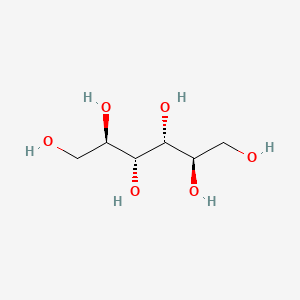
Structural illustration of mannitol. Image source.
Crystallization Creates a Porous Support Structure
The crystalline matrix provides mechanical strength and prevents cake collapse during primary drying. Studies show that mannitol crystals form a three-dimensional network with interconnected pores[3].
Key Properties for Research:
- High eutectic temperature (-1.5°C to -2.2°C) allows warm drying
- Rapid crystallization during controlled freezing protocols
- Chemical inertness prevents reactions with peptide compounds
- Low hygroscopicity (less than 0.2% moisture uptake) during storage
- Isotonicity properties reduce irritation upon reconstitution by maintaining osmotic balance
Processing Advantages Allow Faster Research Cycles
Research shows that mannitol’s high eutectic melting point allows primary drying at -10°C versus below -30°C required for amorphous systems[4].
This temperature advantage reduces cycle times by 50% compared to amorphous excipients like trehalose. Laboratory throughput increases while energy consumption decreases for research applications requiring multiple batches.
Polymorphism Creates Stability Challenges
Mannitol crystallizes into multiple forms with different stability profiles during lyophilization cycles.
Mannitol Polymorphs in Research Applications:
| Polymorph | Thermodynamic Stability | Formation Conditions | Long-term Risk |
|---|---|---|---|
| α-mannitol | Metastable | Rapid cooling rates | Low moisture release |
| β-mannitol | Most stable | Slow, controlled cooling | Minimal risk |
| δ-mannitol | Metastable | Standard lyophilization | Moderate risk |
| Hemihydrate | Unstable hydrate | Crystallization ≤-20°C | High water release |
Research identifies mannitol hemihydrate formation as creating major stability risks through water release during storage[5].
Direct Peptide Protection Requires Amorphous Form
Studies reveal that crystalline mannitol provides minimal molecular-level peptide protection due to phase separation during crystallization[6].
Only amorphous mannitol acts as a molecular protectant through direct peptide interactions. This creates a basic conflict between mannitol’s primary structural role and potential stabilizing functions.
Trehalose Provides Direct Molecular Protection
Trehalose operates as an amorphous lyoprotectant that remains in glassy form to stabilize peptides at the molecular level.
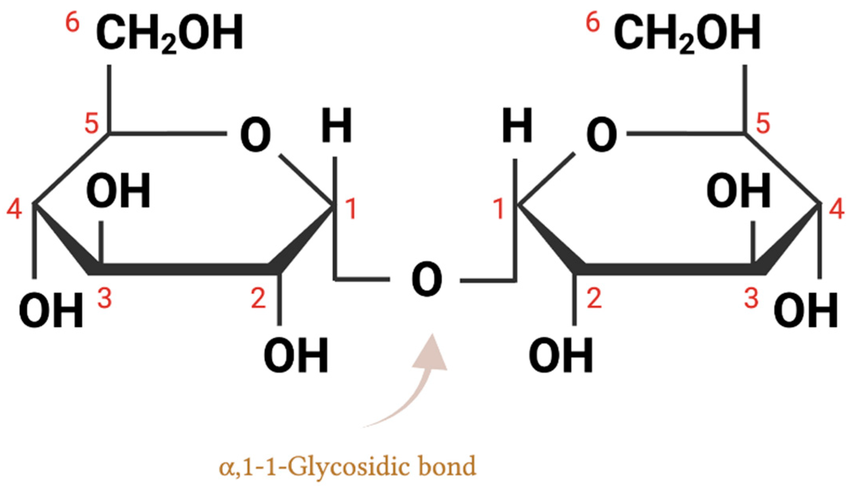
Structural illustration of trehalose. Image source.
Dual Mechanisms Protect Peptides During Drying
Research establishes two complementary pathways through which trehalose preserves peptide structure and function[7].
Vitrification Mechanism: Trehalose forms a rigid glass matrix with viscosity exceeding 10^12 Pa·s that completely immobilizes peptide molecules and prevents degradation reactions.
Water Replacement Mechanism:
Trehalose hydroxyl groups form hydrogen bonds directly with peptide surfaces, replacing the natural water shell that maintains protein structure in dehydrated states.
Superior Glass Properties Ensure Long-term Stability
Trehalose’s glass transition temperature of 110°C to 120°C in the dried state ensures matrix stability under accelerated aging conditions.
The maximally freeze-concentrated glass transition (Tg’) occurs at -28°C to -32°C. Primary drying must remain below this collapse temperature to maintain structural integrity throughout the process.
Crystallization Eliminates Protective Function
Research identifies that any trehalose crystallization completely negates lyoprotective effects through peptide expulsion from the protective matrix[8].
Common Crystallization Triggers:
- Co-crystallizing excipients including mannitol, sodium chloride, and phosphate buffers
- Extended annealing above the glass transition temperature
- Temperature cycling during primary or secondary drying phases
- Nucleation sites from particulate contamination
Performance Comparison Reveals Basic Trade-offs
Direct comparison shows that mannitol and trehalose serve complementary rather than competing functions in research peptide formulations.
Processing Requirements Differ Substantially
Manufacturing parameters vary dramatically between crystalline and amorphous excipient systems.
The American Pharmaceutical Review confirms that process temperature restrictions determine cycle economics.
Process Parameters:
| Property | Mannitol | Trehalose |
|---|---|---|
| Working Temperature | -1.5°C to -2.2°C | -28°C to -32°C |
| Primary Drying Time | 12-24 hours | 36-72 hours |
| Energy Requirements | Low (warm drying) | High (cold drying) |
| Manufacturing Cost | Reduced by 50% | Baseline |
Stability Performance Shows Clear Advantages
Research data shows trehalose’s superior molecular protection versus mannitol’s structural benefits[9].
Trehalose formulations maintain peptide activity longer under accelerated aging at 40°C and 75% relative humidity. Mannitol formulations exhibit faster reconstitution times under 30 seconds and more appealing cake appearance.
Product Quality Attributes Depend on Excipient Choice
Final product characteristics reflect the underlying excipient properties and processing requirements.
Quality Comparison Table:
| Attribute | Mannitol Advantage | Trehalose Advantage |
|---|---|---|
| Cake Appearance | Elegant, uniform, white | Can appear glassy |
| Reconstitution | Fast (<30 seconds) | Slow (>2 minutes) |
| Mechanical Strength | High structural integrity | Prone to collapse |
| Molecular Stability | Limited protection | Superior protection |
| Storage Stability | Risk from polymorphism | Excellent when amorphous |
Combination Strategies Capture Synergistic Benefits
Combining mannitol and trehalose allows formulations that leverage crystalline structure with amorphous protection when properly controlled.
Mass Ratio Determines Final Product Characteristics
Research shows that the mannitol-to-trehalose mass ratio (R) controls phase behavior and final product properties more than total excipient concentration[9].
Ratio Guidelines for Best Performance:
- R > 1 (Mannitol excess): Crystalline scaffold forms with amorphous trehalose protection
- R = 1 (Equal mass): Unpredictable behavior with heterogeneous crystallization
- R < 1 (Trehalose excess): Inhibited mannitol crystallization, poor structural integrity
Process Control Creates Engineered Microstructures
Successful combination formulations require coordinated process design including controlled nucleation, annealing protocols, and temperature ramping.
Studies show that systematic annealing promotes complete mannitol crystallization while preventing trehalose crystallization[10].
The final product achieves a kinetically stable, non-equilibrium state where crystalline mannitol provides structure while amorphous trehalose protects peptides within the pore network.
Research Application Decision Framework
Excipient selection requires systematic analysis of peptide properties, stability requirements, processing constraints, and research timeline demands.
Selection Criteria for Laboratory Applications
Mannitol for:
- High-throughput research requiring rapid processing cycles
- Peptide concentrations exceeding 10 mg/mL requiring structural support
- Applications demanding fast reconstitution for time-sensitive assays
- Budget-constrained projects requiring manufacturing cost control
Trehalose for:
- Maximum peptide stability during extended storage periods
- Low-concentration peptides requiring molecular-level protection
- Research applications where processing time constraints allow longer cycles
- Studies involving peptides sensitive to crystallization-induced stress
Commercial Validation Examples
Market analysis of approved formulations shows practical implementation approaches. Studies of commercial formulations reveal diverse strategies across therapeutic categories[11].
Approved Peptide Formulations:
| Product Category | Primary Excipient | Function | Formulation Type |
|---|---|---|---|
| GnRH Analogs | Mannitol | Bulking agent | Lyophilized microspheres |
| Somatostatin Analogs | Mannitol | Structural support | Depot suspension |
| GLP-1 Agonists | Propylene glycol | Tonicity modifier | Liquid solution |
Regulatory Considerations for Research Applications
Both mannitol and trehalose maintain Generally Recognized as Safe (GRAS) status with extensive safety databases supporting research use. Regulatory guidance documents their acceptance in parenteral formulations[1].
Quality Control Requirements for Research Formulations
Research-grade peptide formulations demand comprehensive analytical characterization throughout development and manufacturing processes.
Analytical Methods
Monitor excipient behavior and peptide stability using complementary analytical techniques including X-ray powder diffractometry for crystallinity assessment, differential scanning calorimetry for thermal transitions, and dynamic vapor sorption for moisture sensitivity evaluation.
Quality Attributes for Documentation
Certificate of analysis documentation should include excipient purity specifications, peptide content verification, moisture content below 3%, and solid-state characterization confirming expected crystalline or amorphous forms.
Long-term stability studies require monitoring both peptide integrity through HPLC analysis and excipient stability through solid-state characterization to detect formulation changes before peptide degradation occurs.
Advanced Research Considerations
Modern peptide research increasingly demands sophisticated formulation approaches informed by mechanistic understanding and predictive modeling capabilities.
Excipient Bioactivity Screening Prevents Interference
Research shows that excipients can possess unexpected biological activities that interfere with research outcomes, as shown in P140 peptide studies where trehalose’s autophagy activity counteracted the therapeutic mechanism[12].
Comprehensive excipient screening must evaluate potential biological activities alongside physicochemical properties to prevent interference with intended research mechanisms and ensure accurate experimental results.
Computational Tools Accelerate Development
Advanced approaches allow prediction of excipient-peptide interactions and optimal stabilizer selection through molecular dynamics simulations and machine learning algorithms[13].
These predictive tools reduce reliance on extensive empirical screening while accelerating identification of optimal formulation approaches for complex research peptides.
Guidelines for Research Teams
Laboratory implementation requires systematic evaluation protocols and quality control procedures to ensure reproducible formulation performance.
Development Protocol Recommendations
Begin formulation development with single-excipient studies to establish baseline performance metrics for both mannitol and trehalose before evaluating combination approaches.
Conduct accelerated stability studies at 40°C and 75% relative humidity to rapidly assess formulation strength and identify potential degradation pathways under stress conditions.
Process Scale-up Considerations
Laboratory-scale lyophilization protocols require validation during scale-up to production equipment due to differences in heat transfer rates, vacuum capabilities, and temperature control precision.
Document process parameters including freezing rates, annealing conditions, and primary drying temperatures to ensure consistent product quality across different lyophilizer systems.
Quick Review
Mannitol and trehalose serve distinct roles in research peptide formulation with clear advantages for specific applications and constraints.
Mannitol excels as a process-enabling bulking agent that creates strong cake structures, reduces manufacturing costs by 50%, and allows efficient processing for high-throughput research applications requiring multiple formulation batches.
Trehalose provides superior molecular protection through glass formation at 110°C to 120°C and water replacement mechanisms that preserve peptide structure during extended storage periods exceeding 24 months.
Combination strategies balance these benefits when properly controlled through mass ratio management (R > 1) and coordinated process design that achieves stable microstructures with crystalline support and amorphous protection.
Research teams benefit from systematic evaluation approaches that consider peptide properties, stability requirements, processing constraints, and timeline demands to select optimal excipient strategies for each specific application.
Scientific Reviewer
This research article has been scientifically reviewed and fact-checked by Dr. Ky H. Le, MD. Dr. Le earned his medical degree from St. George’s University School of Medicine and completed his residency training at Memorial Hermann Southwest Hospital. Board-certified in family medicine with experience in hospital medicine, he brings over two decades of clinical experience to reviewing research content and ensuring scientific accuracy.
About BioLongevity Labs
BioLongevity Labs supplies USA-made research peptides for in vitro laboratory applications. All compounds undergo independent third-party testing to verify purity and composition, with full certificates of analysis available for researchers requiring documentation. Browse our complete peptide catalog to find research-grade peptides for your laboratory needs.
References
- S. Kumar et al., “USFDA-approved parenteral peptide formulations and excipients: Industrial perspective,” Elsevier BV, May 2024. doi: 10.1016/j.jddst.2024.105589. Available: https://doi.org/10.1016/j.jddst.2024.105589
- A. Butreddy, K. Y. Janga, S. Ajjarapu, S. Sarabu, and N. Dudhipala, “Instability of therapeutic proteins — An overview of stresses, stabilization mechanisms and analytical techniques involved in lyophilized proteins,” Elsevier BV, Jan. 2021. doi: 10.1016/j.ijbiomac.2020.11.188. Available: https://doi.org/10.1016/j.ijbiomac.2020.11.188
- S. Thakral, J. Sonje, B. Munjal, B. Bhatnagar, and R. Suryanarayanan, “Mannitol as an Excipient for Lyophilized Injectable Formulations,” Elsevier BV, Jan. 2023. doi: 10.1016/j.xphs.2022.08.029. Available: https://doi.org/10.1016/j.xphs.2022.08.029
- J. Horn and W. Friess, “Detection of Collapse and Crystallization of Saccharide, Protein, and Mannitol Formulations by Optical Fibers in Lyophilization,” Frontiers Media SA, Jan. 2018. doi: 10.3389/fchem.2018.00004. Available: https://doi.org/10.3389/fchem.2018.00004
- C. Zeng, J. Li, J. Shi, S. Bates, B. Munjal, and R. Suryanarayanan, “Modulating the Physical Form of Mannitol Crystallizing in Frozen Solutions: The Role of Cosolute and Processing,” American Chemical Society (ACS), Feb. 2025. doi: 10.1021/acs.molpharmaceut.4c01481. Available: https://doi.org/10.1021/acs.molpharmaceut.4c01481
- K. IZUTSU, S. YOSHIOKA, and T. TERAO, “Effect of Mannitol Crystallinity on the Stabilization of Enzymes during Freeze-Drying.,” Pharmaceutical Society of Japan, 1994. doi: 10.1248/cpb.42.5. Available: https://doi.org/10.1248/cpb.42.5
- A. Murray, P. Kilbride, and M. I. Gibson, “Trehalose in cryopreservation. Applications, mechanisms and intracellular delivery opportunities,” Royal Society of Chemistry (RSC), 2024. doi: 10.1039/d4md00174e. Available: https://doi.org/10.1039/d4md00174e
- P. Sundaramurthi and R. Suryanarayanan, “Trehalose Crystallization During Freeze-Drying: Implications On Lyoprotection,” American Chemical Society (ACS), Dec. 2009. doi: 10.1021/jz900338m. Available: https://doi.org/10.1021/jz900338m
- [9] S. Jena, R. Suryanarayanan, and A. Aksan, “Mutual Influence of Mannitol and Trehalose on Crystallization Behavior in Frozen Solutions,” Springer Science and Business Media LLC, Feb. 2016. doi: 10.1007/s11095-016-1883-7. Available: https://doi.org/10.1007/s11095-016-1883-7
- X. Liao, R. Krishnamurthy, and R. Suryanarayanan, “Influence of Processing Conditions on the Physical State of Mannitol—Implications in Freeze-Drying,” Springer Science and Business Media LLC, Dec. 2006. doi: 10.1007/s11095-006-9158-3. Available: https://doi.org/10.1007/s11095-006-9158-3
- Y. Zhang, H. Zhang, D. Ghosh, and R. O. Williams, “Just how prevalent are peptide therapeutic products? A critical review,” Elsevier BV, Sep. 2020. doi: 10.1016/j.ijpharm.2020.119491. Available: https://doi.org/10.1016/j.ijpharm.2020.119491
- S. Muller, “Excipients: not so inert? When the excipient plays the role of an active substance, as exemplified by systemic lupus,” SMW Supporting Association, Jul. 2018. doi: 10.4414/smw.2018.14631. Available: https://doi.org/10.4414/smw.2018.14631
- T. E. King, J. R. Humphrey, C. A. Laughton, N. R. Thomas, and J. D. Hirst, “Optimizing Excipient Properties to Prevent Aggregation in Biopharmaceutical Formulations,” American Chemical Society (ACS), Dec. 2023. doi: 10.1021/acs.jcim.3c01898. Available: https://doi.org/10.1021/acs.jcim.3c01898