
Scientifically reviewed by
Dr. Ky H. Le, MD

The information presented in this article is for educational and research purposes only, intended for laboratory professionals, researchers and collaborators. This content does not constitute medical or clinical advice.
Table of Contents
Thyroid peptide bioregulators represent a distinct class of research compounds derived from thyroid tissue. These ultrashort peptide complexes interact with thyroid cells at the gene expression level, offering researchers tools to study tissue-specific regulation and endocrine aging mechanisms.
Thyreogen (peptide complex A-2) is the primary thyroid bioregulator, consisting of peptide fractions isolated from young animal thyroid glands. Unlike thyroid hormones such as T3, T4, or TSH, these compounds work through epigenetic modulation rather than classical receptor activation.
The research applications span gene regulation studies, epigenetic mapping, and endocrine stress response models. This guide examines the mechanisms behind thyroid bioregulators and their potential uses in laboratory research.
Key Highlights
- Thyroid bioregulators are ultrashort peptide complexes (<5 kDa) that enter cells and modulate gene expression through DNA and histone binding
- These compounds differ from thyroid hormones by acting as epigenetic regulators rather than receptor agonists in the HPT axis
- Research evidence includes the Magadan region study examining thyroid function under environmental stress
- Laboratory applications include in vitro thyroid cell models, epigenetic research, and endocrine aging studies
What Are Thyroid Peptide Bioregulators?
Thyroid peptide bioregulators belong to a broader class of tissue-derived compounds called cytomedins, originally identified by the Khavinson research group. These are low-molecular-weight peptides extracted from specific organs that show selective regulatory effects on their tissue of origin.
The foundational work began in the 1970s when researchers isolated peptide fractions from multiple tissues:
- Thymus, pineal gland, and hypothalamus
- Vessel wall, bone marrow, and retina
- Various endocrine glands including thyroid
These peptides appeared to act as intercellular information carriers, encoding regulatory signals through their amino acid sequences.
Thyreogen (A-2) Composition
Thyreogen, also designated as peptide complex A-2, consists of peptide fractions isolated from the thyroid glands of young animals. Key characteristics include:
- Molecular weight under 5 kDa
- Primarily di-, tri-, and tetrapeptides with some oligopeptides
- Free of detectable DNA and protein contaminants
- Derived using Khavinson’s cytomax extraction protocols
The specific amino acid sequences have not been published in peer-reviewed literature, which distinguishes them from well-characterized synthetic peptides like AEDG (Epitalon) or EDR (Pinealon).
Related bioregulators include Bonothyrk (A-21), a parathyroid-specific peptide complex that targets calcium-phosphate homeostasis through similar mechanisms. Both compounds share the characteristic tissue specificity of the broader bioregulator class.
Third-Party Tested, USA-Made, 99% Purity
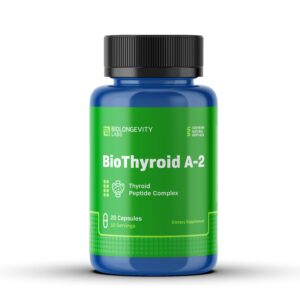
Discover BioThyroid featuring Thyreogen peptide complex A-2.
How They Differ from Thyroid Hormones
The hypothalamic-pituitary-thyroid axis operates through classical hormone signaling. TRH from the hypothalamus activates pituitary thyrotropes, which then secrete TSH to stimulate thyroid hormone synthesis.[1]
Thyroid bioregulators represent a different regulatory layer. They don’t act as GPCR agonists in the HPT axis. Instead, they function within thyroid cells themselves, modulating gene expression and cellular metabolism through epigenetic mechanisms.
This creates three distinct regulatory levels:
- Hypothalamic control: TRH (neuropeptide signaling)
- Pituitary-thyroid axis: TSH, T3, T4 (classic endocrine hormones)
- Local tissue regulation: Ultrashort peptides (gene expression modulators)
Core Mechanisms of Peptide Bioregulators
Most mechanistic research has focused on defined synthetic peptides rather than complex tissue extracts. The working model extrapolates from these well-characterized compounds to organ-derived preparations like A-2.
The consensus mechanism involves direct nuclear interaction rather than membrane receptor binding. Ultrashort peptides can penetrate cell membranes and nuclear envelopes due to their small size (2-7 amino acids, <3 kDa).[2]
Nuclear Entry and Localization
Fluorescent tracking studies show that short peptides readily enter cells and accumulate in nuclei and nucleoli. This nuclear localization supports the hypothesis of direct chromatin interaction rather than cytoplasmic signaling cascades.
The small molecular weight allows passive diffusion across membranes. Once inside the nucleus, these peptides can access DNA regulatory regions and histone proteins.
DNA and Histone Binding
Systematic biophysical studies demonstrate that specific peptides bind DNA with sequence specificity. For example, the dipeptide KE binds TCGA motifs, while EDR recognizes CCTGCC/CCAGCC sequences.[3]
These interactions produce several effects:
- Destabilize double helices at physiological temperatures
- Facilitate partial DNA melting in promoter regions
- Improve strand separation for transcriptional access
- Bind histones H1, H2B, H3, and H4
- Modify chromatin compaction in promoter regions
This histone interaction alters how tightly DNA wraps around histone cores, making genes more accessible to transcriptional machinery.
Gene-Specific Transcriptional Regulation
The tissue specificity emerges from preferential targeting of certain gene promoters. Research on EDR (Glu-Asp-Arg) shows it binds promoters of antioxidant genes (PPARA, PPARG, SOD2, GPX1) and neuroprotective factors.[3]
Similarly, AEDG and KE regulate genes involved in cell cycle control (p16, p21), telomere maintenance (TERT), and circadian clock function (Clock, Csnk1e, Cry2). Each peptide appears to have a specific gene target profile.
For thyroid bioregulators, the hypothesis is that A-2 contains sequences targeting thyroid-specific genes like thyroglobulin (TG), thyroid peroxidase (TPO), sodium-iodide symporter (NIS/SLC5A5), and TSH receptor (TSHR).
Epigenetic Modulation
Beyond immediate transcription effects, these peptides can alter DNA methylation patterns. Research shows they often reduce promoter hypermethylation of genes associated with cellular youth and function.
This epigenetic switch function may explain long-term effects observed in aging studies. By modifying methylation marks, peptides could shift gene expression patterns back toward younger phenotypes.
Histone modifications also contribute to these epigenetic changes. Peptide binding alters how tightly DNA wraps around histone cores, changing which genes are accessible for transcription.
How Thyroid Bioregulators Work

The general peptide mechanisms apply specifically to thyroid tissue through A-2’s organ-derived composition. The working model proposes that peptides in the A-2 complex preferentially target thyroid cells.
After absorption, these peptides reach thyroid follicular epithelium. Their small size allows them to enter cells and navigate to the nucleus where thyroid-specific genes reside.
Tissue-Specific Action on Thyroid Cells
Multiple sources attribute selective action to Thyreogen, meaning it preferentially affects thyroid cells over other cell types. This selectivity follows the general cytomedin principle that organ extracts target their tissue of origin.
The mechanism behind this specificity remains incompletely understood. It may involve peptide sequences that recognize promoter motifs common in thyroid-specific genes, or interactions with thyroid-enriched transcription factors.
What distinguishes bioregulators from hormones is this intracellular action. Rather than binding cell-surface receptors to trigger signaling cascades, they work inside cells at the chromatin level.
Target Genes in Thyroid Function
Although direct sequence-to-gene mapping hasn’t been published for A-2, extrapolation suggests several gene categories as probable targets:
Thyroid hormone biosynthesis genes:
- Thyroglobulin (TG)
- Thyroid peroxidase (TPO)
- Sodium-iodide symporter (NIS/SLC5A5)
- These encode machinery for iodine uptake and hormone synthesis
Stress resilience pathways:
- Antioxidant enzymes and DNA repair proteins
- Address oxidative stress from iodine handling
- Support cellular response to hormone production demands
Cell cycle and apoptotic regulators:
- Affect follicular cell turnover and tissue maintenance
- May parallel effects on p16, p21, and related genes seen with other bioregulators
Signaling Pathway Modulation
Beyond direct gene effects, bioregulators can influence major signaling cascades. Studies show modulation of MAPK/ERK and PI3K/Akt pathways, which control proliferation, survival, and stress responses.[3]
NF-κB and Nrf2/Keap1 pathways relevant to inflammation and oxidative stress also respond to peptide exposure. For thyroid research, this connects to autoimmune thyroid conditions and inflammatory processes.
Changes in cyclic nucleotide levels (cAMP/cGMP) and calcium handling represent additional regulatory points. These secondary effects cascade from the primary gene expression changes.
Mechanistic Research Summary
Table 1: Mechanistic Themes of Thyroid Bioregulators
| Mechanistic Level | Key Evidence | Research Relevance |
|---|---|---|
| Cell entry & nuclear localization | Ultrashort peptides penetrate cytoplasm and nucleus in multiple cell types | Supports plausibility that thyroid peptides reach nuclear targets in gland cells |
| DNA binding | Sequence-specific binding to promoter motifs (e.g., CCTGCC by EDR) | Suggests A-2 peptides may target promoters of TPO, TG, PTH, and related genes |
| Histone binding & chromatin | KE, AEDG, EDR bind histones H1/H2B/H3/H4, increasing promoter accessibility | Mechanism for de-repressing genes silenced during endocrine aging |
| Epigenetic modulation | Changes in DNA methylation and expression of aging/circadian genes | Tool for studying age-related methylation changes in thyroid tissue |
| Signaling cascades | Modulation of MAPK/ERK, PI3K/Akt, NF-κB, antioxidant pathways | Relevant to thyroid autoimmunity, oxidative stress, and calcium-sensing networks |
Research Evidence for Thyroid Bioregulators
Direct mechanistic studies specifically mapping A-2 sequences to thyroid genes remain unpublished. Current evidence comes from clinical observations, cross-tissue studies, and extrapolation from better-characterized peptides.
The Magadan region study represents the most thyroid-focused experimental work. Broader peptide research and endocrine cross-talk studies provide supporting context.
Thyramin Magadan Study Overview
This Russian trial examined a thyroid peptide bioregulator (Thyramin) in populations with reduced thyroid function. The Magadan region experiences high thyroid pathology prevalence due to adverse biogeochemical and climatic conditions.[4]
The intervention used Thyramin, described as exerting tissue-specific effects on thyroid cells to restore disturbed function. Study endpoints included:
- TSH levels
- Clinical hypothyroid status
- Trace element analyses
- Hair chemistry measurements
From a research perspective, this study probes how thyroid-derived peptides influence endocrine parameters under combined environmental and age stress. It offers phenomenological support for tissue specificity but lacks detailed molecular mechanisms.
The abstract is brief and the full paper is in Russian. Omics-level data on receptor engagement or epigenetic markers were not reported in the indexed abstract.
Cross-Axis Endocrine Effects
Research on epithalamin, a pineal gland peptide complex, shows it can alter thyroid hormone profiles. In rats, a 5-day course increased T3 and decreased T4 in young animals, while reducing both in old rats.[5]
These shifts suggest peptide bioregulators from one endocrine organ can measurably affect thyroid function. The mechanism may involve altered TRH or TSH secretion, or changes in thyroidal sensitivity to these signals.
For thyroid researchers, this demonstrates that thyroid-specific peptides likely participate in a broader peptidergic regulatory network. The HPT axis may receive modulation at multiple levels from tissue-derived peptides.
Limitations and Open Questions
Several constraints affect mechanistic interpretation of current evidence:
- Sequence characterization: Exact amino acid sequences in A-2 haven’t been published in peer-reviewed literature, preventing precise promoter mapping and structure-activity relationship studies
- Mechanistic depth: Indexed data specific to thyroid/parathyroid bioregulators remains sparse compared to peptides like AEDG or EDR
- Concentration and pharmacokinetics: How in vitro concentrations translate to in vivo tissue distribution in thyroid glands isn’t well defined
- Replication needs: Much of the bioregulator literature comes from associated institutions, with independent replication needed in diverse laboratory settings
Laboratory Research Applications
Thyroid bioregulators serve as experimental tools rather than therapeutic endpoints in research contexts. They offer ways to probe tissue-specific gene regulation and endocrine resilience mechanisms.
Several experimental directions emerge from the mechanistic framework and available evidence.
In Vitro Thyroid Cell Models
Primary cell systems include FRTL-5 rat thyrocytes, primary human thyroid follicular cells, and iPSC-derived thyroid organoids. These models allow controlled exposure to bioregulator peptides.
Key experimental questions researchers can address:
- How does A-2 affect expression of TG, TPO, NIS, TSHR, deiodinases, and antioxidant enzymes?
- Does bioregulator exposure open closed chromatin at thyroid gene loci (measured by ATAC-seq)?
- Can A-2 reduce promoter methylation at youth-associated genes (assessed by bisulfite sequencing)?
- What signaling network changes occur in ERK, PI3K/Akt, and NF-κB pathways?
RNA-seq, qPCR, Western blotting, and phospho-flow cytometry provide readouts for these questions.
Gene Expression Studies
Transcriptomic approaches offer unbiased gene discovery. Treating thyroid cells with A-2 or individual fractionated peptides, then performing RNA-seq, reveals the full transcriptional response.
This identifies both expected targets (thyroid-specific genes) and unexpected hits that may reveal new regulatory connections. Gene ontology analysis groups responding genes by function.
Time-course studies distinguish immediate-early responses from secondary effects. Does gene expression change within hours (direct chromatin effects) or days (downstream consequences)?
Dose-response curves establish concentration-dependent effects. This helps separate physiologically relevant responses from high-dose artifacts.
Epigenetic Research Tools
Bioregulators may serve as probes for age-related epigenetic drift in thyroid tissue. Comparing methylation and histone marks in young versus old thyroid cells, with and without peptide exposure, maps aging signatures.
Research shows ultrashort peptides can reverse some aging-associated epigenetic marks. Testing whether A-2 shows similar effects in thyroid-specific contexts advances understanding of endocrine aging.[2]
ChIP-seq (chromatin immunoprecipitation sequencing) can map where bioregulator peptides or their associated transcription factors bind across the genome. This requires antibodies or tagged peptides.
Endocrine Aging Research
Rodent models of subclinical hypothyroidism (iodine-poor diet, environmental toxins) or thyroiditis allow in vivo testing. Longitudinal experiments assess thyroid histology, gene expression, and methylation with chronic peptide exposure.
Systemic endocrine parameters including TSH, T4, and T3 serve as readouts of axis adaptation. The research value lies in mapping how local peptide signals reshape endocrine set-points under stress or aging.
Parathyroid aging models using Bonothyrk (A-21) provide a parallel system. These could examine calcium-phosphate homeostasis, PTH secretion, and parathyroid gland histology under similar experimental frameworks.
Age-related parathyroid hyperplasia or hypoparathyroidism models might respond to A-21 through effects on PTH, calcium-sensing receptor (CaSR), or bone remodeling genes. Other tissue-specific bioregulators like Cerluten (brain) or Chelohart (heart) follow similar research paradigms in their respective tissues.
Bottom-Up Peptide Identification
A promising strategy involves LC-MS/MS sequencing of A-2 preparations to identify recurrent ultrashort peptides. Once sequences are known, individual peptides can be synthesized and tested mechanistically.
This approach mirrors how AEDG, EDR, and KE were characterized. Knowing exact sequences enables promoter motif prediction, molecular docking studies, and rational peptide design.
For researchers, this represents a tractable path from complex tissue extract to defined molecular tools with clear structure-activity relationships.
Potential In Vitro Applications
Table 2: Laboratory Research Applications of Thyroid Bioregulators
| Research Area | Experimental Model | Key Readouts | Research Value |
|---|---|---|---|
| Thyroid gene regulation | FRTL-5 cells, primary human thyrocytes | TG, TPO, NIS, TSHR expression; chromatin accessibility | Map tissue-specific gene networks |
| Epigenetic aging | Young vs. old thyroid organoids | DNA methylation, histone marks at thyroid gene loci | Identify aging-related epigenetic drift |
| Stress response | Thyroid cells + oxidative stress | Antioxidant enzyme expression, NF-κB activation, ROS levels | Model environmental stress adaptation |
| Endocrine cross-talk | Co-culture thyroid + pituitary cells | TSH secretion, T3/T4 production, feedback dynamics | Probe peptide effects on HPT axis |
| Autoimmunity | Hashimoto’s disease models | Inflammatory marker expression, apoptosis rates | Study regulatory pathways in thyroiditis |
| Parathyroid regulation | Primary parathyroid cells, A-21 peptide | PTH transcription, CaSR expression, calcium sensing | Understand calcium-phosphate homeostasis |
Thyroid Bioregulators vs. Traditional Thyroid Compounds
Understanding the differences between bioregulators and peptides versus thyroid compounds helps clarify appropriate experimental uses.
Key compound categories:
- Thyroid hormones (T3, T4): End products of thyroid function that bind nuclear thyroid hormone receptors throughout the body, regulating metabolism and gene expression globally
- TSH and TRH: Upstream regulators acting through GPCR signaling; TRH activates pituitary receptors to trigger TSH release[6]
- Bioregulators like A-2: Work inside thyroid cells at the chromatin level, modulating gene expression machinery rather than replacing hormone synthesis
- Synthetic thyroid peptides: Defined sequences (like AEDG) offer molecular precision with known targets
This makes bioregulators complementary tools. Hormone and TSH studies examine endpoint signaling, while bioregulator research probes the regulatory mechanisms controlling thyroid cell identity and capacity.
The choice depends on research goals: defined peptides for mechanistic precision, natural complexes for modeling tissue-level regulation.
Quick Review
Thyroid peptide bioregulators represent research tools for probing tissue-specific gene regulation in endocrine systems. Thyreogen (A-2) offers a thyroid-targeted preparation, while Bonothyrk (A-21) serves similar functions for parathyroid research.
The mechanistic framework—ultrashort peptides entering cells, binding DNA and histones, and modulating gene expression—provides testable hypotheses for experimental design. Current evidence supports tissue specificity and functional effects, though molecular details remain incompletely characterized.
For laboratories focused on endocrine biology, aging research, or epigenetic regulation, these compounds serve as starting points for gene network mapping and omics-driven investigation. The path from complex tissue extracts to defined molecular tools parallels successful characterization of other bioregulators.
BioLongevity Labs provides research-grade peptide bioregulators with triple third-party testing, comprehensive certificates of analysis, and >99% purity guarantees. All products are manufactured in USA GMP facilities and properly stored to maintain stability, intended strictly for laboratory research purposes.
Scientific Reviewer
This research article has been scientifically reviewed and fact-checked by Dr. Ky H. Le, MD. Dr. Le earned his medical degree from St. George’s University School of Medicine and completed his residency training at Memorial Hermann Southwest Hospital. Board-certified in family medicine with experience in hospital medicine, he brings over two decades of clinical experience to reviewing research content and ensuring scientific accuracy.
References
- Yang F, Zhang H, Meng X, Li Y, Zhou Y, Ling S, et al. Structural insights into thyrotropin-releasing hormone receptor activation by an endogenous peptide agonist or its orally administered analogue. Springer Science and Business Media LLC; 2022. https://doi.org/10.1038/s41422-022-00646-6
- Khavinson VK, Popovich IG, Linkova NS, Mironova ES, Ilina AR. Peptide regulation of gene expression: a systematic review. MDPI AG; 2021. https://doi.org/10.3390/molecules26227053
- Khavinson V, Linkova N, Kozhevnikova E, Trofimova S. EDR peptide: possible mechanism of gene expression and protein synthesis regulation involved in the pathogenesis of Alzheimer’s disease. MDPI AG; 2020. https://doi.org/10.3390/molecules26010159
- Gorbachev AL, Lugovaia EA, Ryzhak G, Khavinson V. Peptide bioregulator efficacy in the correction of reduced thyroid gland function in the residents of Magadan Region. Advances in Gerontology = Uspekhi gerontologii. 2005;16:80–7.
- Khavinson VKh, Kuznik BI, Ryzhak GA. Peptide bioregulators: a new class of geroprotectors. Message 1: results of experimental studies. Pleiades Publishing Ltd; 2013. https://doi.org/10.1134/s2079057013030065
- Vella KR, Hollenberg AN. The ups and downs of thyrotropin-releasing hormone. The Endocrine Society; 2009. https://doi.org/10.1210/en.2009-0261