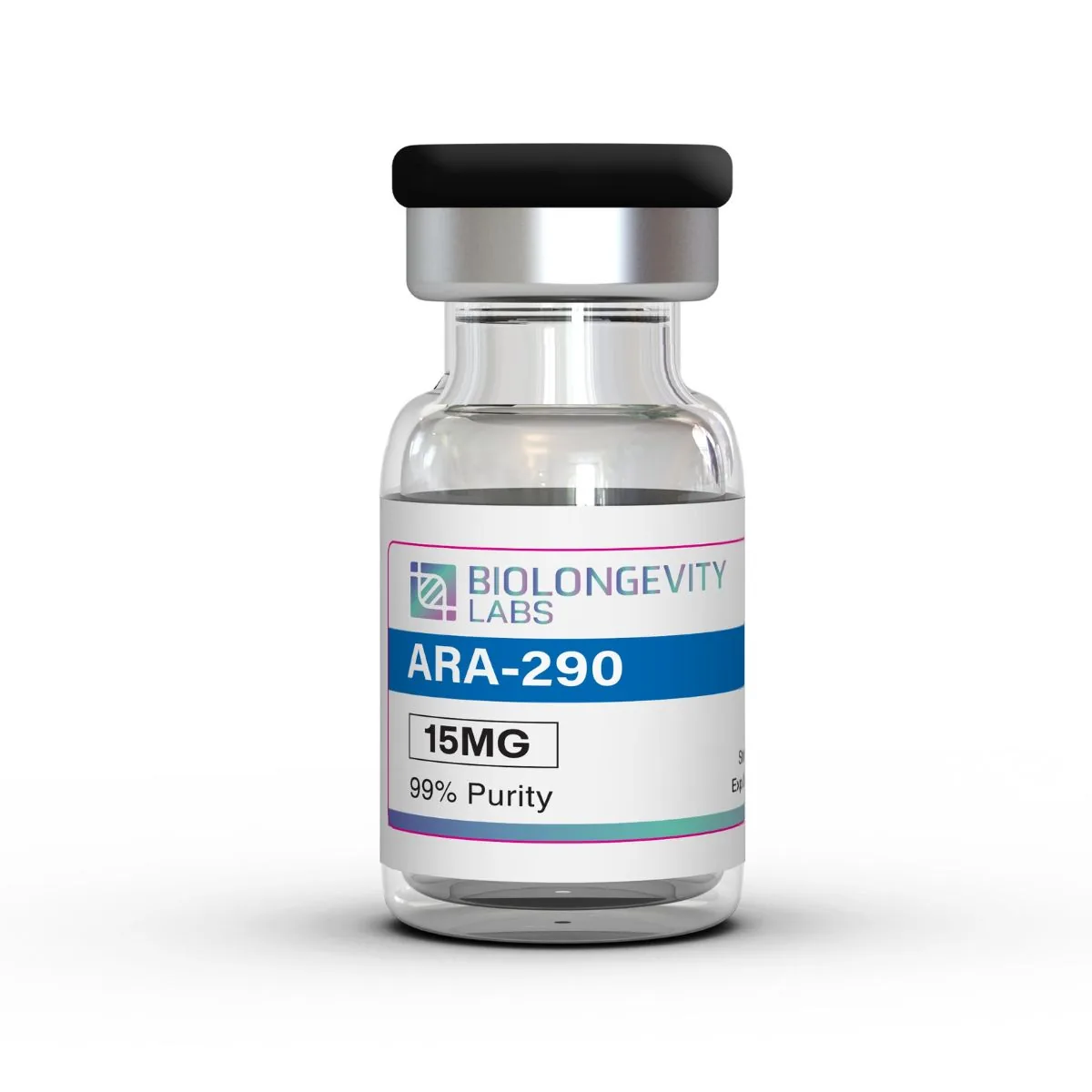
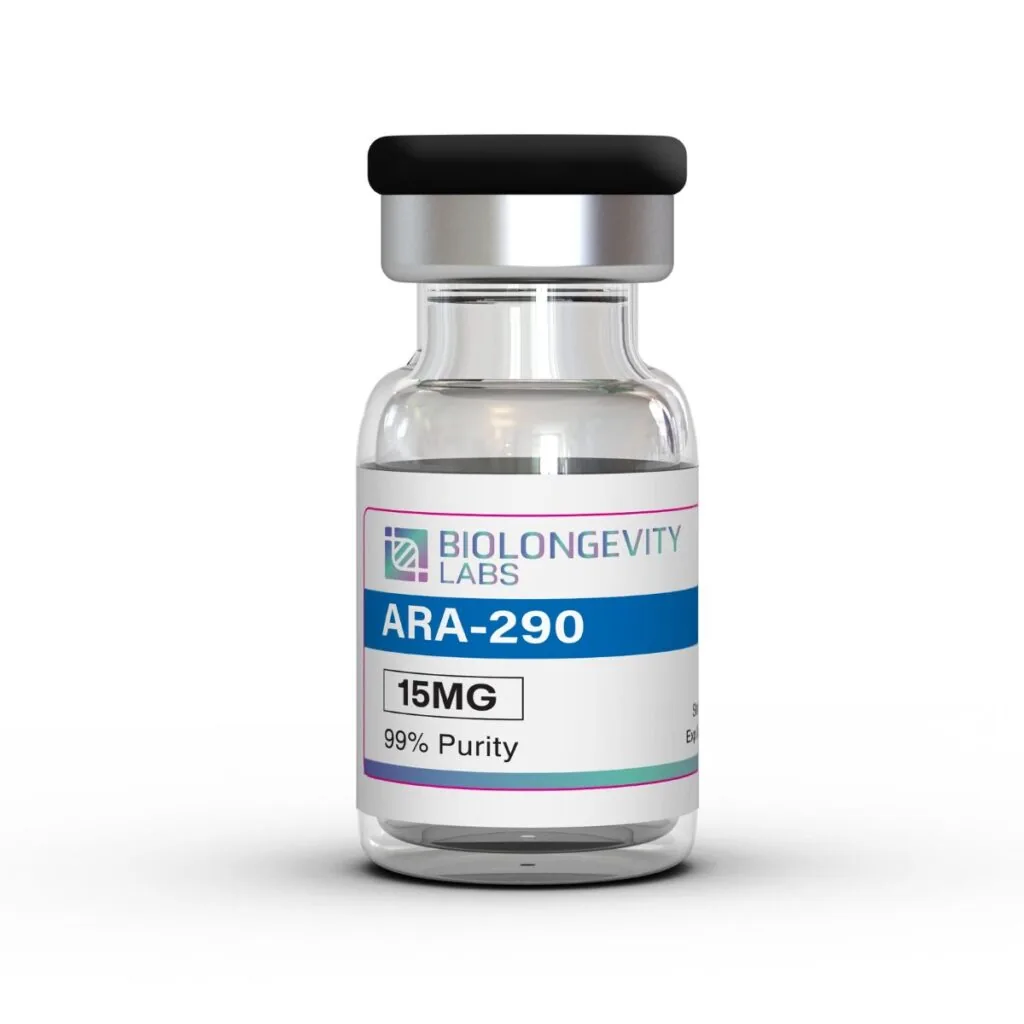
ARA-290 is a synthetic 11-amino-acid peptide modeled on the helix B surface of erythropoietin, produced through controlled peptide synthesis. Also known as cibinetide, it ships as 15mg of lyophilized powder in a sealed vial. The compound is characterized in laboratory research on the innate repair receptor, a receptor complex distinct from the one that drives erythropoiesis. Researchers use it to study inflammatory cytokine signaling, cell survival pathways and nociceptor activity in research models.
≥99% Purity
Third-Party Tested
COA Available
U.S. Manufactured
Quantity
In stock
Third-Party Verified Quality
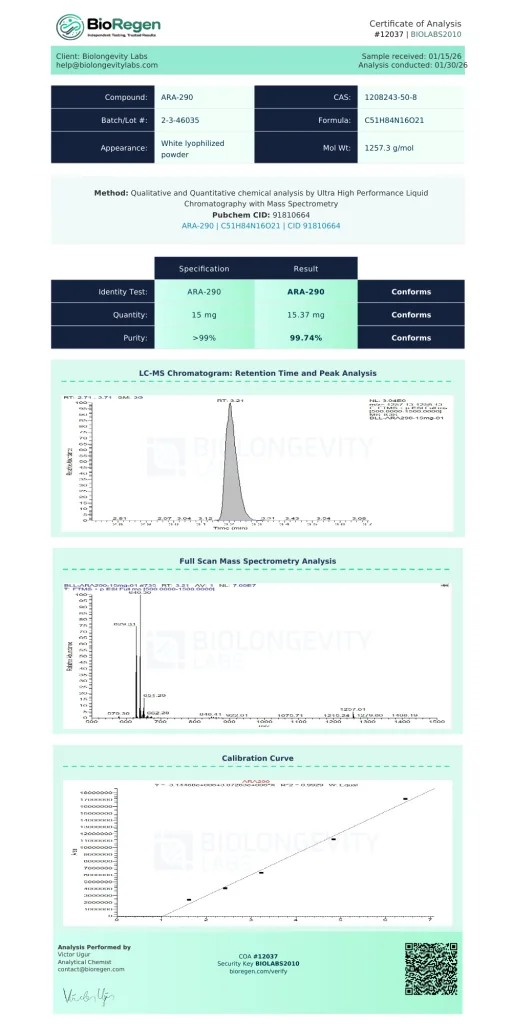
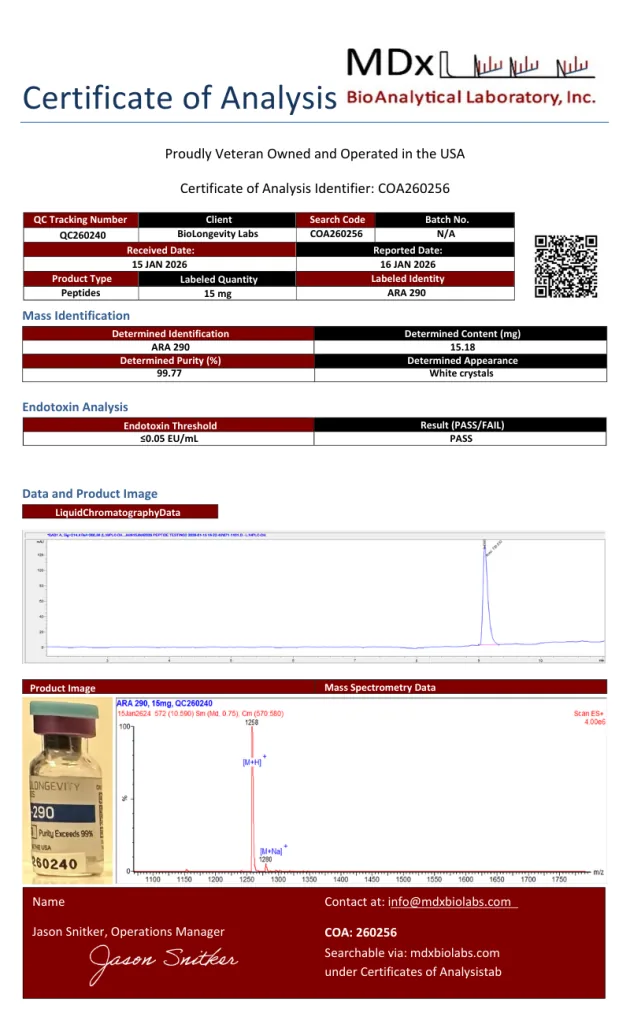
≥99% purity verified through independent UHPLC-MS testing. Certificates of Analysis are available before purchase.
COAs available before purchase
U.S.-manufactured research-grade
Same-business-day U.S. dispatch for in-stock orders placed before 12 PM PT
Secure Checkout · Free shipping on orders over $400
ARA-290 belongs to a family of nonerythropoietic peptides designed from the three-dimensional structure of erythropoietin (EPO). Its sequence reproduces the residues that form the aqueous face of EPO helix B, capped with an N-terminal pyroglutamate.
In the literature the ARA 290 peptide also appears as cibinetide, ARA290 and pyroglutamate helix B surface peptide (pHBSP).
Research interest centers on its activity at the EPO receptor and CD131 heterocomplex, while the classical EPO receptor homodimer stays unengaged. That selectivity makes ARA-290 a practical tool for separating the cytoprotective and erythropoietic branches of EPO signaling in laboratory models.
Store the lyophilized compound at -20°C, protected from light and moisture.
After reconstitution, store at 2–8°C and use promptly.
Maintain aseptic handling to preserve compound integrity.
Lyophilized Format
This compound ships in lyophilized (freeze-dried) form. Freeze-drying supports long-term storage stability and preserves compound integrity. No fillers are added.
Research Use Disclaimer
ARA-290 is supplied for research use only. It is not a drug, food, cosmetic, or dietary supplement and has not been evaluated by the FDA. By purchasing, the buyer confirms the compound will be used solely for in vitro research.
Frequently Asked Questions
What Is ARA-290 Peptide?
ARA-290 is a synthetic 11-amino-acid peptide modeled on the helix B surface of erythropoietin. It is studied in laboratory research on the innate repair receptor, the EPO receptor and CD131 complex linked to cytoprotective signaling.
Is ARA-290 the Same Compound as Cibinetide?
Yes. Cibinetide is the nonproprietary name for ARA-290, and the literature also lists it as ARA 290 and pHBSP under CAS number 1208243-50-8.
What Is the Molecular Weight of ARA-290?
ARA-290 has a molecular weight of 1257.3 g/mol and the molecular formula C51H84N16O21. Its sequence is pGlu-Glu-Gln-Leu-Glu-Arg-Ala-Leu-Asn-Ser-Ser, eleven residues with an N-terminal pyroglutamate.
How Should ARA-290 Be Stored?
Store lyophilized ARA-290 at -20°C, protected from light and moisture. After reconstitution, keep the solution at 2–8°C and use it promptly.
How Is ARA-290 Purity Verified?
ARA-290 from BioLongevity Labs is tested by independent third-party laboratories against a ≥99% purity specification. The certificates of analysis are published online, so researchers can review them before ordering.
Research Overview
ARA-290 was first described as an 11-residue peptide that mimics the aqueous surface of EPO helix B. In the founding study it was protective in neuronal cultures and research models, and it showed no erythropoietic activity in vitro or in vivo [1].
The receptor it engages is a heterocomplex of the EPO receptor subunit and CD131, the beta common receptor. Reviews of this system describe the complex as largely absent from undamaged tissue and upregulated by inflammation and hypoxia [2].
Knockout work supports that receptor dependence. In a spared nerve injury model, ARA-290 reduced tactile and cold sensitivity in rats and wild-type mice but had no measurable effect in mice lacking the beta common receptor [3].
Beyond receptor mapping, several laboratory threads examine the cellular responses downstream of that receptor.
Nociceptor and Cytokine Signaling
In calcium imaging of cultured sensory neurons, ARA-290 inhibited TRPV1 channel activity in response to capsaicin [4]. In murine macrophage cultures it reduced secretion of IL-6, IL-12 and TNF-α, and it limited cytokine-induced apoptosis in cultured pancreatic islets [5].
Endothelial Cell Survival
In endothelial colony-forming cell cultures, ARA-290 activated pro-survival signaling and raised viability under hydrogen peroxide-induced oxidative stress [6]. The same study reported lower IL-1β and TNF-α expression in a murine oxygen-induced retinal injury model [6].
Research Area
In Vitro Application
Receptor pharmacology
Characterizing EPO receptor and CD131 heterocomplex signaling apart from the EPO receptor homodimer
Inflammatory signaling
Measuring IL-6, IL-12 and TNF-α secretion from cultured macrophages
Nociceptor biology
Calcium imaging of TRPV1 activity in cultured sensory neurons
Cell survival
Pro-survival signaling in endothelial colony-forming cells under oxidative stress
Structure-activity studies
Comparing helix B-derived peptides with full-length erythropoietin
References
Brines M, Patel NSA, Villa P, et al. (2008). Nonerythropoietic, tissue-protective peptides derived from the tertiary structure of erythropoietin. Proceedings of the National Academy of Sciences of the United States of America. https://pmc.ncbi.nlm.nih.gov/articles/PMC2504825/
Swartjes M, Morariu A, Niesters M, et al. (2011). ARA290, a peptide derived from the tertiary structure of erythropoietin, produces long-term relief of neuropathic pain: an experimental study in rats and β-common receptor knockout mice. Anesthesiology. https://doi.org/10.1097/ALN.0b013e31822fcefd
Zhang W, Yu G, Zhang M. (2016). ARA 290 relieves pathophysiological pain by targeting TRPV1 channel: Integration between immune system and nociception. Peptides. https://doi.org/10.1016/j.peptides.2016.01.003
Watanabe M, Lundgren T, Saito Y, et al. (2016). A Nonhematopoietic Erythropoietin Analogue, ARA 290, Inhibits Macrophage Activation and Prevents Damage to Transplanted Islets. Transplantation. https://doi.org/10.1097/TP.0000000000001026
O’Leary OE, Canning P, Reid E, et al. (2019). The vasoreparative potential of endothelial colony-forming cells in the ischemic retina is enhanced by cibinetide, a non-hematopoietic erythropoietin mimetic. Experimental Eye Research. https://doi.org/10.1016/j.exer.2019.03.001
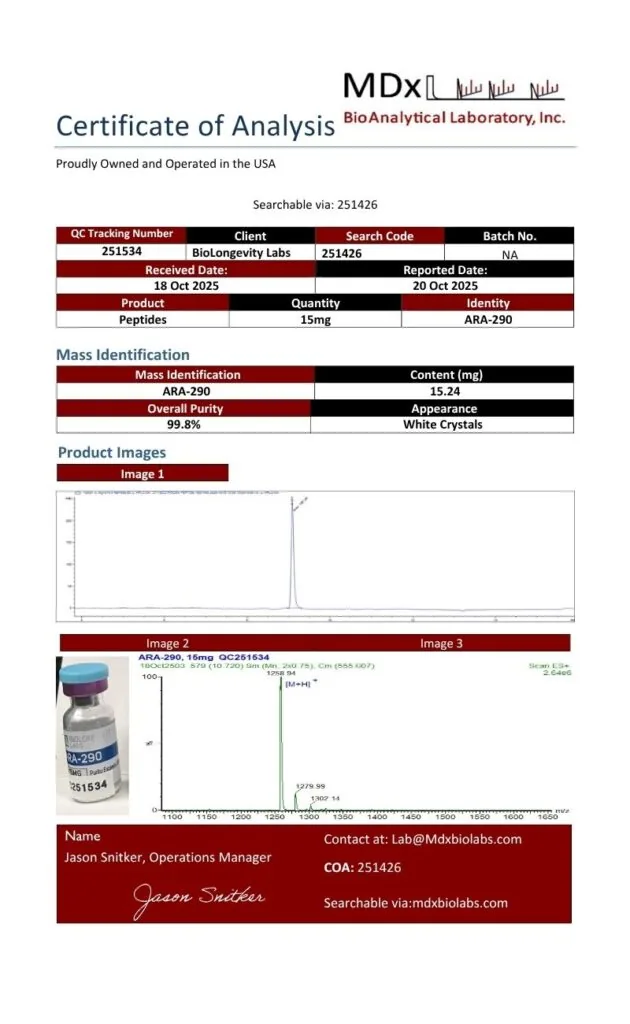
A Certificate of Analysis (COA) is a document that verifies a compound’s identity, purity and quality through independent laboratory testing. Every compound from BioLongevity Labs is third-party tested, and its COA is published here, so researchers can review the testing record before a compound enters a protocol.
Each COA reports results from third-party laboratory analysis, including:
Ultra-high-performance liquid chromatography with mass spectrometry (UHPLC-MS) for purity, measured against a 98% or 99% specification depending on the compound
Mass identification for molecular confirmation and content quantitation
Endotoxin testing by Limulus amebocyte lysate (LAL) or recombinant Factor C (rFC) assay, depending on the laboratory
Visual and physical characterization of the finished material
How to Verify a COA Independently
You can check every certificate against the issuing laboratory’s own records, not just the copy hosted here. Verification does not depend on BioLongevity Labs.
AV Analytics certificates carry a search code. Scan the QR code on the certificate to open the laboratory’s verification page, or enter the search code at avanalytical.com/coa-search to pull the official record.
BioRegen reports of analysis carry a Report ID and a Validation Key. Scan the QR code on the certificate to open the official record, or quote both identifiers when you contact the laboratory at the address printed on the report.
SafeCert Labs issued a number of earlier certificates. Each one carries a COA number and the signature of the reporting chemist. Quote that number when you ask the laboratory to confirm it.
Older certificates from other laboratories list their own verification details on the document.
When a batch is sent to more than one laboratory, each certificate resolves at its own issuing laboratory. A researcher can then check the results against two unrelated sources.
These COAs come from independent certified laboratories, not in-house testing. That gives researchers a verifiable record of molecular integrity for each compound. All compounds are supplied for research use only.
Scientifically reviewed by Dr. Ky H. Le, MD. Dr. Le is a board-certified family medicine physician with over 20 years of clinical experience. Dr. Le validates the scientific accuracy of all technical content and research citations.
Disclaimer: For Research Purposes Only
This content is provided strictly for research purposes and does not constitute an endorsement or recommendation for the non-laboratory application or improper handling of peptides designed for research. The information, including discussions about specific peptides and their researched benefits, is presented for informational purposes only and must not be construed as health, clinical, or legal guidance, nor an encouragement for non-research use. Peptides described here are solely for use in structured scientific study by authorized individuals. We advise consulting with research experts, medical practitioners, or legal counsel prior to any decisions about obtaining or utilizing these peptides. The expectation of responsible, ethical utilization of this information for legitimate investigative and scholarly objectives is paramount. This notice is dynamic and governs all provided content on research peptides.