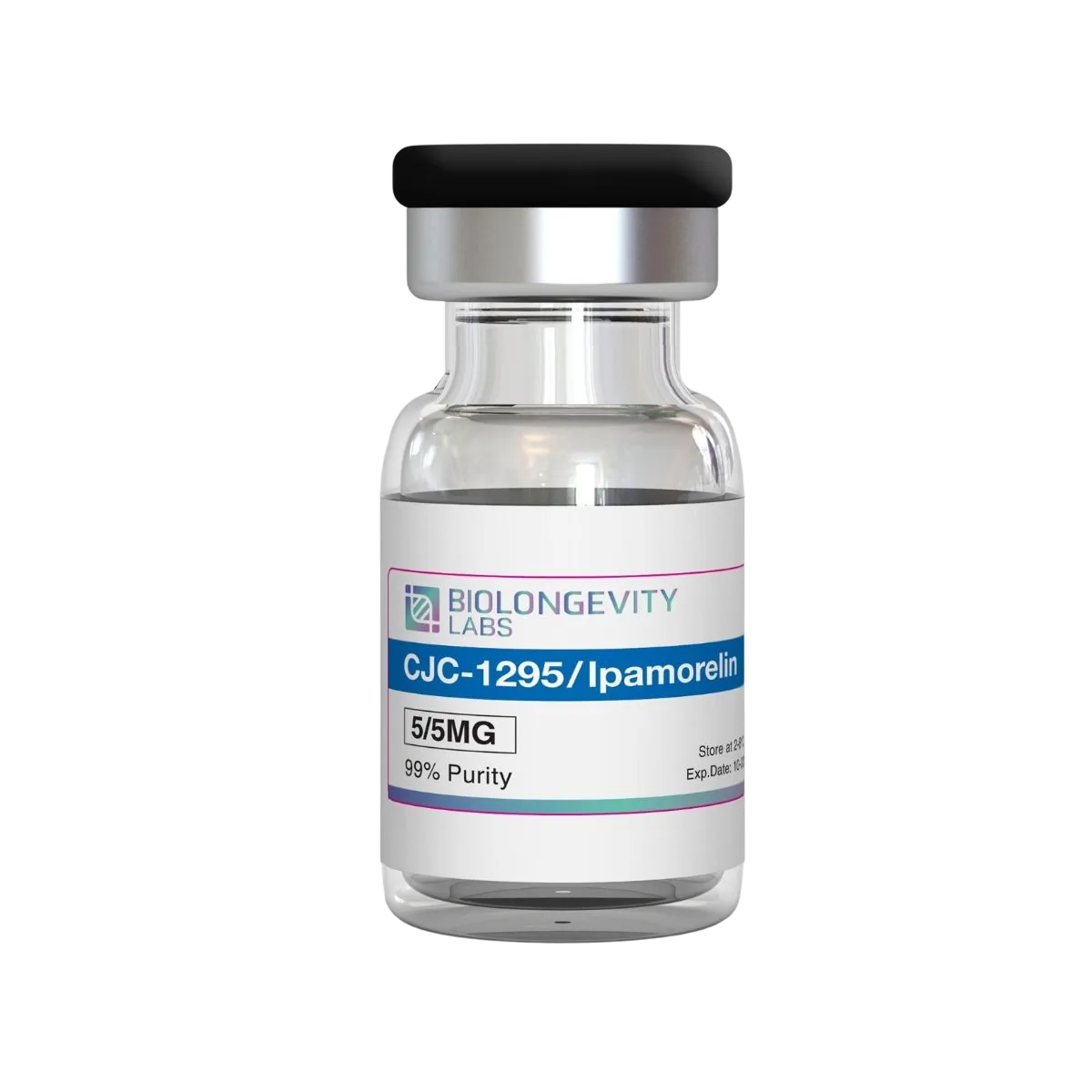
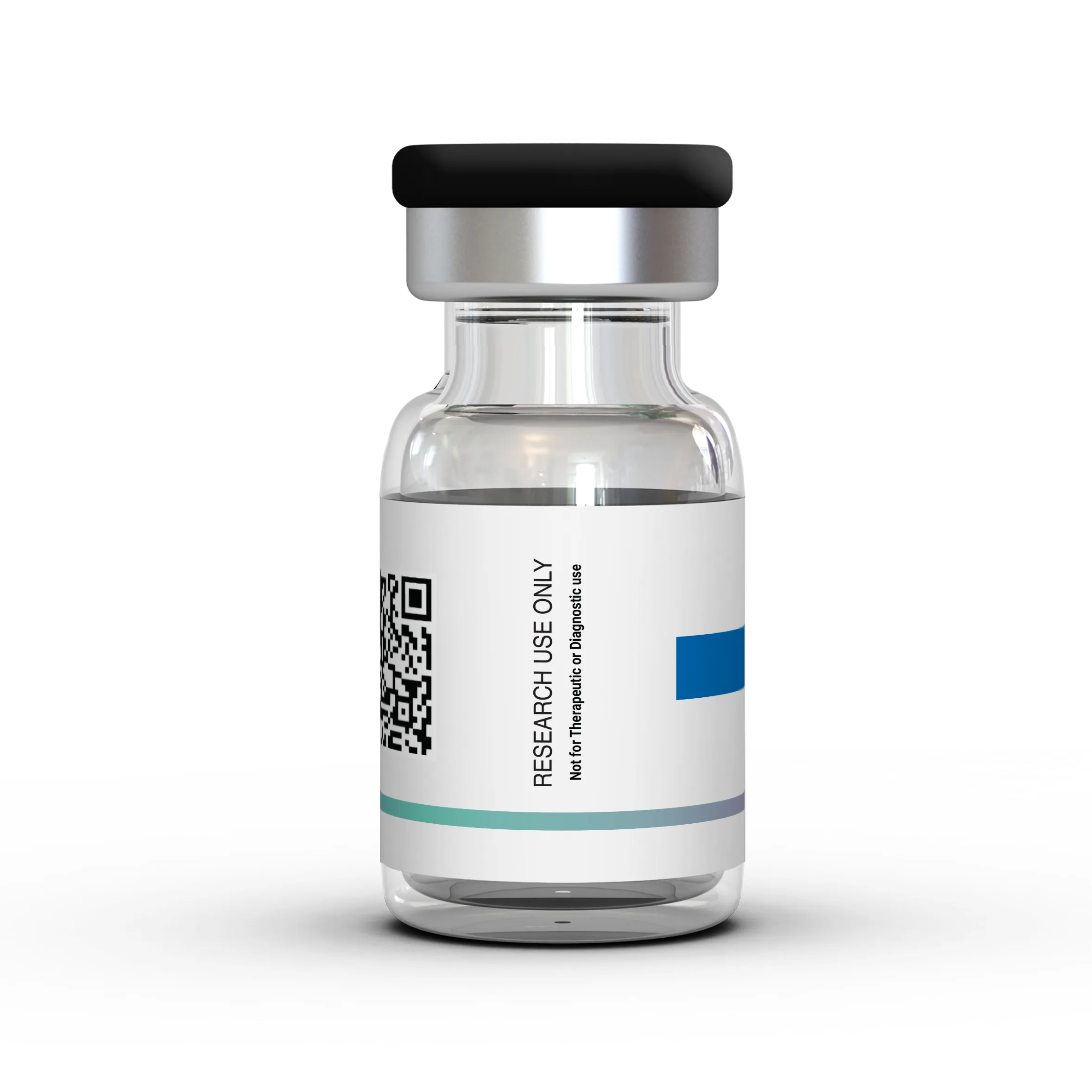
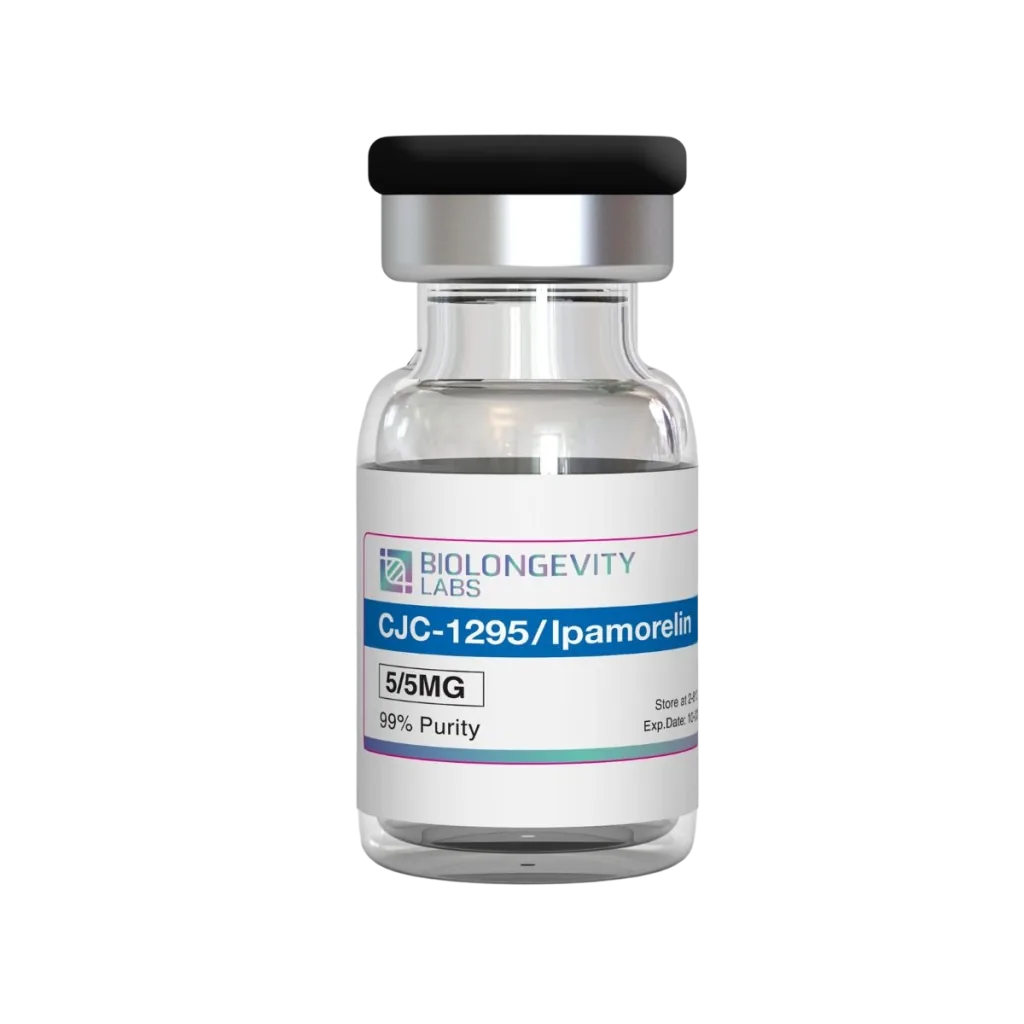
CJC-1295 Ipamorelin blend is a combination of two synthetic peptides, Modified GRF (1-29) without DAC and the pentapeptide ipamorelin. Each lyophilized vial contains 5mg of each component, totaling 10mg. The components provide distinct molecular starting points for laboratory investigations of GHRH-receptor and growth hormone secretagogue signaling. BioLongevity Labs supplies this blend for in vitro research use only.
≥99% Purity
Third-Party Tested
COA Available
U.S. Manufactured
Quantity
In stock
Third-Party Verified Quality
≥99% purity verified through independent UHPLC-MS testing. Certificates of Analysis are available before purchase.
COAs available before purchase
U.S.-manufactured research-grade
Same-business-day U.S. dispatch for in-stock orders placed before 12 PM PT
Secure Checkout · Free shipping on orders over $400
CJC-1295 (No DAC) + Ipamorelin Blend Technical Overview
CJC-1295 without DAC is commonly called Modified GRF (1-29), a 29-residue, C-terminally amidated GHRH analog. Its reference sequence contains D-Ala², Gln⁸, Ala¹⁵ and Leu²⁷ substitutions. Ipamorelin is a five-residue peptide containing Aib and D-2-Nal, two nonstandard amino-acid building blocks. [1,2]
This formulation combines two separate peptide sequences in one vial. The listed 5mg + 5mg composition is a mass ratio, so it does not imply an equimolar mixture. Component identity and assay response should be assessed separately when designing laboratory comparisons.
Compound Specifications
Property
Value
Compound Class
Two-component synthetic peptide blend
Vial Content
10mg total; 5mg CJC-1295 (No DAC) + 5mg ipamorelin
Blend Ratio
1:1 by component mass
CAS Number
CJC-1295 (No DAC) reference peptide: 446036-97-1; ipamorelin: 170851-70-4
PubChem CID
CJC-1295 (No DAC) reference structure: 56841945; ipamorelin: 9831659
Molecular Formula
CJC-1295 (No DAC): C₁₅₂H₂₅₂N₄₄O₄₂; ipamorelin: C₃₈H₄₉N₉O₅
Molecular Weight
CJC-1295 (No DAC): approximately 3367.9 g/mol; ipamorelin: approximately 711.9 g/mol
Synonyms
CJC-1295 (No DAC): Modified GRF (1-29), Mod GRF 1-29; ipamorelin: NNC 26-0161
CJC-1295 (No DAC): 29 residues; ipamorelin: 5 residues
Source
Synthetic peptides
InChIKey
CJC-1295 (No DAC) reference structure: XOZMWINMZMMOBR-HRDSVTNWSA-N; ipamorelin: NEHWBYHLYZGBNO-BVEPWEIPSA-N
Purity
≥99%, as specified on the product listing; UHPLC-MS testing
Appearance
Lyophilized powder in a vial
Solubility
Qualify solvent compatibility and dissolved-component recovery for the assay
Storage
Lyophilized material at −20°C; protect from light and moisture
Storage and Handling
Store the sealed lyophilized vial at −20°C, protected from light and moisture.
After reconstitution, follow the validated storage conditions for your assay and use promptly.
Maintain aseptic handling and avoid repeated freeze-thaw cycles.
Lyophilized Format
This compound ships in lyophilized (freeze-dried) form. Freeze-drying supports long-term storage stability and preserves compound integrity. No fillers are added.
Research Use Disclaimer
CJC-1295 (No DAC) & Ipamorelin Blend is supplied for research use only. It is not a drug, food, cosmetic, or dietary supplement and has not been evaluated by the FDA. By purchasing, the buyer confirms the compound will be used solely for in vitro research.
Frequently Asked Questions
What Is in the CJC-1295 Ipamorelin 10mg Blend?
The CJC-1295 Ipamorelin 10mg blend contains 5mg CJC-1295 without DAC and 5mg ipamorelin in one lyophilized vial. The 1:1 ratio describes component mass, rather than equal numbers of molecules.
What Does No DAC Mean in This Peptide Blend?
CJC-1295 without DAC is the 29-residue Modified GRF (1-29) peptide without the added albumin-binding DAC group. The no-DAC and DAC constructs have different chemical identities.
Does the CJC-1295 Ipamorelin Blend Have One Molecular Weight?
The CJC-1295 Ipamorelin blend contains two separate peptides with reference molecular weights of approximately 3367.9 g/mol and 711.9 g/mol, respectively. A single molecular weight does not describe this mixture.
What Testing Documentation Is Available for the Blend?
BioLongevity Labs lists third-party UHPLC-MS testing, a ≥99% purity specification and an available Certificate of Analysis for the CJC-1295 Ipamorelin blend. Review the applicable lot report for the reported analytical results.
Research Overview
GRF(1-29) structure-activity research used rat pituitary receptor-binding assays and cAMP measurements to examine how amino-acid substitutions affect receptor interaction. These experiments provide context for studying GHRH analogs, rather than evidence for the finished blend. [3]
Raun and colleagues characterized ipamorelin in primary rat pituitary cell cultures. Antagonist profiling supported activity through a GHRP-like receptor pathway, distinct from the GHRH pathway. [4]
In cells expressing both GHRH and GHS receptors, Cunha and Mayo observed a larger cAMP response during receptor coactivation. The study examined ghrelin and other secretagogues; it did not establish the response of this specific CJC-1295 (No DAC) and ipamorelin formulation. [5]
Research Area
In Vitro Application
GHRH-Receptor Signaling
Compare binding and cAMP readouts in receptor-expressing cell systems. [3]
Secretagogue Pathway Characterization
Evaluate ipamorelin-associated responses in pituitary cell assays. [4]
Receptor Coactivation
Compare single-component and blend conditions with vehicle controls in validated cell assays. [5]
Analytical Identity
Use chromatography and mass spectrometry to distinguish expected peptides from sequence variants. [6]
Cayman Chemical. CJC-1295 product information and Safety Data Sheet, Item 32704. Reference sequence and identity. Product informationSafety Data Sheet
Lefrançois L, Gaudreau P. (1994). Identification of receptor-binding pharmacophores of growth-hormone-releasing factor in rat adenopituitary. Neuroendocrinology. 59(4):363–370. doi:10.1159/000126679
Raun K, et al. (1998). Ipamorelin, the first selective growth hormone secretagogue. European Journal of Endocrinology. 139(5):552–561. doi:10.1530/eje.0.1390552
Cunha SR, Mayo KE. (2002). Ghrelin and growth hormone (GH) secretagogues potentiate GH-releasing hormone (GHRH)-induced cyclic adenosine 3′,5′-monophosphate production in cells expressing transfected GHRH and GH secretagogue receptors. Endocrinology. 143(12):4570–4582. doi:10.1210/en.2002-220670
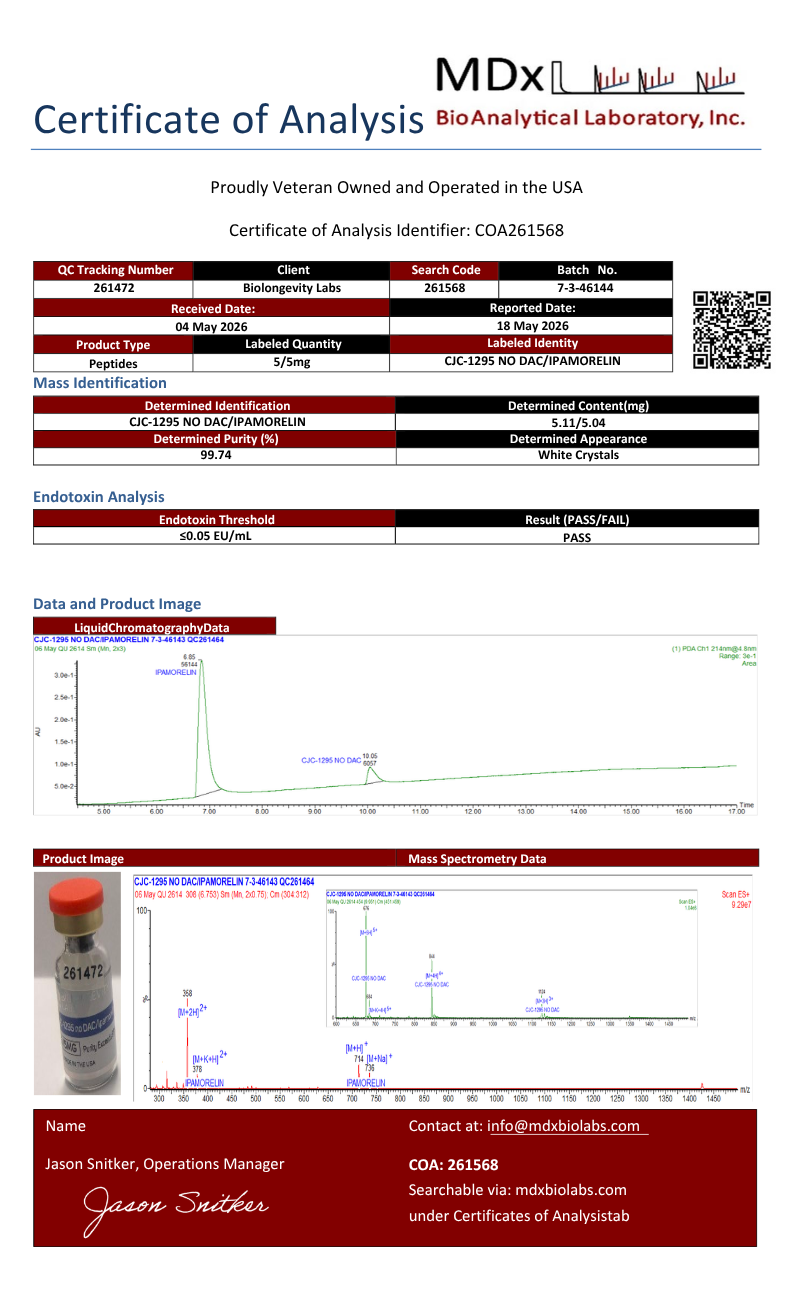
Certificate of Analysis (COA)
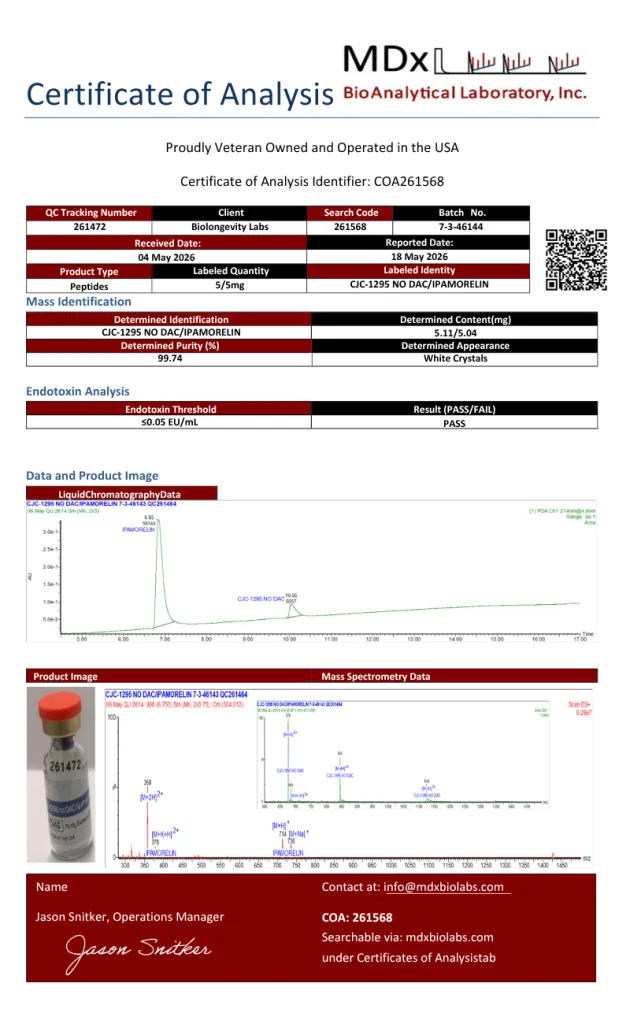
CJC-1295 NO DAC/IPAMORELIN (261472)
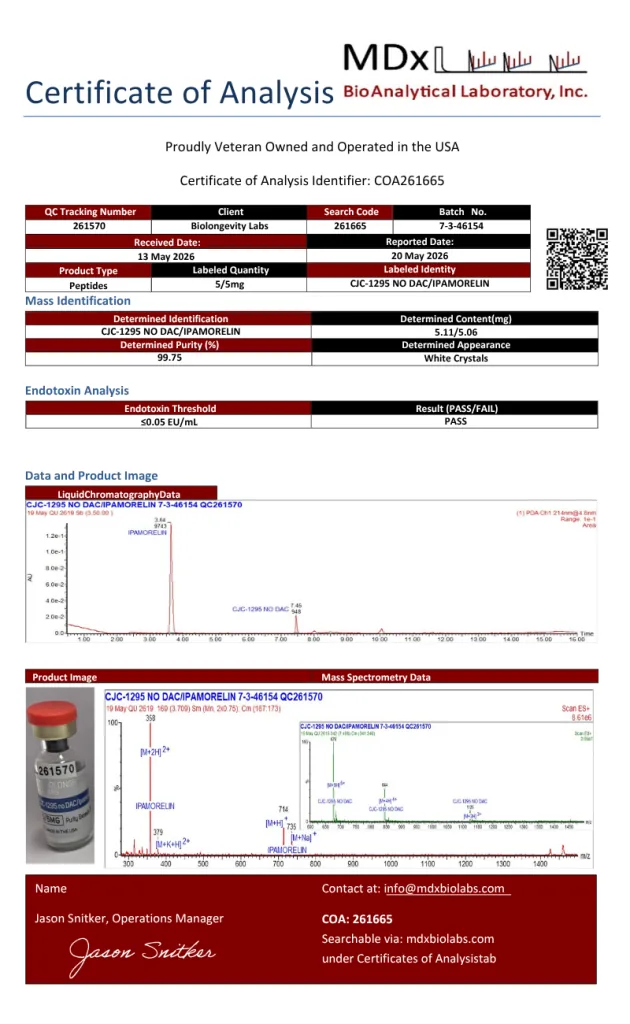
CJC-1295 NO DAC/IPAMORELIN (261570)
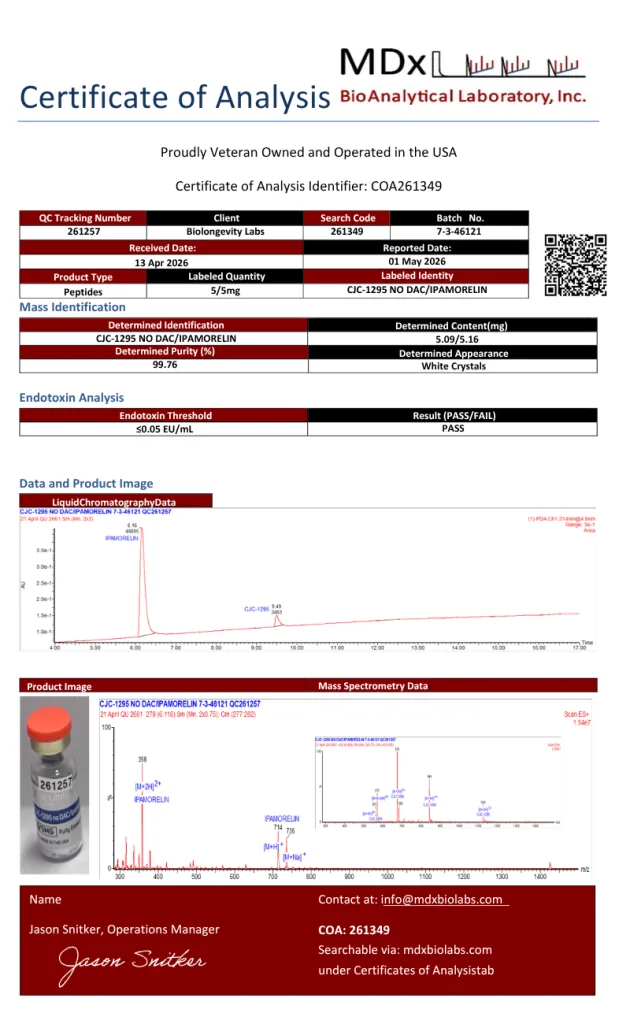
CJC-1295 NO DAC IPAMORELIN (261257)
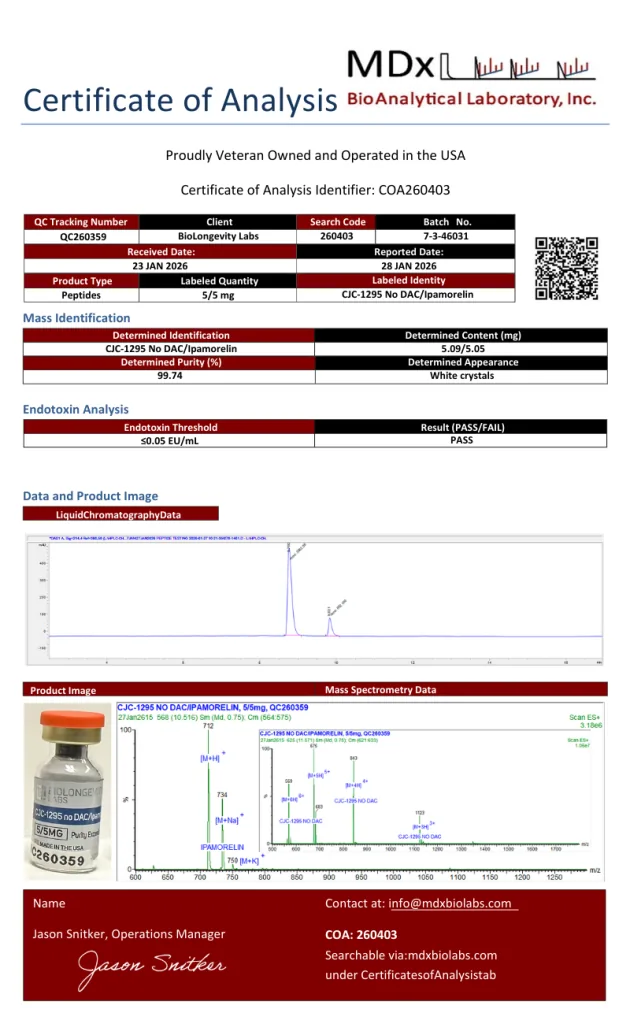
CJC-1295 No DAC Ipamorelin (260403)
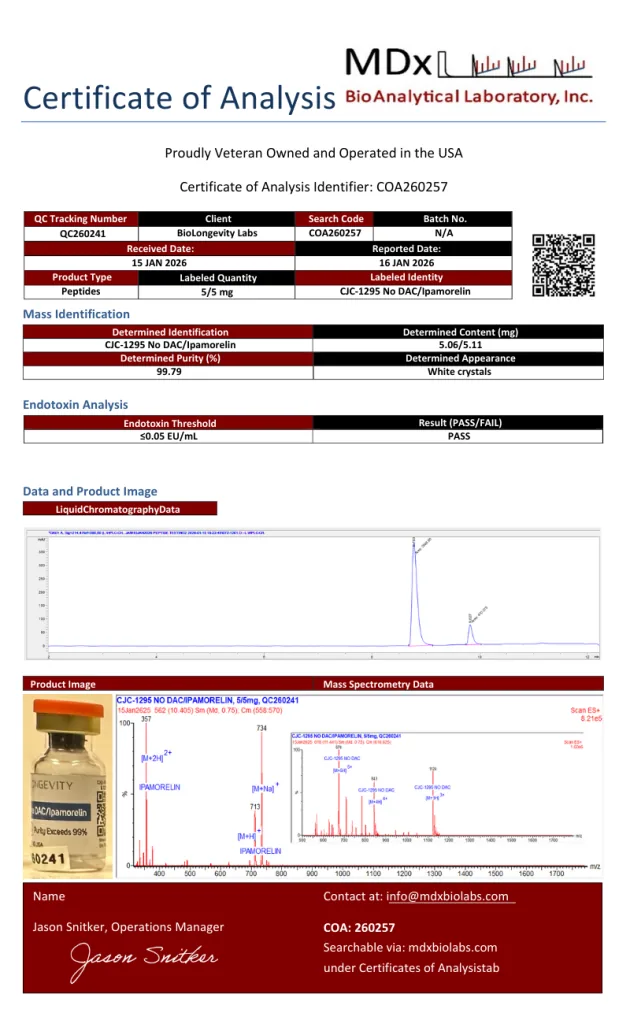
CJC-1295 No DAC / Ipamorelin (260257)
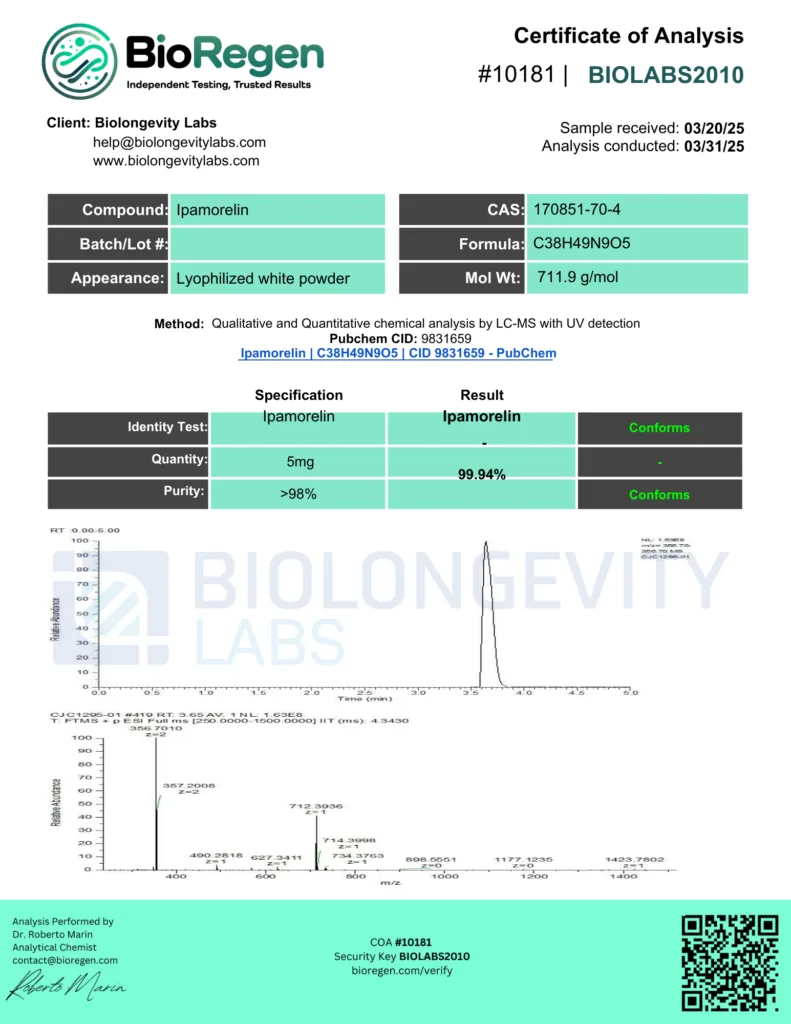
Endotoxin Ipamorelin
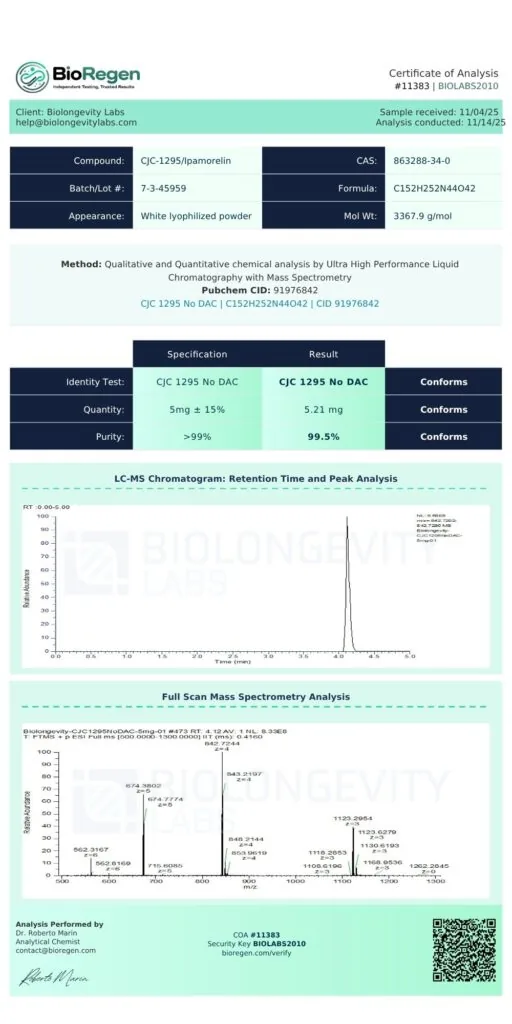
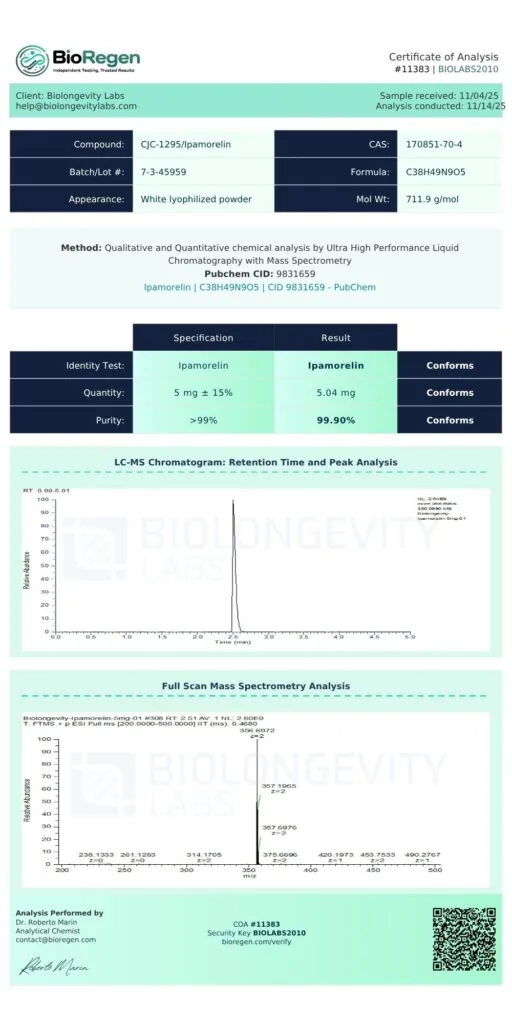
CJC-1295 Ipamorelin (11383)
CJC-1295 Ipamorelin (11383)
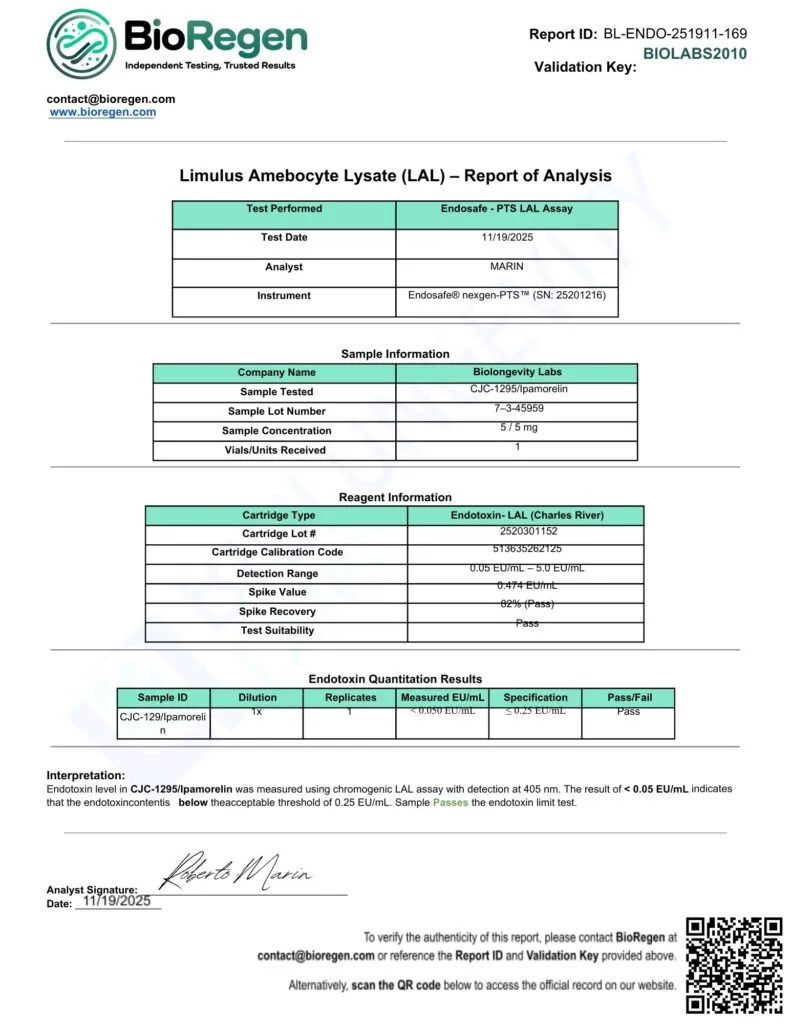
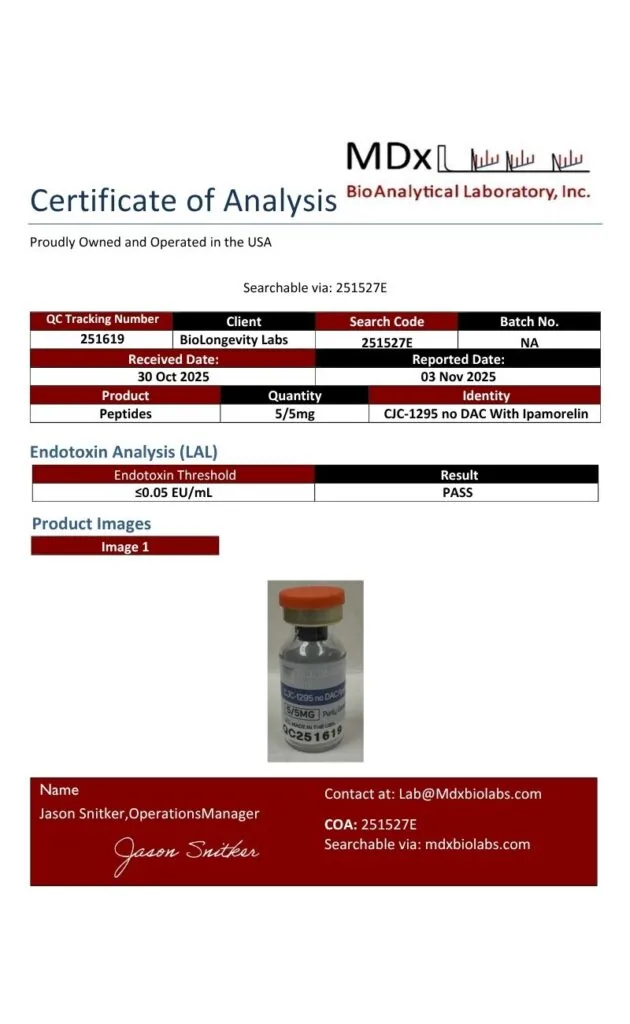
CJC-1295 no DAC & Ipamorelin (251527E)
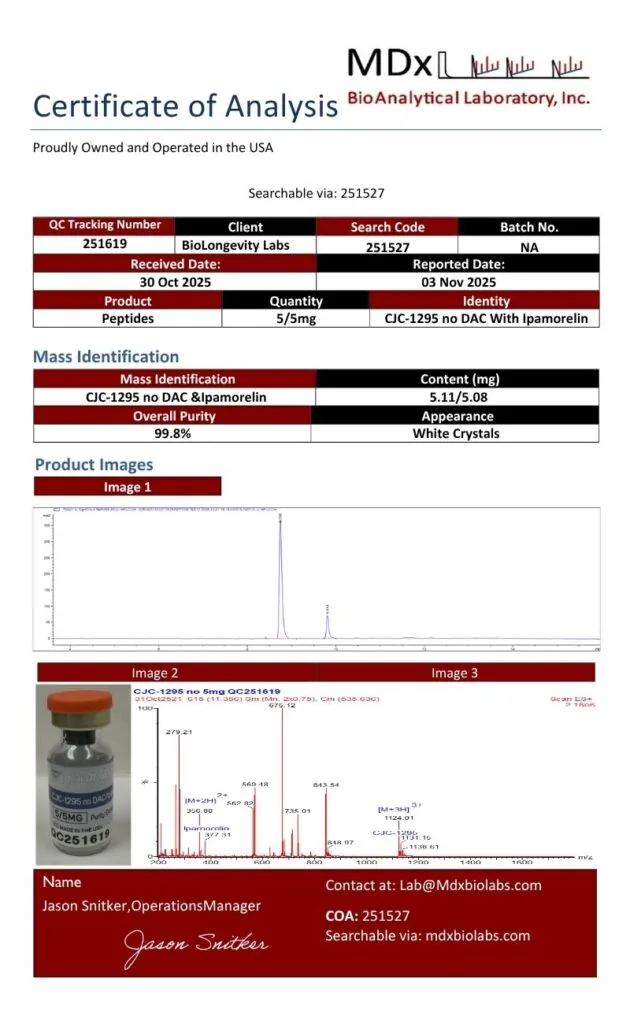
CJC-1295 no DAC & Ipamorelin (251527)
CJC-1295 no DAC / Ipamorelin
CJC-1295 no DAC / Ipamorelin
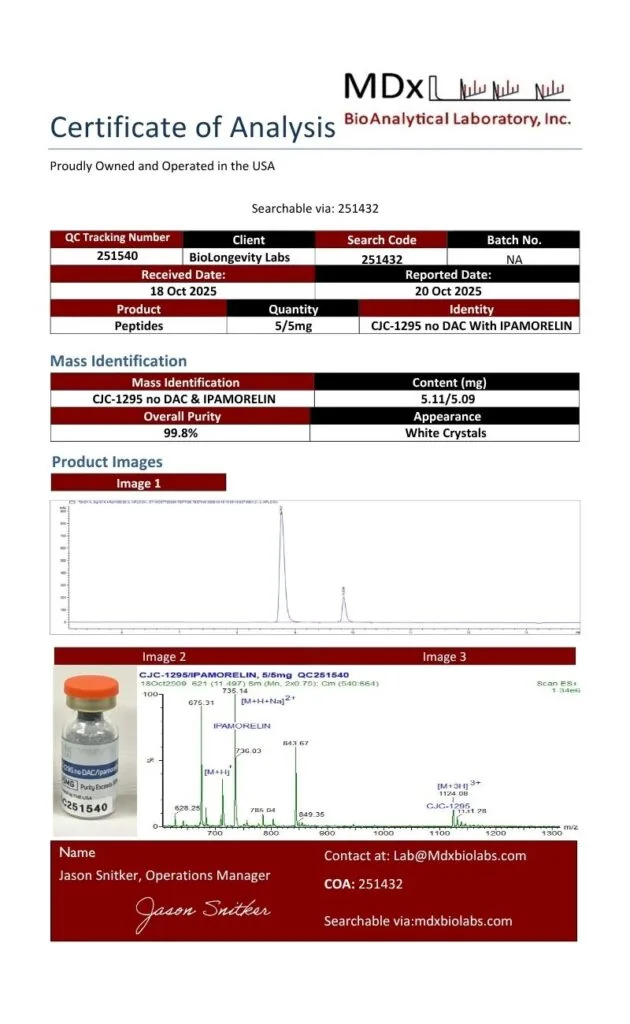
CJC-1295/IPAMORELIN(251432)
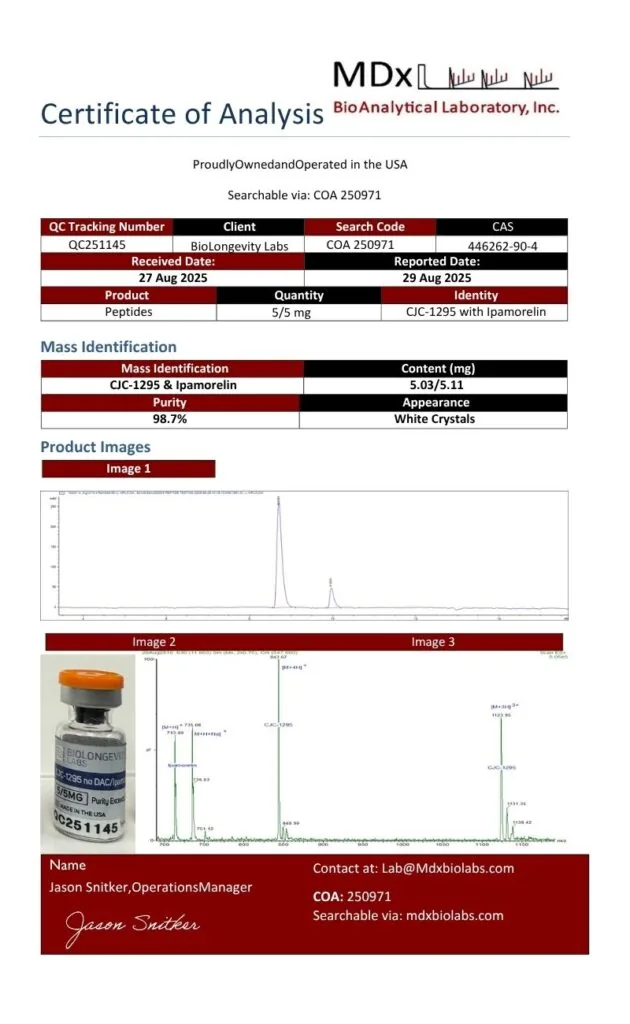
CJC-1295/Ipamorelin (250971)
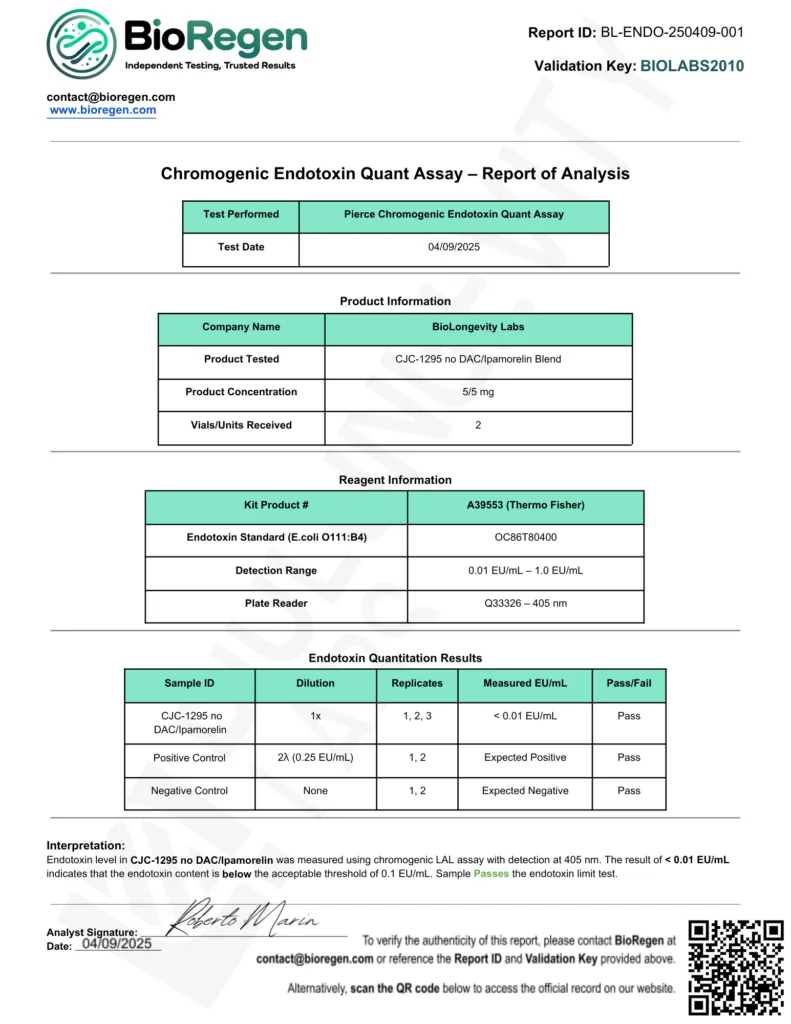
CJC-1295 no DAC/Ipamorelin Blend BL-ENDO-250409-001
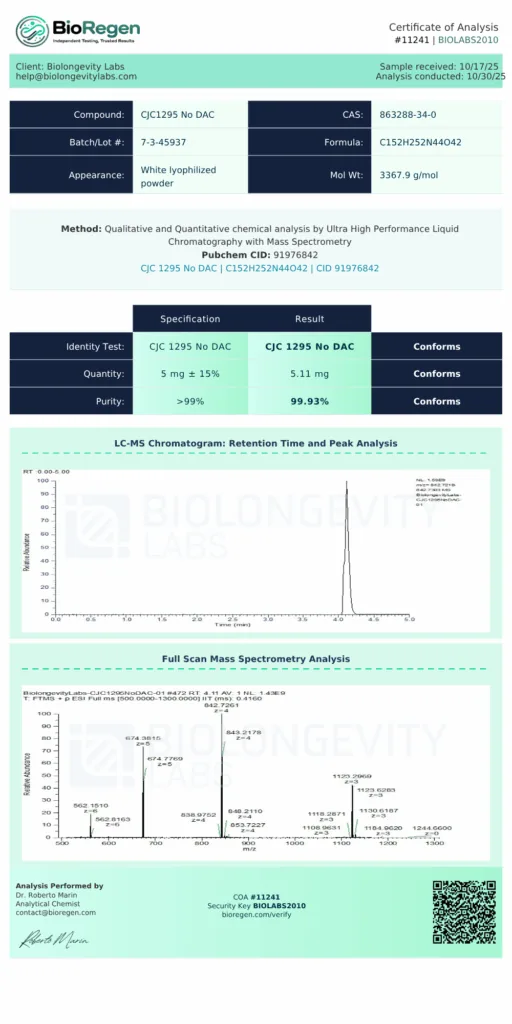
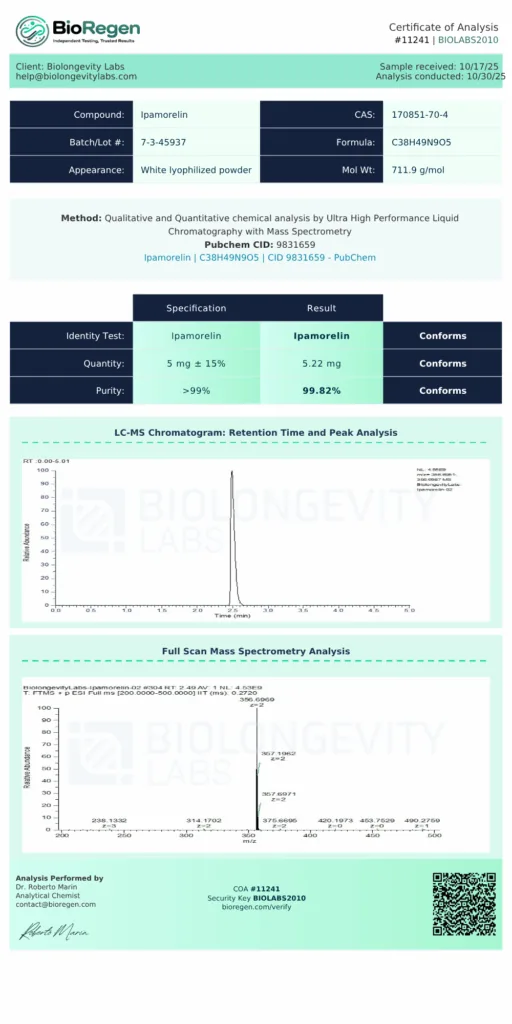
A Certificate of Analysis (COA) is a document that verifies a compound’s identity, purity and quality through independent laboratory testing. Every compound from BioLongevity Labs is third-party tested, and its COA is published here, so researchers can review the testing record before a compound enters a protocol.
Each COA reports results from third-party laboratory analysis, including:
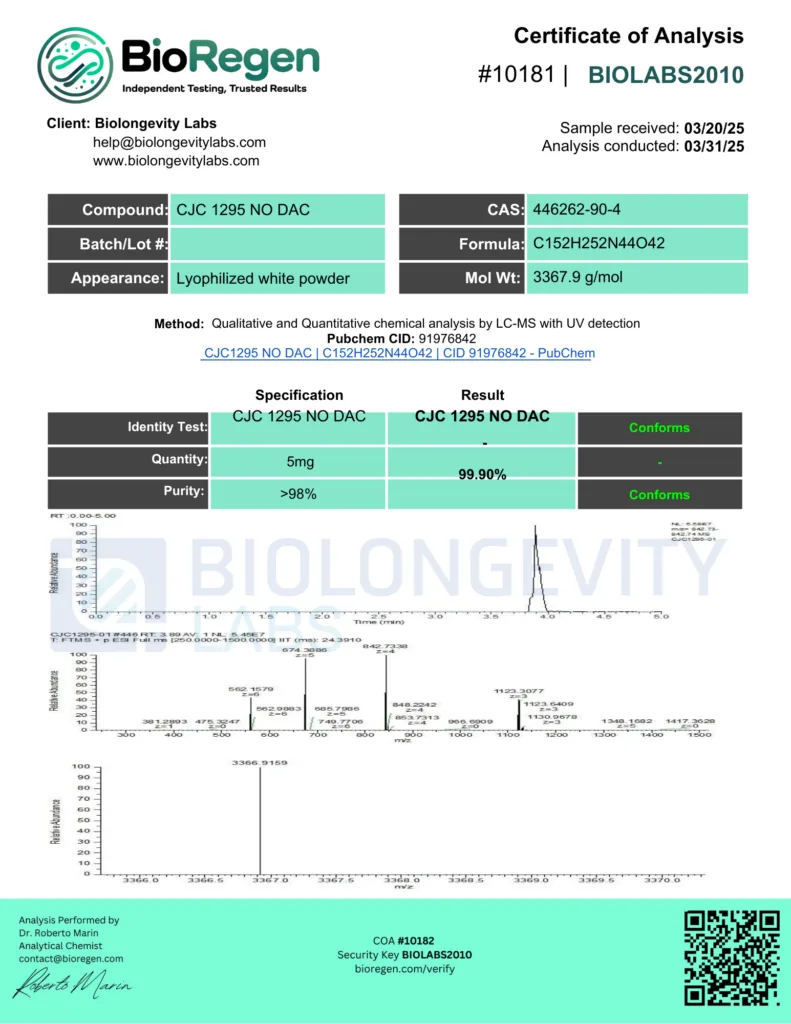
Ultra-high-performance liquid chromatography with mass spectrometry (UHPLC-MS) for purity, measured against a 98% or 99% specification depending on the compound
Mass identification for molecular confirmation and content quantitation
Endotoxin testing by Limulus amebocyte lysate (LAL) or recombinant Factor C (rFC) assay, depending on the laboratory
Visual and physical characterization of the finished material
How to Verify a COA Independently
You can check every certificate against the issuing laboratory’s own records, not just the copy hosted here. Verification does not depend on BioLongevity Labs.
AV Analytics certificates carry a search code. Scan the QR code on the certificate to open the laboratory’s verification page, or enter the search code at avanalytical.com/coa-search to pull the official record.
BioRegen reports of analysis carry a Report ID and a Validation Key. Scan the QR code on the certificate to open the official record, or quote both identifiers when you contact the laboratory at the address printed on the report.
SafeCert Labs issued a number of earlier certificates. Each one carries a COA number and the signature of the reporting chemist. Quote that number when you ask the laboratory to confirm it.
Older certificates from other laboratories list their own verification details on the document.
When a batch is sent to more than one laboratory, each certificate resolves at its own issuing laboratory. A researcher can then check the results against two unrelated sources.
These COAs come from independent certified laboratories, not in-house testing. That gives researchers a verifiable record of molecular integrity for each compound. All compounds are supplied for research use only.
Scientifically reviewed by Dr. Ky H. Le, MD. Dr. Le is a board-certified family medicine physician with over 20 years of clinical experience. Dr. Le validates the scientific accuracy of all technical content and research citations.
Disclaimer: For Research Purposes Only
This content is provided strictly for research purposes and does not constitute an endorsement or recommendation for the non-laboratory application or improper handling of peptides designed for research. The information, including discussions about specific peptides and their researched benefits, is presented for informational purposes only and must not be construed as health, clinical, or legal guidance, nor an encouragement for non-research use. Peptides described here are solely for use in structured scientific study by authorized individuals. We advise consulting with research experts, medical practitioners, or legal counsel prior to any decisions about obtaining or utilizing these peptides. The expectation of responsible, ethical utilization of this information for legitimate investigative and scholarly objectives is paramount. This notice is dynamic and governs all provided content on research peptides.