KLOW Blend Technical Overview
KLOW Blend is a co-formulated multi-peptide research article rather than a single chemical entity. Its name is an acronym assembled from the component designations, and each constituent retains its own CAS number, PubChem record, and published research literature. A blend of this kind is used in laboratory settings where more than one signaling pathway is being examined in parallel within the same experimental system.
The four components span three structural categories. GHK-Cu is a copper(II) coordination complex of the tripeptide glycyl-L-histidyl-L-lysine. BPC-157 and KPV are short linear peptides of fifteen and three residues respectively. The TB-500 component is a 43-residue acetylated polypeptide corresponding to the beta-thymosin sequence.
Because the components differ substantially in molecular weight, from 342 g/mol for KPV to roughly 4,963 g/mol for the beta-thymosin component, the specifications below are given per component rather than as a single averaged set of values. Researchers working with the blend should handle each constituent as a separate analyte for LC-MS and HPLC verification.
Compound Specifications
The blend-level summary applies to the vial as supplied. The four sub-tables below give verified identity data for each constituent as an individual chemical entity.
Blend-Level Summary
| Property | Value |
|---|---|
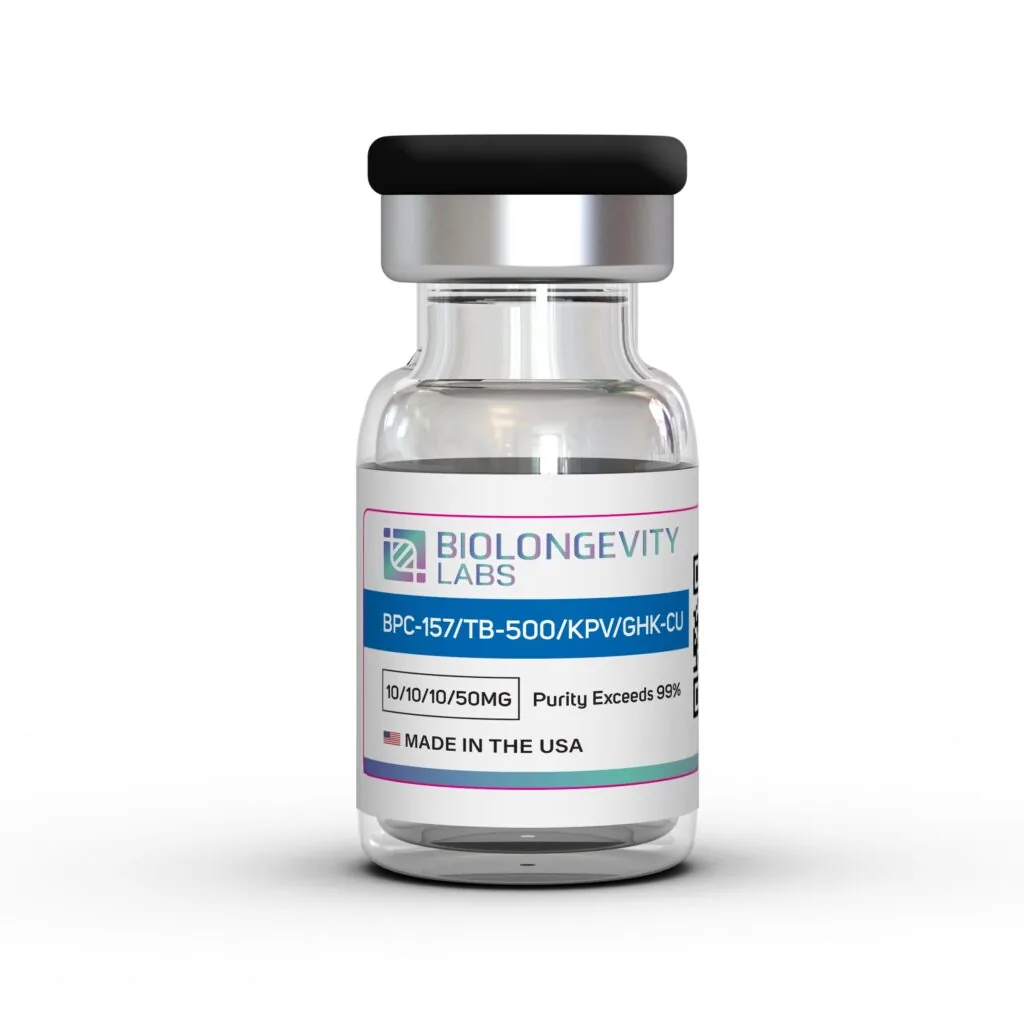
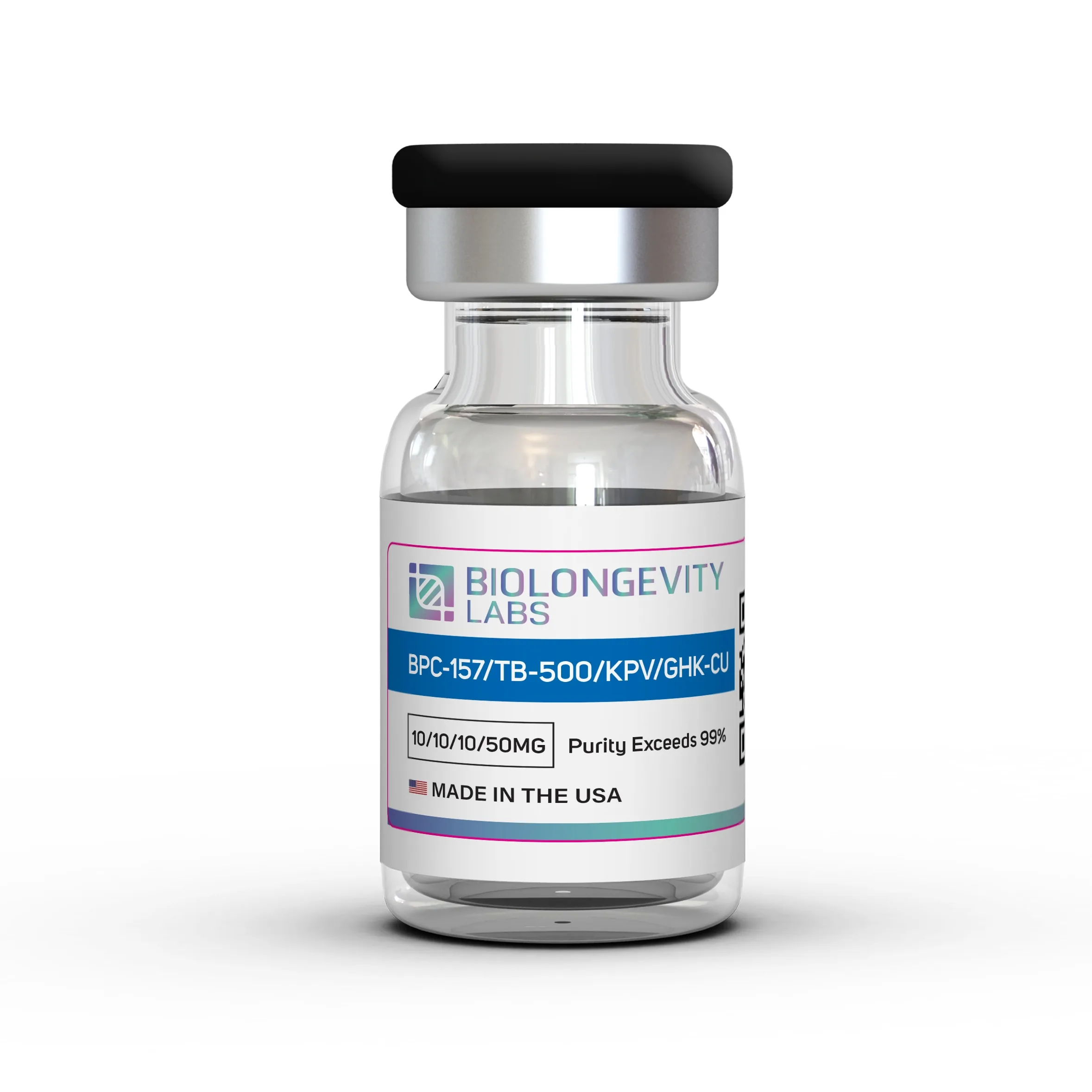
| Blend Composition | GHK-Cu 50 mg, BPC-157 10 mg, TB-500 10 mg, KPV 10 mg |
| Total Peptide Content Per Vial | 80 mg |
| Component Ratio (GHK-Cu : BPC-157 : TB-500 : KPV) | 5 : 1 : 1 : 1 |
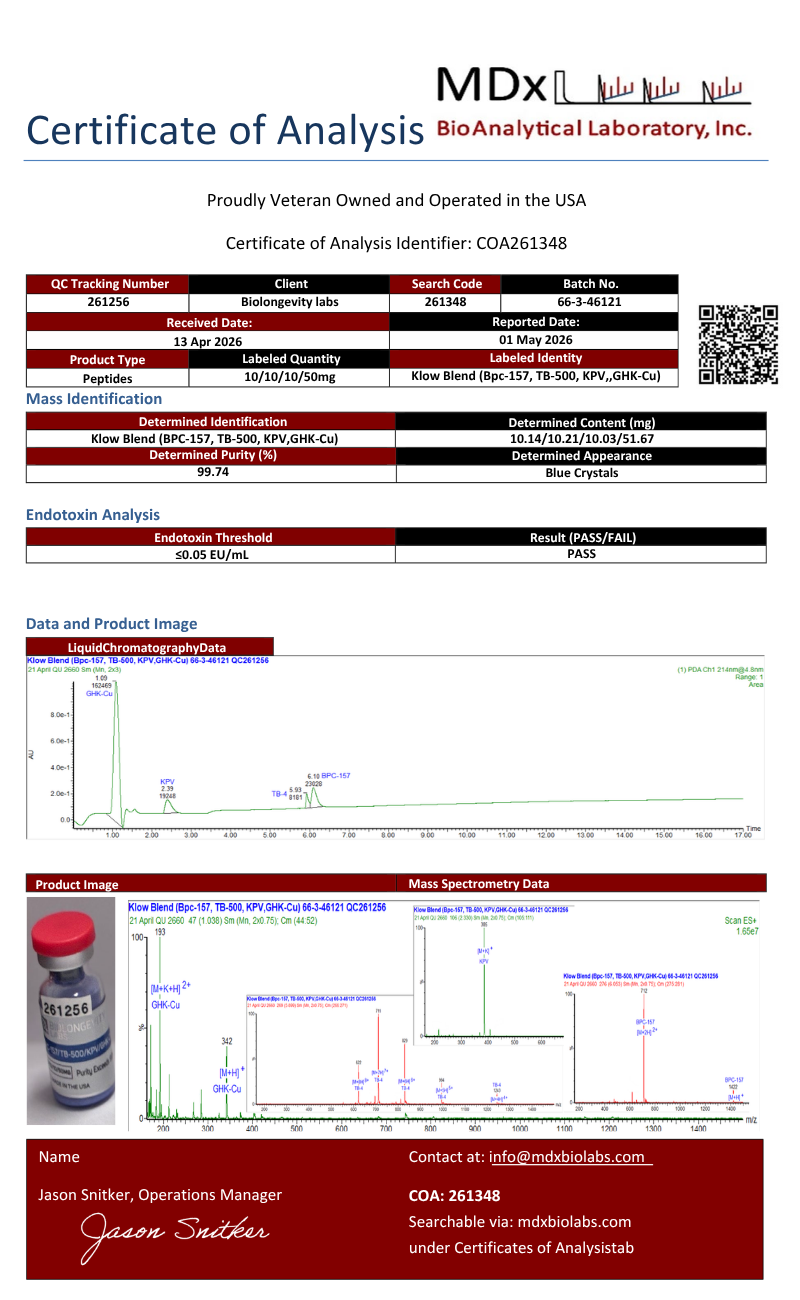
| Purity | ≥99% (HPLC), per component |
| Appearance | Lyophilized powder, blue to blue-violet tint contributed by the copper complex |
| Solubility | Soluble in water and in bacteriostatic water for laboratory reconstitution |
| Source | Synthetic (solid-phase peptide synthesis) |
| Storage | -20°C or below, protect from light |
GHK-Cu Specifications
| Property | Value |
|---|---|
| CAS Number | 89030-95-5 |
| PubChem CID | 139035031 |
| Molecular Formula | C₁₄H₂₁CuN₆O₄⁻ |
| Molecular Weight | 400.90 g/mol |
| Monoisotopic Mass | 400.0920 |
| InChIKey | LREZPQNYQZAPJC-ACMTZBLWSA-L |
| Amino Acid Sequence | Gly-His-Lys (GHK), copper(II) complex |
| Sequence Length | 3 residues |
| Free-Peptide Reference | GHK free tripeptide: CAS 49557-75-7, PubChem CID 73587, C₁₄H₂₄N₆O₄, 340.38 g/mol |
| Source | Synthetic |
| Synonyms | Copper tripeptide-1, GHK-Cu, copper peptide, Gly-His-Lys-Cu(II), prezatide copper (free peptide: prezatide, tripeptide-1) |
BPC-157 Specifications
| Property | Value |
|---|---|
| CAS Number | 137525-51-0 |
| PubChem CID | 9941957 |
| Molecular Formula | C₆₂H₉₈N₁₆O₂₂ |
| Molecular Weight | 1419.5 g/mol |
| Monoisotopic Mass | 1418.7042 |
| InChIKey | HEEWEZGQMLZMFE-RKGINYAYSA-N |
| Amino Acid Sequence | GEPPPGKPADDAGLV (Gly-Glu-Pro-Pro-Pro-Gly-Lys-Pro-Ala-Asp-Asp-Ala-Gly-Leu-Val) |
| Sequence Length | 15 residues |
| ChEMBL ID | CHEMBL4297358 |
| UNII | 8ED8NXK95P |
| Source | Synthetic |
| Synonyms | BPC 157, PL-14736, PLD-116, PL-10, bepecin, pentadecapeptide BPC 157 |
TB-500 Specifications
| Property | Value |
|---|---|
| CAS Number | 77591-33-4 |
| PubChem CID | 16132341 |
| Molecular Formula | C₂₁₂H₃₅₀N₅₆O₇₈S |
| Molecular Weight | 4963 g/mol |
| Monoisotopic Mass | 4960.4863 |
| Exact Mass | 4962.4930 |
| InChIKey | UGPMCIBIHRSCBV-XNBOLLIBSA-N |
| Amino Acid Sequence | Ac-SDKPDMAEIEKFDKSKLKKTETQEKNPLPSKETIEQEKQAGES-OH |
| Sequence Length | 43 residues |
| N-Terminal Modification | N-terminal acetylation |
| UNII | 2D5MRE3SSY |
| Source | Synthetic |
| Synonyms | Timbetasin, thymosin beta 4, Tβ4, TB4, Fx peptide, WHO 10716 |
KPV Specifications
| Property | Value |
|---|---|
| CAS Number | 67727-97-3 |
| PubChem CID | 125672 |
| Molecular Formula | C₁₆H₃₀N₄O₄ |
| Molecular Weight | 342.43 g/mol |
| Monoisotopic Mass | 342.2267 |
| InChIKey | YSPZCHGIWAQVKQ-AVGNSLFASA-N |
| Amino Acid Sequence | KPV (Lys-Pro-Val) |
| Sequence Length | 3 residues |
| ChEBI ID | CHEBI:160254 |
| Source | Synthetic |
| Synonyms | Lys-Pro-Val, alpha-MSH (11-13), ACTH (11-13), L-lysyl-L-prolyl-L-valine, tripeptide KPV |
Storage and Handling
- Store the lyophilized blend at -20°C or below, protected from light.
- After reconstitution with a sterile laboratory solvent, store aliquots at -20°C or below and use promptly.
- Aliquot before freezing to avoid repeated freeze-thaw cycles across the four components.
- Maintain aseptic handling to preserve compound integrity.
Lyophilized Format
This compound ships in lyophilized (freeze-dried) form. Freeze-drying supports long-term storage stability and preserves compound integrity. No fillers are added.
Research Use Disclaimer
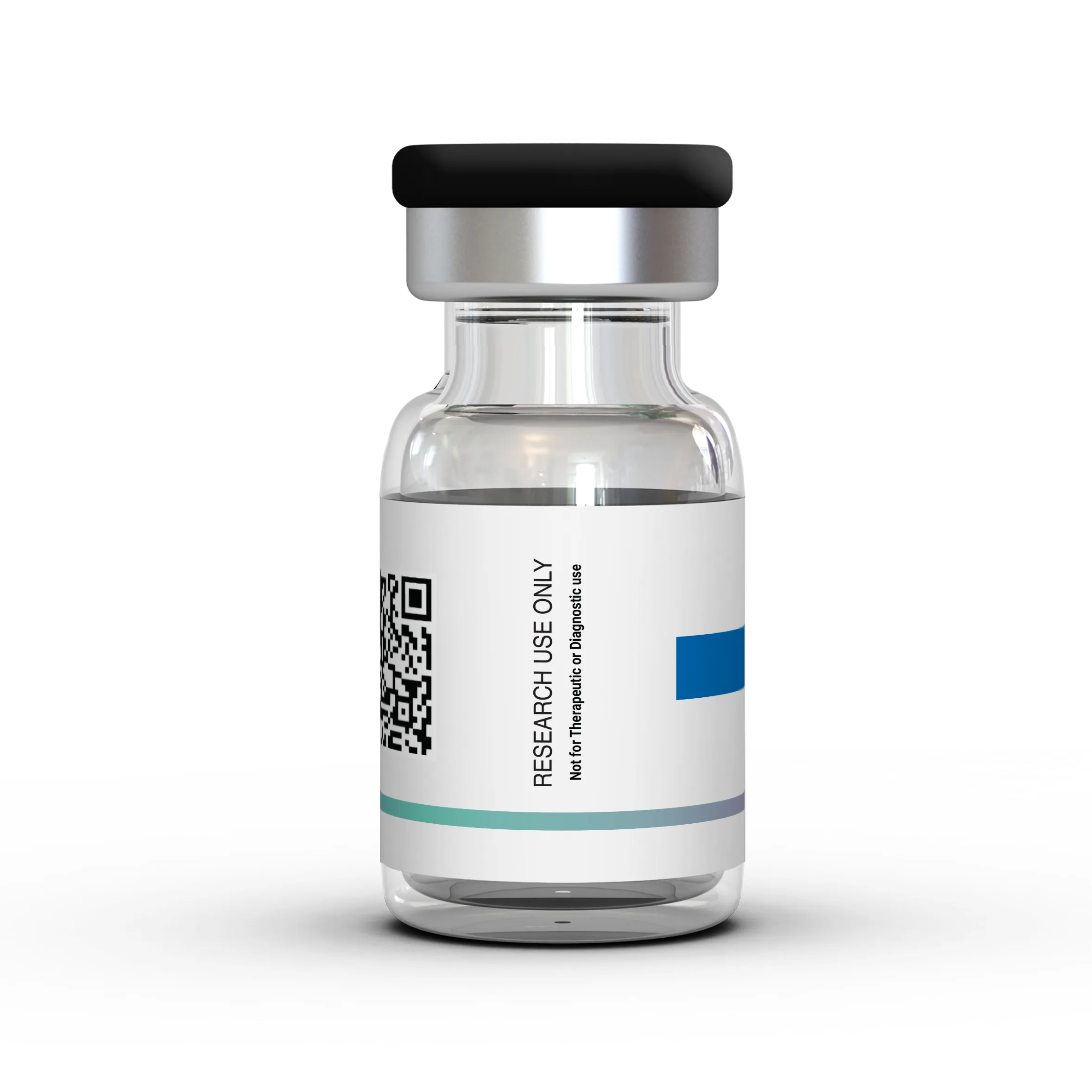
KLOW Blend is supplied for research use only. It is not a drug, food, cosmetic, or dietary supplement and has not been evaluated by the FDA. By purchasing, the buyer confirms the compound will be used solely for in vitro research.
Frequently Asked Questions
What Is KLOW Blend Made Of?
KLOW Blend contains four separately synthesized peptides in one vial: 50 mg GHK-Cu, 10 mg BPC-157, 10 mg TB-500, and 10 mg KPV, for 80 mg of total peptide content. Each component is supplied at ≥99% purity by HPLC and carries its own CAS number and PubChem record.
Which Entity Does the TB-500 Component Refer To?
The TB-500 component in KLOW Blend is the 43-residue acetylated beta-thymosin polypeptide, CAS 77591-33-4, PubChem CID 16132341. Its N-terminal tetrapeptide Ac-SDKP is a separate research entity that is generated from this sequence by prolyl oligopeptidase cleavage.
What Are the Molecular Weights of the KLOW Blend Components?
The four components range from 342.43 g/mol for KPV and 400.90 g/mol for GHK-Cu up to 1419.5 g/mol for BPC-157 and roughly 4,963 g/mol for the TB-500 component. Because the range is wide, each constituent is confirmed as a separate analyte during mass-spectrometric verification.
How Should KLOW Blend Be Stored in a Laboratory Setting?
KLOW Blend is stored lyophilized at -20°C or below and protected from light. Reconstituted material is aliquoted and kept at -20°C or below so that the four components are not subjected to repeated freeze-thaw cycles.
Why Is KLOW Blend Blue in Color?
The blue to blue-violet tint comes from the GHK-Cu component, which is a copper(II) coordination complex of the tripeptide glycyl-L-histidyl-L-lysine. The other three components are colorless peptides and do not contribute to the tint.