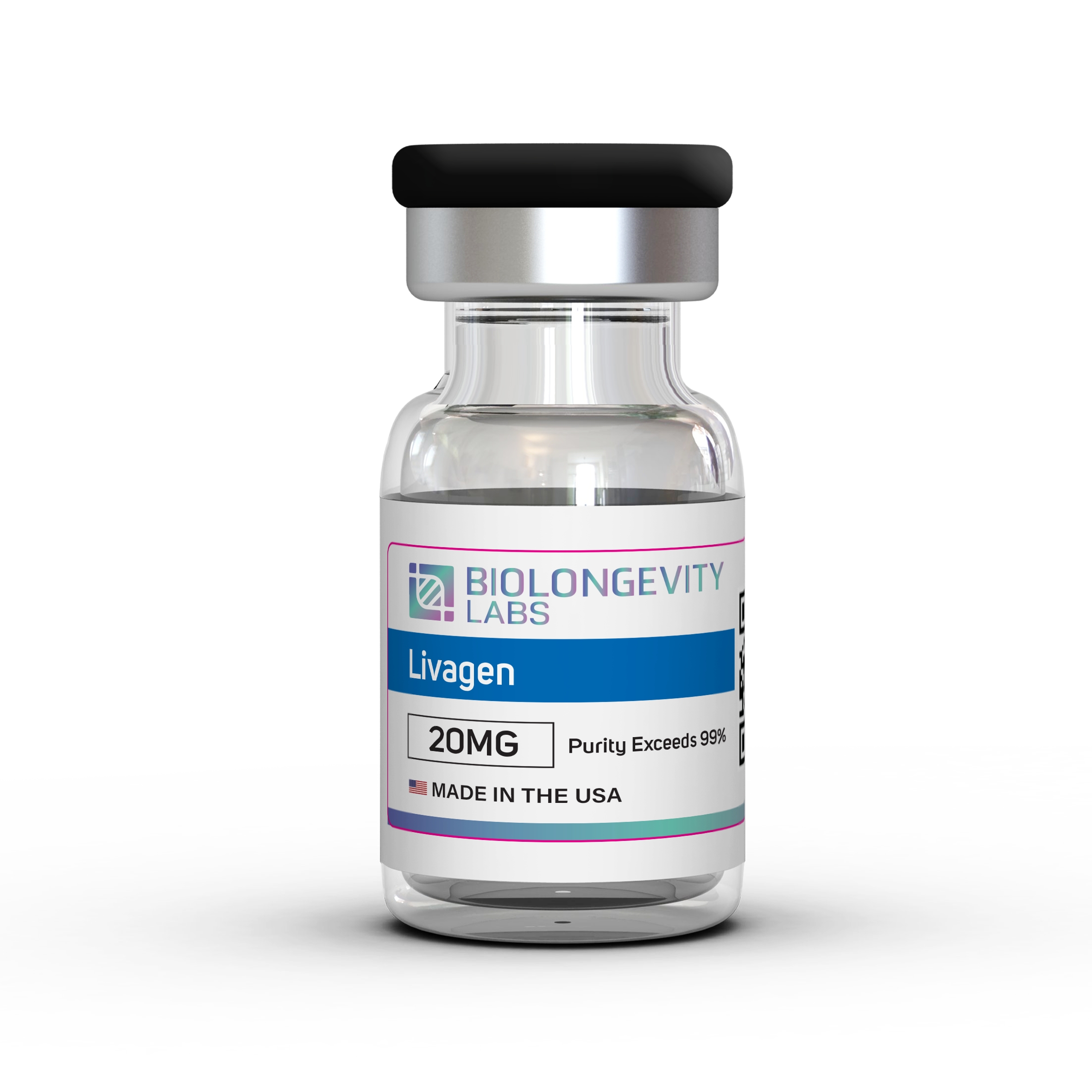
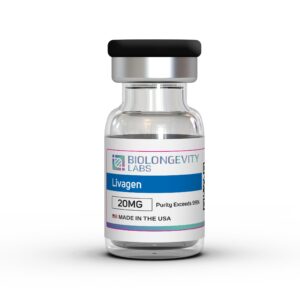
Livagen Khavinson Short Peptide Bioregulator
Livagen sits within the short peptide bioregulator class described by Khavinson and colleagues, in which peptides of two to four residues are examined for interactions with DNA sequences and nucleosomal proteins [8]. Its four residues carry three carboxyl groups against a single primary amine, giving the molecule a strongly anionic character at neutral pH.
The tetrapeptide was designed from the amino acid composition of liver-tissue peptide complexes, and organotypic culture work has grouped it with tissue-directed peptides rather than broadly acting ones [5]. Laboratory interest centers on how a molecule of this size associates with condensed chromatin regions.
Compound Specifications
| Property |
Value |
| CAS Number |
433257-50-2 |
| PubChem CID |
87919683 |
| Molecular Formula |
C₁₈H₃₁N₅O₉ |
| Molecular Weight |
461.5 g/mol |
| Monoisotopic Mass |
461.21218 Da |
| Amino Acid Sequence |
H-Lys-Glu-Asp-Ala-OH (KEDA) |
| Sequence Length |
4 residues |
| Source |
Synthetic |
| InChIKey |
IKVDKWACACMDLR-BJDJZHNGSA-N |
| Canonical SMILES |
CC(C(=O)O)NC(=O)C(CC(=O)O)NC(=O)C(CCC(=O)O)NC(=O)C(CCCCN)N |
| Purity |
≥99% (HPLC) |
| Appearance |
Lyophilized white powder |
| Solubility |
Soluble in water |
| Storage |
-20°C, protect from light |
Storage and Handling
- Store the lyophilized compound at -20°C, protected from light.
- After reconstitution, store at 2-8°C and use promptly.
- Avoid repeated freeze-thaw cycles of reconstituted material.
- Maintain aseptic handling to preserve compound integrity.
Lyophilized Format
This compound ships in lyophilized (freeze-dried) form. Freeze-drying supports long-term storage stability and preserves compound integrity. No fillers are added.
Livagen Research
In cultured lymphocytes drawn from donors aged 75 to 88 years, Livagen was reported to activate ribosomal genes and decondense densely packed chromatin fibrils [1]. The same work described release of genes repressed by age-related condensation of euchromatic chromosome regions [1].
A comparison across five short peptides placed Livagen with Epitalon among the sequences associated with decondensation of pericentromeric structural chromatin on chromosomes 1 and 9 [2]. Later differential scanning calorimetry and cytogenetic work reported that each bioregulator acted on defined chromosomal regions rather than uniformly across the genome [4].
Lezhava and Jokhadze examined lymphocyte cultures exposed to cobalt chloride with and without Livagen, and reported a shift in sister chromatid exchange distribution toward telomeric heterochromatin under the combined condition [3].
Two further research threads sit outside the chromatin work and are worth separating out.
Tissue Explant and Peptidase Research Threads
Organotypic rat liver culture exposed to the tetrapeptide was assessed by immunocytochemical and morphometric analysis, with reported changes in cell-population morphology and markers of cellular regeneration [6]. This organ-directed pattern matches the tissue-specific outgrowth results reported for the same peptide family in explant culture [5].
In serum enzyme assays, Livagen was characterized as an inhibitor of enkephalin-degrading enzyme activity in vitro, with a reported IC50 near 20 µM, and showed no measurable interaction with mu- or delta-opioid receptors in rat brain membrane fractions [7].
| Research Area |
In Vitro Application |
| Chromatin Structure |
Measurement of heterochromatin decondensation in cultured lymphocytes |
| Ribosomal Gene Activity |
Silver staining of nucleolus organizer regions in aged-donor cell cultures |
| Cytogenetic Analysis |
Sister chromatid exchange distribution mapping under metal-ion exposure |
| Tissue Explant Models |
Organotypic liver culture morphology and cell-population studies |
| Peptidase Screening |
In vitro assays against enkephalin-degrading serum enzymes |
| Comparative Peptide Panels |
Side-by-side evaluation with Epitalon, Vilon, and Cortagen sequences |
References
- Khavinson VK, Lezhava TA, Monaselidze JG, et al. (2002). Effects of Livagen Peptide on Chromatin Activation in Lymphocytes from Old People. Bulletin of Experimental Biology and Medicine, 134(4), 389-392. https://link.springer.com/article/10.1023/A:1021924702103
- Khavinson VK, Lezhava TA, Malinin VV (2004). Effects of Short Peptides on Lymphocyte Chromatin in Senile Subjects. Bulletin of Experimental Biology and Medicine, 137(1), 78-81. https://link.springer.com/article/10.1023/B:BEBM.0000024393.40560.05
- Lezhava T, Jokhadze T (2007). Activation of Pericentromeric and Telomeric Heterochromatin in Cultured Lymphocytes from Old Individuals. Annals of the New York Academy of Sciences, 1100, 387-399. https://nyaspubs.onlinelibrary.wiley.com/doi/10.1196/annals.1395.043
- Lezhava T, Jokhadze T, Monaselidze J, et al. (2020). Epigenetic Modification Under the Influence of Peptide Bioregulators on “Aged” Heterochromatin. Georgian Medical News, (309), 120-124. https://pubmed.ncbi.nlm.nih.gov/33526740/
- Khavinson VK (2001). Tissue-Specific Effects of Peptides. Bulletin of Experimental Biology and Medicine, 132(2), 807-808. https://link.springer.com/article/10.1023/A:1013058701974
- Riadnova IIu, Filippov SV, Iuzhakov VV (2002). Functional Morphology of an Organotypic Liver Culture Exposed to the Peptide Livagen. Advances in Gerontology, 10, 88-94. https://pubmed.ncbi.nlm.nih.gov/12577697/
- Kost NV, Sokolov OIu, Gabaeva MV, et al. (2003). Effect of New Peptide Bioregulators Livagen and Epitalon on Enkephalin-Degrading Enzymes in Human Serum. Izvestiia Akademii Nauk. Seriia Biologicheskaia, (4), 427-429. https://pubmed.ncbi.nlm.nih.gov/12942748/
- Khavinson VK, Popovich IG, Linkova NS, Mironova ES, Ilina AR (2021). Peptide Regulation of Gene Expression: A Systematic Review. Molecules, 26(22), 7053. https://pmc.ncbi.nlm.nih.gov/articles/PMC8619776/
Certificate of Analysis (COA) for Every Batch
A Certificate of Analysis (COA) is a document that verifies a compound’s identity, purity, and batch quality through independent laboratory testing. Every compound from BioLongevity Labs ships with a COA tied to its specific batch, so researchers can confirm exactly what they received before it enters a protocol.
Each COA reports results from third-party laboratory analysis, including:
- Ultra-high-performance liquid chromatography with mass spectrometry (UHPLC-MS) for purity, typically confirmed at 99% or higher
- Mass identification for molecular confirmation and content quantitation
- Endotoxin quantitation by Limulus amebocyte lysate (LAL) assay where applicable
- Visual and physical characterization of the finished material
How to verify a COA independently
Every certificate can be checked against the issuing laboratory’s own records, not just the copy hosted here. Verification does not depend on BioLongevity Labs.
- MDx BioAnalytical Laboratory certificates carry a QC tracking number and a search code. Newer certificates also carry a QR code. Scan the code, or enter the search code at mdxbiolabs.com, to pull the official record.
- BioRegen reports of analysis carry a Report ID and a Validation Key. Scan the QR code on the certificate to open the official record, or reference both identifiers when contacting the laboratory at the address printed on the report.
- SafeCert Labs certificates, which appear on a number of earlier batches, carry a COA number and the signature of the reporting chemist. Reference that number when requesting confirmation from the laboratory directly.
Batches are frequently tested by both laboratories independently. When two certificates exist for the same lot, each one resolves at its own issuing laboratory, which lets a researcher confirm the same material twice through two unrelated sources.
COAs are sourced from independent certified labs rather than in-house testing alone, giving researchers a verifiable record of molecular integrity for each batch. All compounds are supplied for research use only.
Review the COAs for this batch below, or browse the full COA library.
Livagen (12098)

Livagen (260261)

Endotoxin Livagen

Livagen (251517)

Livagen (251517E)

×
![]()