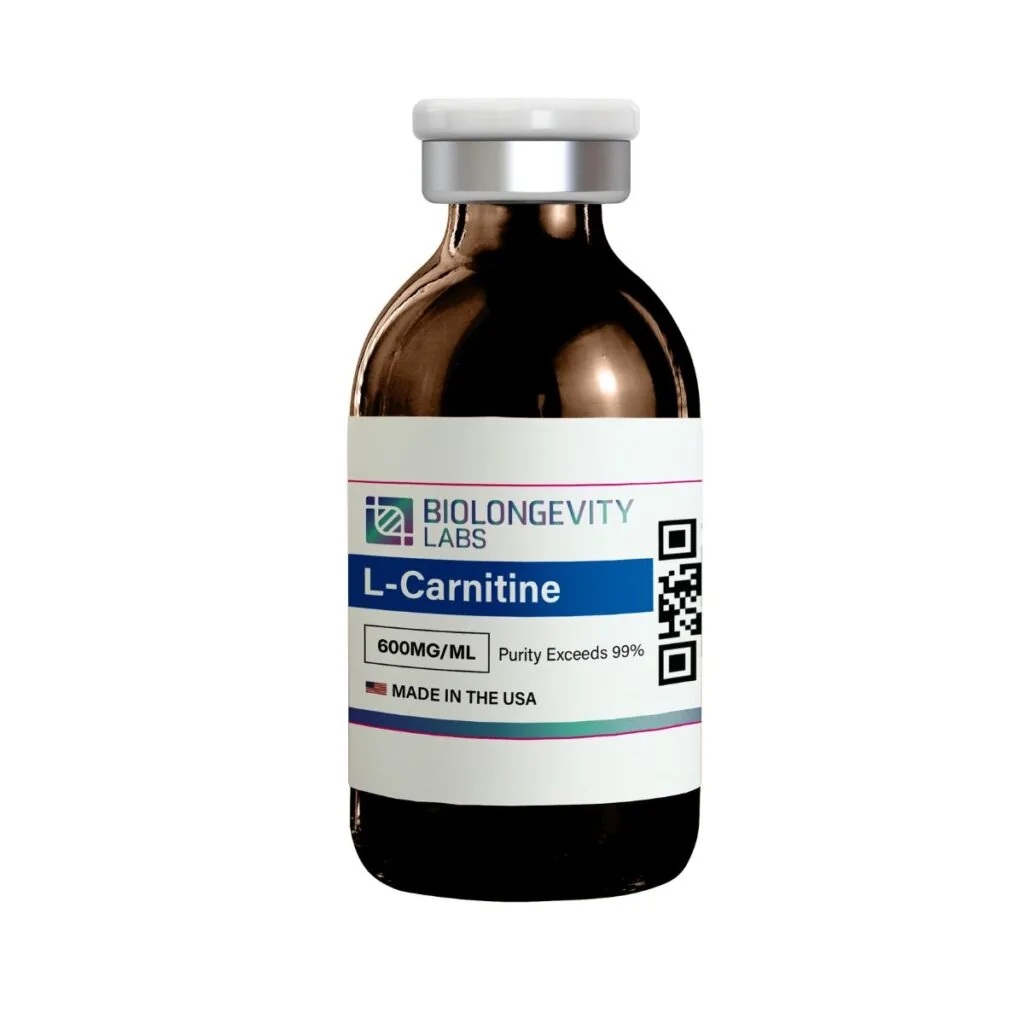
L-Carnitine Technical Overview
L-Carnitine, also indexed as levocarnitine, is the (R)-enantiomer of 3-hydroxy-4-(trimethylammonio)butanoate. It is a small molecule rather than a peptide, with a molecular weight of 161.20 g/mol and no amino acid sequence.
Structurally, it is a quaternary ammonium betaine. The positively charged trimethylammonium group and the negatively charged carboxylate give it a zwitterionic form, and the hydroxyl group at carbon 3 is where acyl groups attach to form acylcarnitine esters.
In L-Carnitine research, the free compound is often labeled C0 to separate it from its acylcarnitine esters. Laboratory work centers on its role as the acyl carrier of the carnitine shuttle, its transport across cell and mitochondrial membranes, and its use in acylcarnitine profiling.
Compound Specifications
| Property |
Value |
| CAS Number |
541-15-1 |
| PubChem CID |
10917 |
| Molecular Formula |
C₇H₁₅NO₃ |
| Molecular Weight |
161.20 g/mol |
| Monoisotopic / Exact Mass |
161.1052 Da |
| Chemical Name (IUPAC) |
(3R)-3-hydroxy-4-(trimethylazaniumyl)butanoate |
| Compound Class |
Quaternary ammonium betaine (amino acid derivative), zwitterionic small molecule |
| Stereochemistry |
(R)-enantiomer (L-form) |
| Synonyms |
Levocarnitine, (R)-Carnitine, L-(-)-Carnitine, (R)-3-hydroxy-4-(trimethylammonio)butanoate, γ-trimethyl-β-hydroxybutyrobetaine |
| InChIKey |
PHIQHXFUZVPYII-ZCFIWIBFSA-N |
| Canonical SMILES |
C[N+](C)(C)CC(CC(=O)[O-])O |
| Isomeric SMILES |
C[N+](C)(C)C[C@@H](CC(=O)[O-])O |
| ChEMBL ID |
CHEMBL1149 |
| UNII |
0G389FZZ9M |
| Concentration |
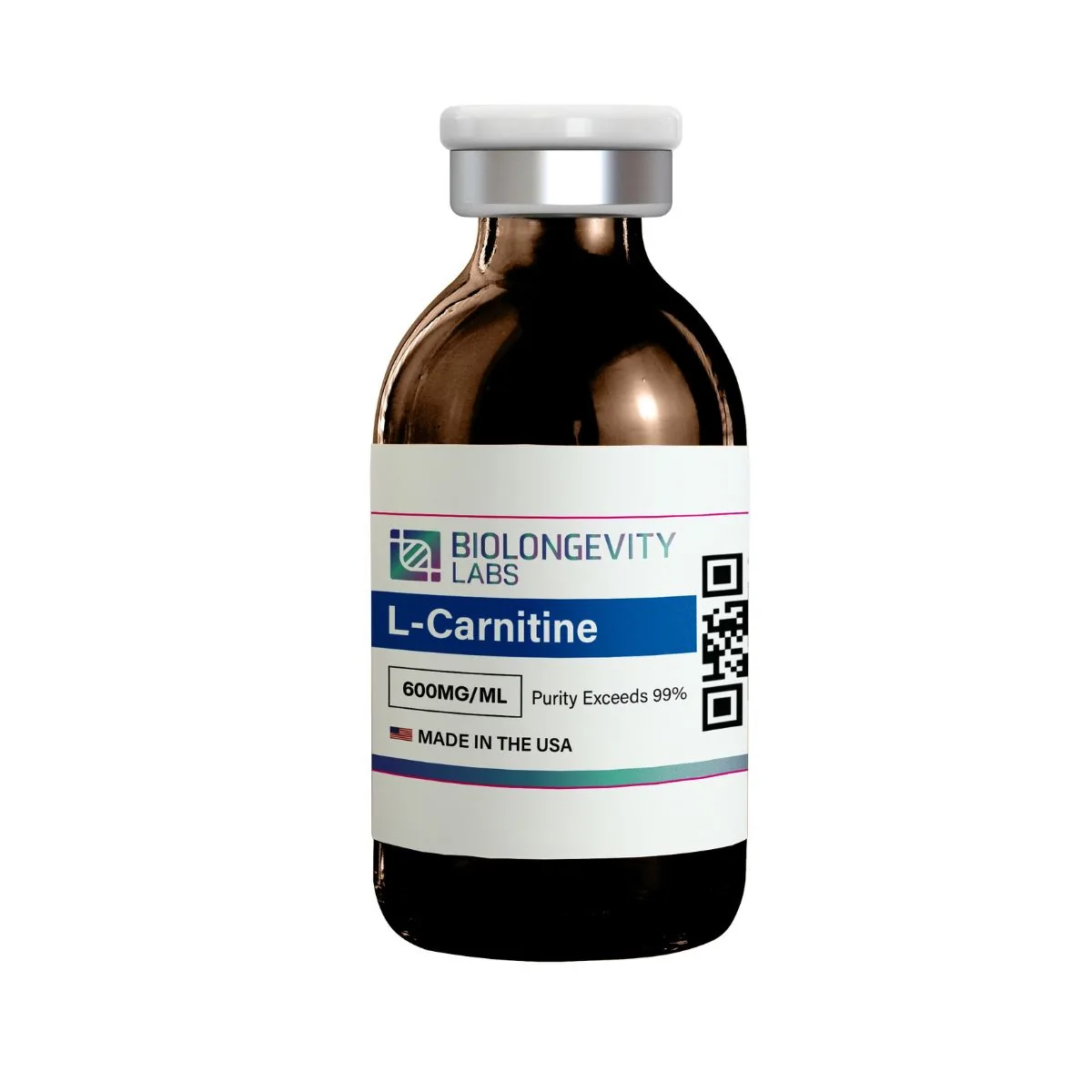
600mg/mL (labeled) |
| Purity |
≥99% (HPLC) |
| Appearance |
Solution in a sealed amber glass vial |
| Solubility |
Freely soluble in water |
| Storage |
Controlled room temperature (20 to 25°C), protect from light, do not freeze |
Storage and Handling
- Store the sealed vial at controlled room temperature (20 to 25°C), protected from light.
- Do not freeze.
- After opening, keep the vial closed, refrigerate at 2 to 8°C and use promptly.
- Maintain aseptic handling to preserve compound integrity.
Solution Format
L-Carnitine 600mg/mL is supplied as a solution rather than a lyophilized (freeze-dried) powder. Its concentration is stated on the vial label in mg/mL, so volumes can be measured directly for laboratory work.
Research Use Disclaimer
L-Carnitine is supplied for research use only. It is not a drug, food, cosmetic, or dietary supplement and has not been evaluated by the FDA. By purchasing, the buyer confirms the compound will be used solely for in vitro research.
Frequently Asked Questions
Is L-Carnitine a Peptide?
L-Carnitine is not a peptide. It is a small-molecule quaternary ammonium compound with the formula C7H15NO3 and a molecular weight of 161.20 g/mol, so it has no amino acid sequence.
What Is L-Carnitine Studied for in Research?
L-Carnitine is studied as the acyl carrier of the carnitine shuttle, in which CPT1, the carnitine/acylcarnitine carrier and CPT2 move long-chain fatty acids into mitochondria for β-oxidation. It is also used in acylcarnitine profiling and in in vitro and rodent metabolic models.
What Is the CAS Number for L-Carnitine?
L-Carnitine (levocarnitine) is registered under CAS number 541-15-1 and PubChem CID 10917. Its InChIKey, PHIQHXFUZVPYII-ZCFIWIBFSA-N, specifies the (R) configuration that separates it from D-carnitine.
How Should L-Carnitine 600mg/mL Be Stored?
L-Carnitine 600mg/mL should be kept sealed at controlled room temperature (20 to 25°C), protected from light and never frozen. Once opened, the vial should be refrigerated at 2 to 8°C and used promptly.
How Is L-Carnitine Purity Verified?
L-Carnitine is tested by an independent third-party laboratory against a ≥99% purity specification by HPLC. Certificates of Analysis are published online so researchers can review them before ordering.
Research Overview
L-Carnitine is characterized in research as the acyl carrier of the carnitine shuttle, the route that moves long-chain fatty acids into the mitochondrial matrix for β-oxidation. Carnitine palmitoyltransferase 1 (CPT1) on the outer mitochondrial membrane transfers the acyl group from acyl-CoA to carnitine, and CPT2 on the inner membrane transfers it back to coenzyme A inside the matrix [1].
Three tissue-specific CPT1 isoforms, CPT1A, CPT1B and CPT1C, have been described, while CPT2 is expressed across tissues [1].
Between the two enzymes, the carnitine/acylcarnitine carrier (CAC, SLC25A20) imports acylcarnitine into the matrix in exchange for free carnitine [2]. Studies using purified CAC reconstituted into proteoliposomes, cross-linking reagents and comparative modelling have examined its transport mechanism and its capacity to form transient dimers [3].
Cells accumulate carnitine through OCTN2, a high-affinity organic cation transporter encoded by SLC22A5, and carnitine uptake in cultured fibroblasts is a standard laboratory measure of its activity [4]. Mammalian cells also synthesize carnitine from trimethyllysine, a pathway characterized in detail in rat models [5].
Two further research threads build on this shuttle biology.
Acylcarnitine Profiling
Because carnitine accepts acyl groups from acyl-CoA, the pattern of acylcarnitines in plasma and tissue reflects the state of mitochondrial acyl-CoA pools [6]. Long-chain acylcarnitine levels rise in blood and muscle when fuel flux outpaces mitochondrial capacity, and researchers are examining whether these esters act as modulators of cell metabolism in their own right [6].
Rodent and Cell Metabolic Models
In rats fed a high-fat diet for 12 months, lower carnitine status coincided with acylcarnitine accumulation in skeletal muscle, more incomplete β-oxidation and impaired switching from fatty acid to pyruvate oxidation [7]. Eight weeks of dietary carnitine reversed these mitochondrial readouts in the same model [7].
Carnitine acetyltransferase (CrAT) converts acetyl-CoA to membrane-permeant acetylcarnitine, which lets excess acetyl groups leave the mitochondria. Muscle-specific Crat knockout mice showed impaired substrate switching, which places carnitine-dependent acetyl buffering at the center of metabolic flexibility research [8].
| Research Area |
In Vitro Application |
| Fatty Acid Oxidation |
CPT1-dependent long-chain fatty acid oxidation assays in isolated mitochondria and cultured cells |
| Membrane Transport |
Carnitine uptake assays for OCTN2 (SLC22A5) and exchange assays for reconstituted CAC (SLC25A20) |
| Acylcarnitine Profiling |
Free carnitine (C0) and acylcarnitine measurement in LC-MS/MS metabolite panels |
| Acetyl Group Buffering |
CrAT-dependent acetylcarnitine formation and acetyl-CoA to free CoA balance |
| Biosynthesis |
Enzyme studies of the trimethyllysine to carnitine pathway |
References
- Bonnefont JP, Djouadi F, Prip-Buus C, Gobin S, Munnich A, Bastin J. (2004). Carnitine palmitoyltransferases 1 and 2: biochemical, molecular and medical aspects. Molecular Aspects of Medicine. https://doi.org/10.1016/j.mam.2004.06.004
- Giangregorio N, Tonazzi A, Console L, Indiveri C. (2026). Structure/function relationships of mitochondrial protein carrier (SLC25A20) for carnitine/acylcarnitine: A review. Biochimica et Biophysica Acta (BBA) – Biomembranes. https://doi.org/10.1016/j.bbamem.2026.184524
- Giangregorio N, Tonazzi A, Pierri CL, Indiveri C. (2024). Insights into Transient Dimerisation of Carnitine/Acylcarnitine Carrier (SLC25A20) from Sarkosyl/PAGE, Cross-Linking Reagents, and Comparative Modelling Analysis. Biomolecules. https://doi.org/10.3390/biom14091158
- Longo N, Frigeni M, Pasquali M. (2016). Carnitine transport and fatty acid oxidation. Biochimica et Biophysica Acta. https://doi.org/10.1016/j.bbamcr.2016.01.023
- Vaz FM, Wanders RJA. (2002). Carnitine biosynthesis in mammals. Biochemical Journal. https://doi.org/10.1042/0264-6021:3610417
- McCoin CS, Knotts TA, Adams SH. (2015). Acylcarnitines–old actors auditioning for new roles in metabolic physiology. Nature Reviews Endocrinology. https://doi.org/10.1038/nrendo.2015.129
- Noland RC, Koves TR, Seiler SE, et al. (2009). Carnitine insufficiency caused by aging and overnutrition compromises mitochondrial performance and metabolic control. Journal of Biological Chemistry. https://doi.org/10.1074/jbc.M109.032888
- Muoio DM, Noland RC, Kovalik JP, et al. (2012). Muscle-specific deletion of carnitine acetyltransferase compromises glucose tolerance and metabolic flexibility. Cell Metabolism. https://doi.org/10.1016/j.cmet.2012.04.005
Certificate of Analysis (COA)
No COAs available for this product.
A Certificate of Analysis (COA) is a document that verifies a compound’s identity, purity and quality through independent laboratory testing. Every compound from BioLongevity Labs is third-party tested, and its COA is published here, so researchers can review the testing record before a compound enters a protocol.
Each COA reports results from third-party laboratory analysis, including:
- Ultra-high-performance liquid chromatography with mass spectrometry (UHPLC-MS) for purity, measured against a 98% or 99% specification depending on the compound
- Mass identification for molecular confirmation and content quantitation
- Endotoxin testing by Limulus amebocyte lysate (LAL) or recombinant Factor C (rFC) assay, depending on the laboratory
- Visual and physical characterization of the finished material
How to Verify a COA Independently
You can check every certificate against the issuing laboratory’s own records, not just the copy hosted here. Verification does not depend on BioLongevity Labs.
- AV Analytics certificates carry a search code. Scan the QR code on the certificate to open the laboratory’s verification page, or enter the search code at avanalytical.com/coa-search to pull the official record.
- BioRegen reports of analysis carry a Report ID and a Validation Key. Scan the QR code on the certificate to open the official record, or quote both identifiers when you contact the laboratory at the address printed on the report.
- SafeCert Labs issued a number of earlier certificates. Each one carries a COA number and the signature of the reporting chemist. Quote that number when you ask the laboratory to confirm it.
- Older certificates from other laboratories list their own verification details on the document.
When a batch is sent to more than one laboratory, each certificate resolves at its own issuing laboratory. A researcher can then check the results against two unrelated sources.
These COAs come from independent certified laboratories, not in-house testing. That gives researchers a verifiable record of molecular integrity for each compound. All compounds are supplied for research use only.
Review the latest COAs for this product below, or browse the full COA library.