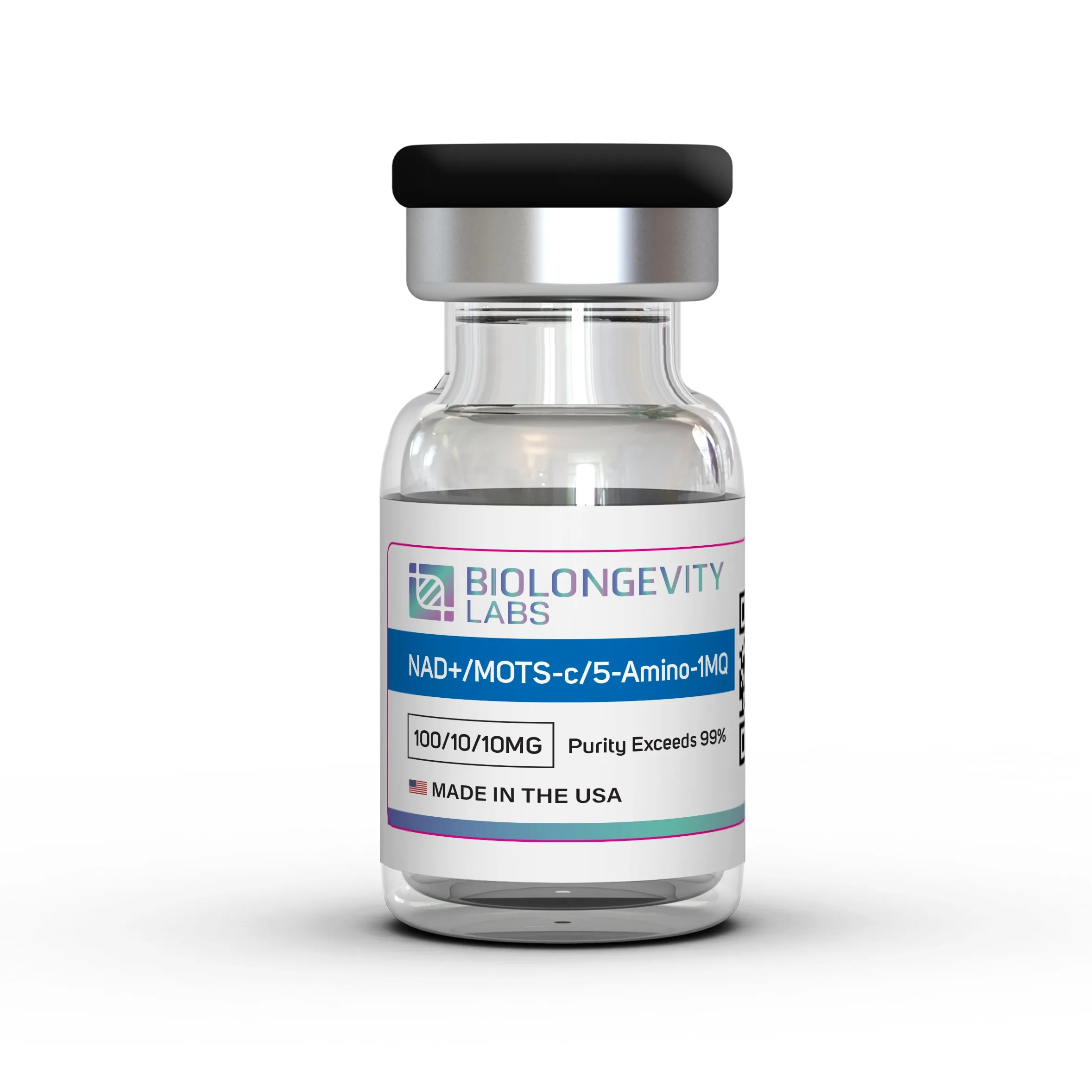
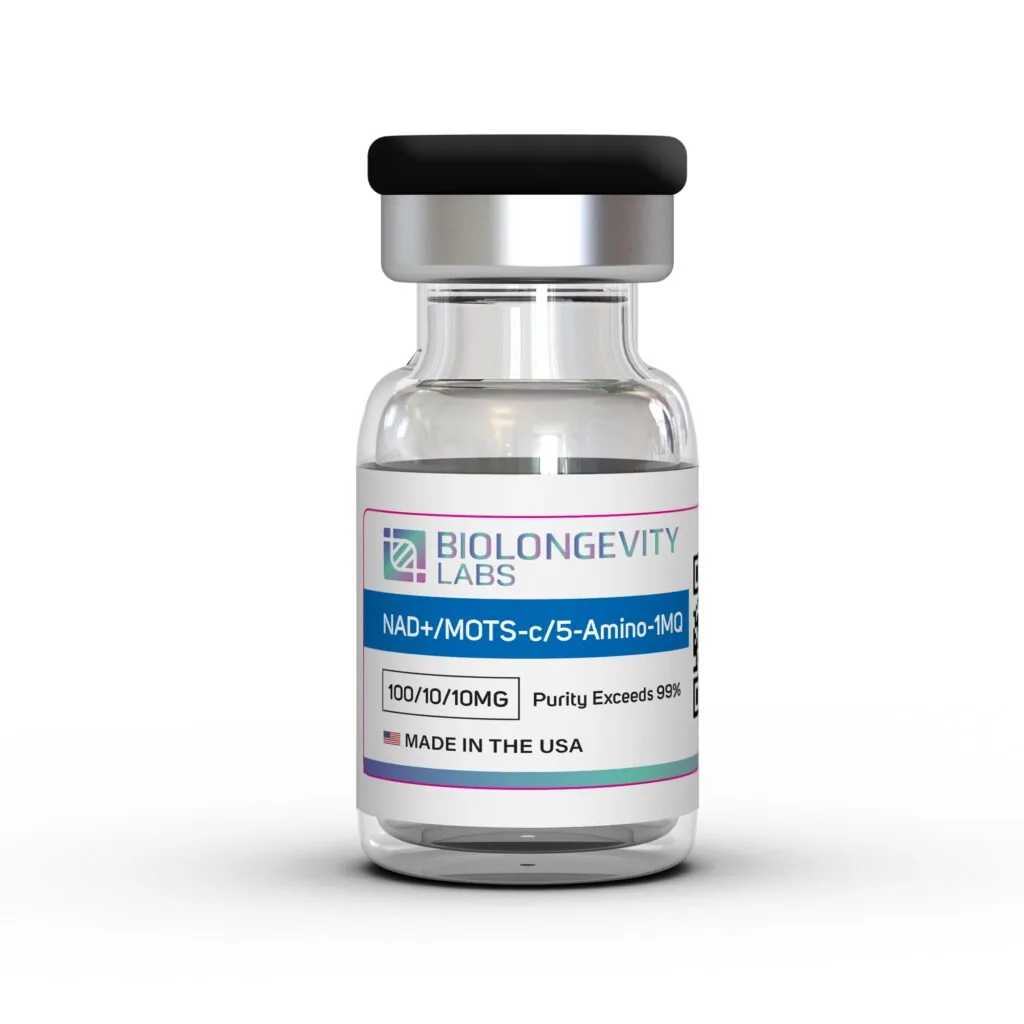
The NAD+ MOTS-c 5-Amino-1MQ blend combines three research compounds in a single 120mg vial: 100mg of the redox coenzyme NAD+, 10mg of the 16-residue mitochondrial-derived peptide MOTS-c, and 10mg of the small-molecule NNMT inhibitor 5-Amino-1MQ. Each component is produced by controlled synthesis and co-lyophilized into one dry powder for stable storage and handling. The blend is supplied for laboratory work on NAD+ metabolism, mitochondrial signaling, and nicotinamide N-methyltransferase (NNMT) activity.
≥99% Purity
Third-Party Tested
COA Available
U.S. Manufactured
Quantity
In stock
Third-Party Verified Quality
≥99% purity verified through independent UHPLC-MS testing. Certificates of Analysis are available before purchase.
COAs available before purchase
U.S.-manufactured research-grade
Same-business-day U.S. dispatch for in-stock orders placed before 12 PM PT
Secure Checkout · Free shipping on orders over $400
This blend brings together two small molecules and one peptide. NAD+ (nicotinamide adenine dinucleotide) is a dinucleotide coenzyme that carries electrons in redox reactions and serves as a substrate for sirtuins, CD38, and poly(ADP-ribose) polymerases [1].
MOTS-c is a synthetic peptide matching a sequence encoded by a short open reading frame in the mitochondrial 12S rRNA gene [2]. 5-Amino-1MQ (5-amino-1-methylquinolinium) is a quaternary quinolinium compound, not a peptide, that binds the substrate site of NNMT [5].
The three compounds meet at one point in cell metabolism. NNMT uses nicotinamide, the salvage precursor of NAD+, and MOTS-c has been characterized in AMPK signaling under metabolic stress. That shared ground is why a NAD+, MOTS-c and 5-Amino-1MQ combination is of interest in metabolic and mitochondrial research models.
Compound Specifications
Each component carries its own identifiers, listed side by side below, followed by structure data for the two small molecules and the properties of the finished vial.
120mg per vial (100mg NAD+, 10mg MOTS-c, 10mg 5-Amino-1MQ)
Format
Single co-lyophilized vial
Purity
≥99% (HPLC)
Appearance
Lyophilized white to off-white powder
Solubility
Soluble in water
Storage
-20°C, protected from light and moisture
Storage and Handling
Store the lyophilized blend at -20°C, protected from light and moisture.
After reconstitution, store at 2–8°C and use promptly.
Maintain aseptic handling to preserve compound integrity.
Lyophilized Format
This compound ships in lyophilized (freeze-dried) form. Freeze-drying supports long-term storage stability and preserves compound integrity. No fillers are added.
Research Use Disclaimer
NAD+ / MOTS-c / 5-Amino-1MQ Blend is supplied for research use only. It is not a drug, food, cosmetic, or dietary supplement and has not been evaluated by the FDA. By purchasing, the buyer confirms the compound will be used solely for in vitro research.
Frequently Asked Questions
What Is the NAD+ MOTS-c 5-Amino-1MQ Blend?
The NAD+ MOTS-c 5-Amino-1MQ blend is a single lyophilized research vial that holds the coenzyme NAD+, the mitochondrial-derived peptide MOTS-c, and the NNMT inhibitor 5-Amino-1MQ. It is supplied for laboratory research on NAD+ metabolism, mitochondrial signaling, and NNMT activity.
How Much of Each Compound Is in the Vial?
Each vial of the blend contains 120mg in total: 100mg of NAD+, 10mg of MOTS-c, and 10mg of 5-Amino-1MQ. All three are co-lyophilized into one dry powder.
Is 5-Amino-1MQ a Peptide?
5-Amino-1MQ is not a peptide. It is a small-molecule quinolinium derivative (5-amino-1-methylquinolinium, PubChem CID 950107), while MOTS-c is the only peptide in the blend.
Why Are NAD+, MOTS-c and 5-Amino-1MQ Studied Together?
NAD+, MOTS-c and 5-Amino-1MQ each act on a linked part of cell metabolism: NAD+ redox and sirtuin chemistry, AMPK signaling, and NNMT, the enzyme that methylates the NAD+ precursor nicotinamide. Combining them lets researchers examine these connected pathways in one model system.
How Should the NAD+ MOTS-c 5-Amino-1MQ Blend Be Stored?
The lyophilized blend should be stored at -20°C, protected from light and moisture. After reconstitution, it should be kept at 2–8°C and used promptly.
Research Overview
No published study has characterized this three-component blend as a single material. Each compound has its own research record, summarized below.
NAD+ is a coenzyme for redox reactions and a cofactor for sirtuins, CD38 and PARP enzymes. Reviews of the field describe a gradual decline in tissue and cellular NAD+ levels with age across multiple model organisms [1].
MOTS-c was identified in 2015 as a 16-amino-acid peptide encoded within the mitochondrial 12S rRNA. In cell models, it inhibited the folate cycle and de novo purine biosynthesis, which led to AMPK activation, and skeletal muscle appeared to be its main target tissue in mouse models [2].
Later work found that MOTS-c moves into the cell nucleus under glucose restriction in an AMPK-dependent manner. There it regulated a broad set of genes, including those with antioxidant response elements, and interacted with the transcription factor NRF2 [3].
The research on 5-Amino-1MQ follows a clear line from enzyme target to compound design to cell and mouse studies.
NNMT Inhibition and the NAD+ Salvage Pathway
NNMT methylates nicotinamide using S-adenosylmethionine (SAM) as the methyl donor. In mouse models, Nnmt knockdown in adipose tissue and liver raised adipose SAM and NAD+ levels and increased cellular energy expenditure [4].
Structure-activity work identified methylquinolinium compounds as a scaffold with NNMT inhibition near 1 µM, binding at the nicotinamide substrate site [5]. In cultured adipocytes, selected quinolinium inhibitors lowered the NNMT product 1-methylnicotinamide, raised intracellular NAD+ and SAM, and suppressed lipogenesis. They did not inhibit related methyltransferases or NAD+ salvage enzymes [6].
In aged mouse muscle and C2C12 myoblast cultures, an NNMT inhibitor was associated with increased muscle stem cell activity and shifts in the NAD+/NADH redox state [7].
Research Area
In Vitro Application
NAD+ metabolism
Substrate supply for sirtuin, PARP and CD38 enzyme assays
Mitochondrial signaling
AMPK activation and folate-cycle studies in cultured cell lines
Mitonuclear communication
Nuclear translocation and NRF2 target-gene studies under glucose restriction
NNMT enzymology
Cell-free NNMT inhibition and 1-methylnicotinamide quantitation
Adipocyte metabolism
Intracellular NAD+, SAM and lipogenesis readouts in cultured adipocytes
Analytical chemistry
Multi-component HPLC and LC-MS method development
References
Covarrubias AJ, Perrone R, Grozio A, Verdin E. (2021). NAD+ metabolism and its roles in cellular processes during ageing. Nature Reviews Molecular Cell Biology, 22(2), 119-141. https://doi.org/10.1038/s41580-020-00313-x (PMID 33353981)
Lee C, Zeng J, Drew BG, et al. (2015). The mitochondrial-derived peptide MOTS-c promotes metabolic homeostasis and reduces obesity and insulin resistance. Cell Metabolism, 21(3), 443-454. https://doi.org/10.1016/j.cmet.2015.02.009 (PMID 25738459)
Kim KH, Son JM, Benayoun BA, Lee C. (2018). The Mitochondrial-Encoded Peptide MOTS-c Translocates to the Nucleus to Regulate Nuclear Gene Expression in Response to Metabolic Stress. Cell Metabolism, 28(3), 516-524.e7. https://doi.org/10.1016/j.cmet.2018.06.008 (PMID 29983246)
Kraus D, Yang Q, Kong D, et al. (2014). Nicotinamide N-methyltransferase knockdown protects against diet-induced obesity. Nature, 508(7495), 258-262. https://doi.org/10.1038/nature13198 (PMID 24717514)
Neelakantan H, Wang HY, Vance V, Hommel JD, McHardy SF, Watowich SJ. (2017). Structure-Activity Relationship for Small Molecule Inhibitors of Nicotinamide N-Methyltransferase. Journal of Medicinal Chemistry, 60(12), 5015-5028. https://doi.org/10.1021/acs.jmedchem.7b00389 (PMID 28548833)
Neelakantan H, Vance V, Wetzel MD, et al. (2018). Selective and membrane-permeable small molecule inhibitors of nicotinamide N-methyltransferase reverse high fat diet-induced obesity in mice. Biochemical Pharmacology, 147, 141-152. https://doi.org/10.1016/j.bcp.2017.11.007 (PMID 29155147)
Neelakantan H, Brightwell CR, Graber TG, et al. (2019). Small molecule nicotinamide N-methyltransferase inhibitor activates senescent muscle stem cells and improves regenerative capacity of aged skeletal muscle. Biochemical Pharmacology, 163, 481-492. https://doi.org/10.1016/j.bcp.2019.02.008 (PMID 30753815)
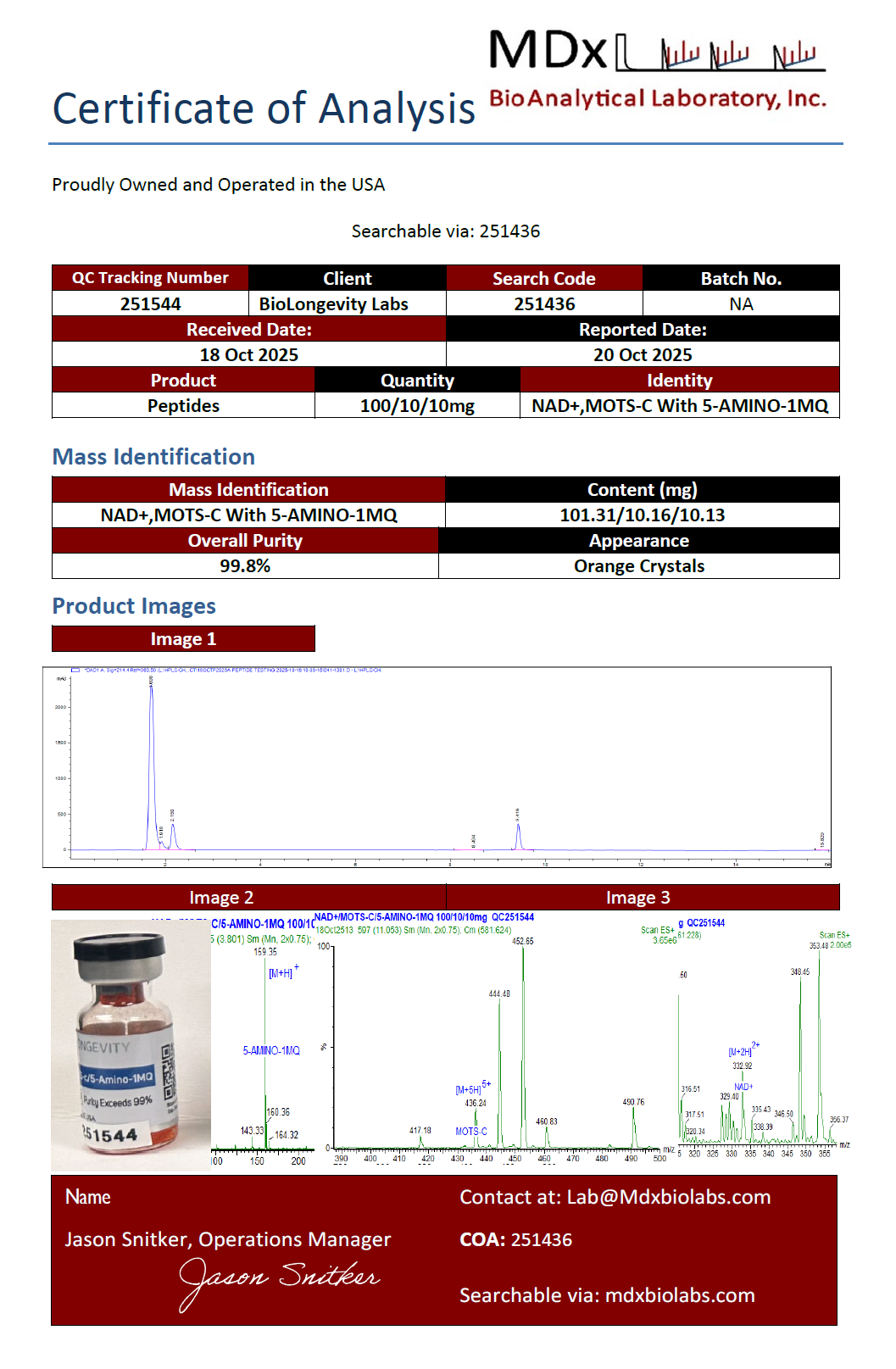
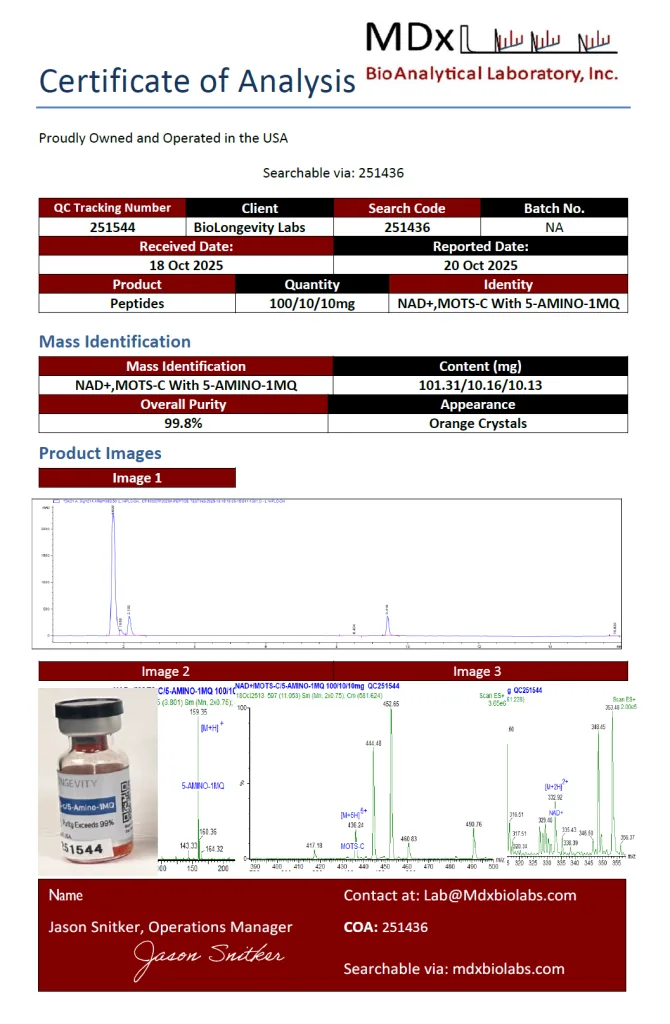
A Certificate of Analysis (COA) is a document that verifies a compound’s identity, purity and quality through independent laboratory testing. Every compound from BioLongevity Labs is third-party tested, and its COA is published here, so researchers can review the testing record before a compound enters a protocol.
Each COA reports results from third-party laboratory analysis, including:
Ultra-high-performance liquid chromatography with mass spectrometry (UHPLC-MS) for purity, measured against a 98% or 99% specification depending on the compound
Mass identification for molecular confirmation and content quantitation
Endotoxin testing by Limulus amebocyte lysate (LAL) or recombinant Factor C (rFC) assay, depending on the laboratory
Visual and physical characterization of the finished material
How to Verify a COA Independently
You can check every certificate against the issuing laboratory’s own records, not just the copy hosted here. Verification does not depend on BioLongevity Labs.
AV Analytics certificates carry a search code. Scan the QR code on the certificate to open the laboratory’s verification page, or enter the search code at avanalytical.com/coa-search to pull the official record.
BioRegen reports of analysis carry a Report ID and a Validation Key. Scan the QR code on the certificate to open the official record, or quote both identifiers when you contact the laboratory at the address printed on the report.
SafeCert Labs issued a number of earlier certificates. Each one carries a COA number and the signature of the reporting chemist. Quote that number when you ask the laboratory to confirm it.
Older certificates from other laboratories list their own verification details on the document.
When a batch is sent to more than one laboratory, each certificate resolves at its own issuing laboratory. A researcher can then check the results against two unrelated sources.
These COAs come from independent certified laboratories, not in-house testing. That gives researchers a verifiable record of molecular integrity for each compound. All compounds are supplied for research use only.
Scientifically reviewed by Dr. Ky H. Le, MD. Dr. Le is a board-certified family medicine physician with over 20 years of clinical experience. Dr. Le validates the scientific accuracy of all technical content and research citations.
Disclaimer: For Research Purposes Only
This content is provided strictly for research purposes and does not constitute an endorsement or recommendation for the non-laboratory application or improper handling of peptides designed for research. The information, including discussions about specific peptides and their researched benefits, is presented for informational purposes only and must not be construed as health, clinical, or legal guidance, nor an encouragement for non-research use. Peptides described here are solely for use in structured scientific study by authorized individuals. We advise consulting with research experts, medical practitioners, or legal counsel prior to any decisions about obtaining or utilizing these peptides. The expectation of responsible, ethical utilization of this information for legitimate investigative and scholarly objectives is paramount. This notice is dynamic and governs all provided content on research peptides.