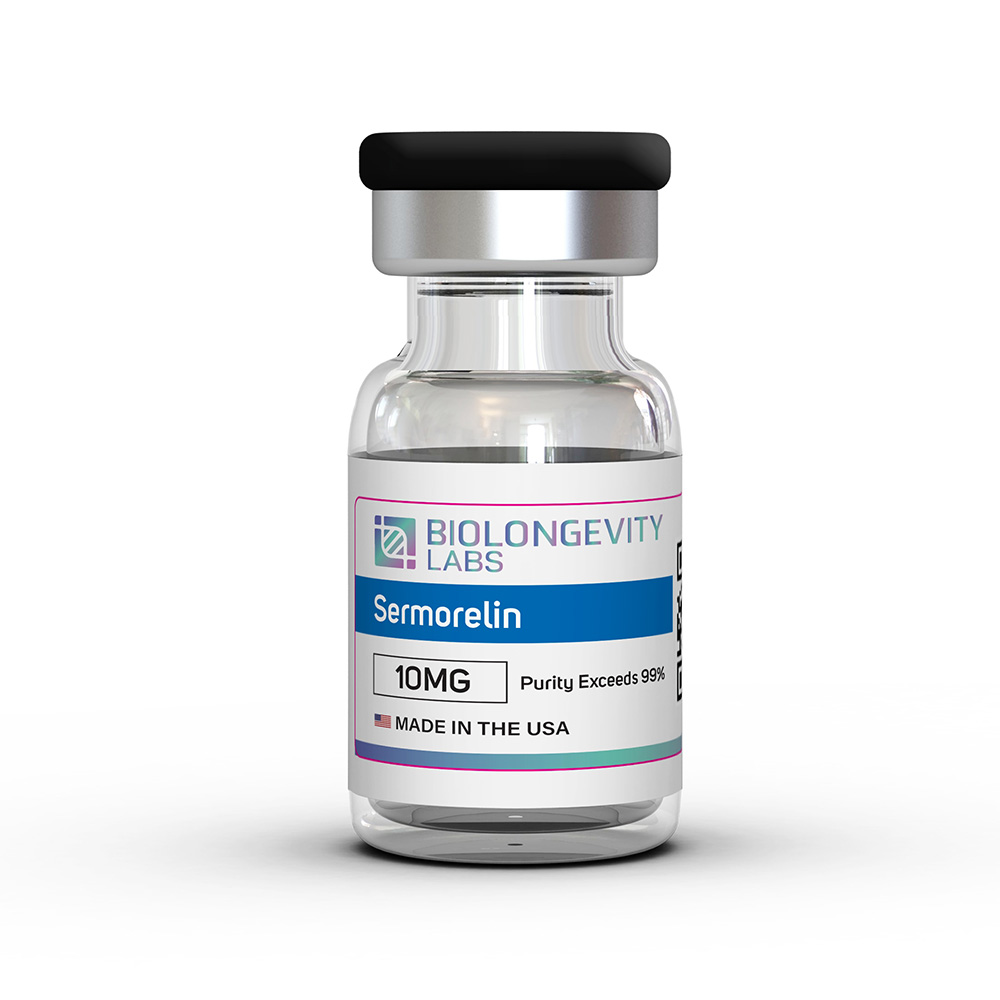
Sermorelin is a synthetic 29-residue peptide amide that matches the N-terminal 1-29 segment of growth hormone-releasing factor (GRF 1-29), produced through controlled peptide synthesis. Each vial holds 10mg of sermorelin as a lyophilized white powder, sealed for storage stability. Sermorelin is characterized in research models as an agonist of the growth hormone-releasing hormone receptor (GHRHR), a G protein-coupled receptor on anterior pituitary somatotroph cells that signals through cyclic AMP. It is studied in pituitary cell culture, receptor signaling and peptide stability work and is supplied for research use only.
≥99% Purity
Third-Party Tested
COA Available
U.S. Manufactured
Quantity
In stock
Third-Party Verified Quality
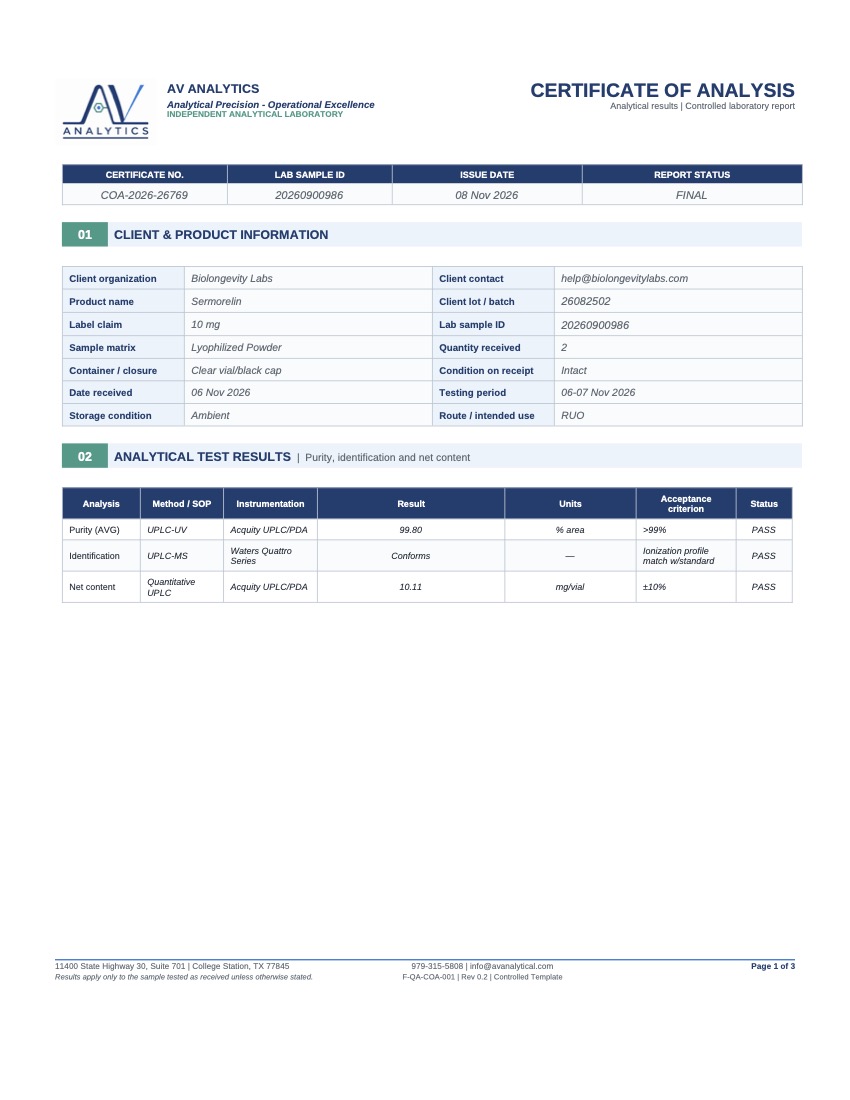
≥99% purity verified through independent UHPLC-MS testing. Certificates of Analysis are available before purchase.
COAs available before purchase
U.S.-manufactured research-grade
Same-business-day U.S. dispatch for in-stock orders placed before 12 PM PT
Secure Checkout · Free shipping on orders over $400
The sermorelin peptide is a linear chain of 29 amino acids with an amidated C-terminus. Its sequence is identical to residues 1 to 29 of growth hormone-releasing factor, a 44-residue hypothalamic peptide.
Early structure-activity work found that this 29-residue fragment keeps the full intrinsic activity of the parent peptide in pituitary cell assays, which made GRF 1-29 a standard reference sequence for GHRH receptor research.
It carries CAS number 86168-78-7 and PubChem CID 16132413. Laboratory work centers on receptor binding, cyclic AMP signaling in pituitary cells, peptide stability and analytical method development. BioLongevity Labs offers sermorelin for sale strictly as a research peptide.
Store the lyophilized peptide at -20°C, sealed and protected from light and moisture.
After reconstitution, store at 2 to 8°C and use promptly.
Maintain aseptic handling to preserve compound integrity.
Lyophilized Format
This compound ships in lyophilized (freeze-dried) form. Freeze-drying supports long-term storage stability and preserves compound integrity. No fillers are added.
Research Use Disclaimer
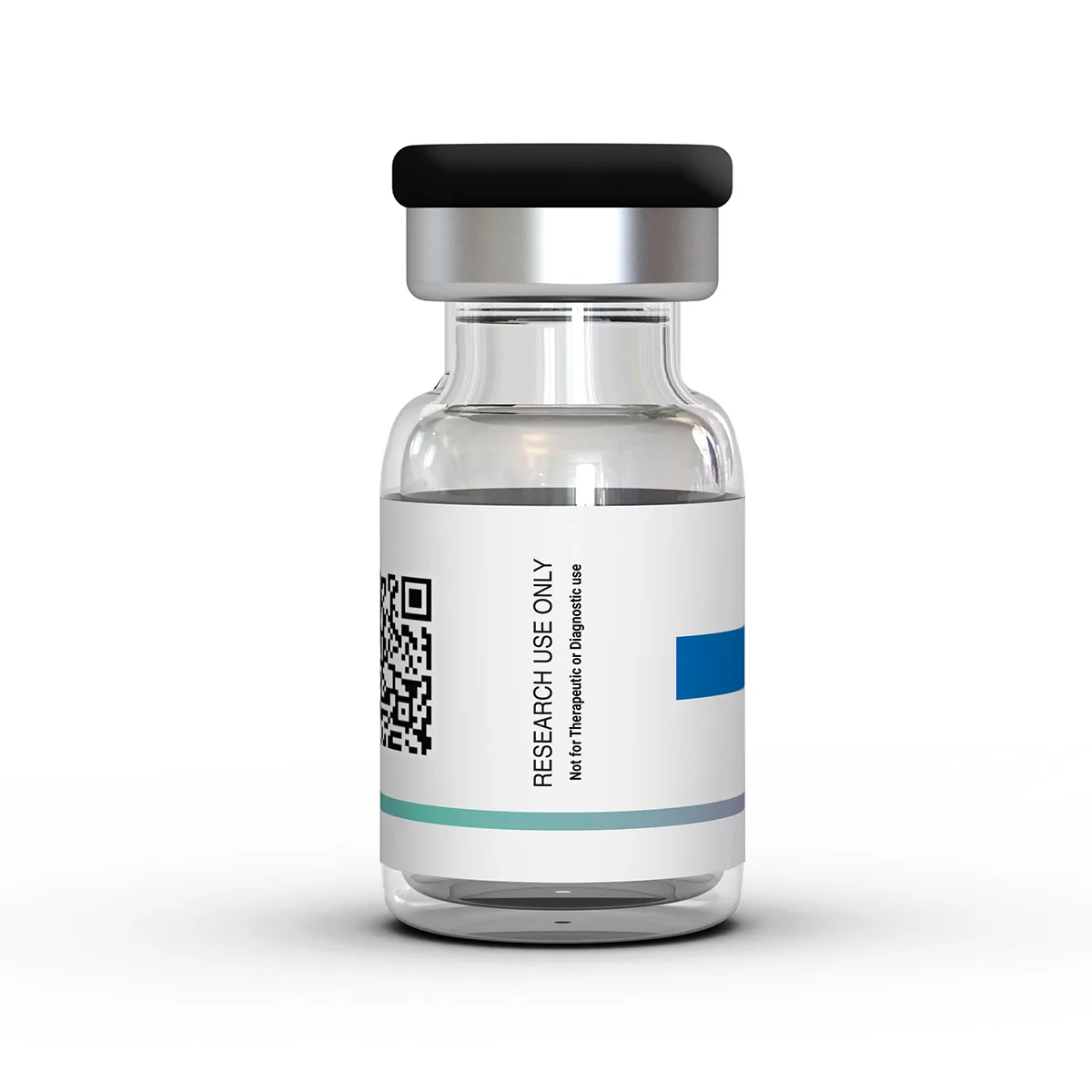
Sermorelin is supplied for research use only. It is not a drug, food, cosmetic, or dietary supplement and has not been evaluated by the FDA. By purchasing, the buyer confirms the compound will be used solely for in vitro research.
Frequently Asked Questions
What Is Sermorelin?
Sermorelin is a synthetic 29-residue peptide amide that matches the first 29 amino acids of growth hormone-releasing factor, also written as GRF (1-29) NH2. BioLongevity Labs supplies it as a 10mg lyophilized powder for research use only.
Is Sermorelin the Same as Mod GRF 1-29?
No. Sermorelin carries the unmodified GRF 1-29 sequence with a C-terminal amide, while Mod GRF 1-29 is a separate analog with amino acid substitutions in that sequence. The two have different identifiers and are not interchangeable as reference material.
What Is the CAS Number and Molecular Weight of Sermorelin?
Sermorelin is listed under CAS number 86168-78-7 and PubChem CID 16132413. Its molecular formula is C149H246N44O42S, with a molecular weight of 3357.9 g/mol.
How Should Sermorelin Be Stored?
Lyophilized sermorelin is stored at -20°C, sealed and protected from light and moisture. Once reconstituted, sermorelin is kept at 2 to 8°C and used promptly, since GRF peptides with an asparagine at position 8 can deamidate in neutral aqueous solution.
How Is Sermorelin Purity Verified?
Each sermorelin batch is tested by an independent third-party laboratory to a ≥99% purity specification. The Certificate of Analysis for each batch is published online and can be reviewed before purchase.
Research Overview
Sermorelin’s sequence comes from growth hormone-releasing factor, a 44-residue amidated peptide that was isolated from hypothalamic tissue and sequenced in 1984 [1]. Sermorelin corresponds to its first 29 residues.
In structure-activity work on rat anterior pituitary cells in monolayer culture, the (1-29) amide fragment kept full intrinsic activity for growth hormone (GH) release, at about half the relative activity of the full-length peptide [2]. Deleting residues down to position 19 removed activity entirely [2].
The N-terminus is position-sensitive as well. In the same pituitary cell assay, GRF analogs without an aromatic residue at position 1 showed sharply lower GH-releasing activity [3].
Two further research threads build on this sequence work.
Receptor Binding and Signaling
The GHRH receptor was cloned from pituitary tissue as a seven-transmembrane G protein-coupled receptor related to the secretin and vasoactive intestinal peptide receptors [4]. Expressed in the 293 kidney cell line, it bound GHRH with high affinity and responded with intracellular cyclic AMP production, and its mRNA was found mainly in the anterior pituitary [4].
A 2.6 Å cryo-electron microscopy structure of the receptor bound to its native ligand and the stimulatory G protein showed the α-helical peptide contacting the extracellular domain, all extracellular loops and every transmembrane helix except TM4 [5]. The peptide’s N-terminus formed a broad set of specific receptor contacts [5].
Stability and Analytical Characterization
In plasma incubated in vitro, full-length GRF was cleaved at the N-terminus by a dipeptidylaminopeptidase, giving a (3-44) product with less than one thousandth of the parent peptide’s biological activity [6].
In neutral aqueous buffer at 37°C, a closely related GRF analog degraded mainly through deamidation of the asparagine at position 8 [7]. The resulting β-aspartyl product showed 400 to 500 times lower GH-releasing activity in cultured pituitary cells [7].
In vitro metabolism studies of sermorelin and related GHRH analogs identified major metabolites, including sermorelin (3-29) amide, and used them as reference materials for a liquid chromatography-tandem mass spectrometry method with detection limits of 1 ng/mL or lower [8].
Research Area
In Vitro Application
GHRH Receptor Pharmacology
Receptor binding and cyclic AMP assays in GHRHR-expressing cell lines
Pituitary Cell Assays
GH release studies in anterior pituitary cells in monolayer culture
Structure-Activity Studies
Comparison with truncated and substituted GRF analogs
Structural Biology
Ligand recognition studies of the GHRHR and stimulatory G protein complex
Peptide Stability
Enzymatic cleavage and asparagine deamidation studies in buffer and plasma
Analytical Chemistry
Reference material for LC-MS/MS method development and metabolite identification
References
Ling N, Esch F, Böhlen P, et al. (1984). Isolation, primary structure, and synthesis of human hypothalamic somatocrinin: growth hormone-releasing factor. Proceedings of the National Academy of Sciences of the United States of America. https://doi.org/10.1073/pnas.81.14.4302
Ling N, Baird A, Wehrenberg WB, et al. (1984). Synthesis and in vitro bioactivity of C-terminal deleted analogs of human growth hormone-releasing factor. Biochemical and Biophysical Research Communications. https://doi.org/10.1016/0006-291x(84)90309-7
Ling N, Baird A, Wehrenberg WB, et al. (1984). Synthesis and in vitro bioactivity of human growth hormone-releasing factor analogs substituted at position-1. Biochemical and Biophysical Research Communications. https://doi.org/10.1016/0006-291x(84)90475-3
Mayo KE. (1992). Molecular cloning and expression of a pituitary-specific receptor for growth hormone-releasing hormone. Molecular Endocrinology. https://doi.org/10.1210/mend.6.10.1333056
Zhou F, Zhang H, Cong Z, et al. (2020). Structural basis for activation of the growth hormone-releasing hormone receptor. Nature Communications. https://doi.org/10.1038/s41467-020-18945-0
Frohman LA, Downs TR, Williams TC, et al. (1986). Rapid enzymatic degradation of growth hormone-releasing hormone by plasma in vitro and in vivo to a biologically inactive product cleaved at the NH2 terminus. The Journal of Clinical Investigation. https://doi.org/10.1172/JCI112679
Friedman AR, Ichhpurani AK, Brown DM, et al. (1991). Degradation of growth hormone releasing factor analogs in neutral aqueous solution is related to deamidation of asparagine residues. Replacement of asparagine residues by serine stabilizes. International Journal of Peptide and Protein Research. https://doi.org/10.1111/j.1399-3011.1991.tb00727.x
Memdouh S, Gavrilović I, Ng K, et al. (2021). Advances in the detection of growth hormone releasing hormone synthetic analogs. Drug Testing and Analysis. https://doi.org/10.1002/dta.3183
A Certificate of Analysis (COA) is a document that verifies a compound’s identity, purity and quality through independent laboratory testing. Every compound from BioLongevity Labs is third-party tested, and its COA is published here, so researchers can review the testing record before a compound enters a protocol.
Each COA reports results from third-party laboratory analysis, including:
Ultra-high-performance liquid chromatography with mass spectrometry (UHPLC-MS) for purity, measured against a 98% or 99% specification depending on the compound
Mass identification for molecular confirmation and content quantitation
Endotoxin testing by Limulus amebocyte lysate (LAL) or recombinant Factor C (rFC) assay, depending on the laboratory
Visual and physical characterization of the finished material
How to Verify a COA Independently
You can check every certificate against the issuing laboratory’s own records, not just the copy hosted here. Verification does not depend on BioLongevity Labs.
AV Analytics certificates carry a search code. Scan the QR code on the certificate to open the laboratory’s verification page, or enter the search code at avanalytical.com/coa-search to pull the official record.
BioRegen reports of analysis carry a Report ID and a Validation Key. Scan the QR code on the certificate to open the official record, or quote both identifiers when you contact the laboratory at the address printed on the report.
SafeCert Labs issued a number of earlier certificates. Each one carries a COA number and the signature of the reporting chemist. Quote that number when you ask the laboratory to confirm it.
Older certificates from other laboratories list their own verification details on the document.
When a batch is sent to more than one laboratory, each certificate resolves at its own issuing laboratory. A researcher can then check the results against two unrelated sources.
These COAs come from independent certified laboratories, not in-house testing. That gives researchers a verifiable record of molecular integrity for each compound. All compounds are supplied for research use only.
Scientifically reviewed by Dr. Ky H. Le, MD. Dr. Le is a board-certified family medicine physician with over 20 years of clinical experience. Dr. Le validates the scientific accuracy of all technical content and research citations.
Disclaimer: For Research Purposes Only
This content is provided strictly for research purposes and does not constitute an endorsement or recommendation for the non-laboratory application or improper handling of peptides designed for research. The information, including discussions about specific peptides and their researched benefits, is presented for informational purposes only and must not be construed as health, clinical, or legal guidance, nor an encouragement for non-research use. Peptides described here are solely for use in structured scientific study by authorized individuals. We advise consulting with research experts, medical practitioners, or legal counsel prior to any decisions about obtaining or utilizing these peptides. The expectation of responsible, ethical utilization of this information for legitimate investigative and scholarly objectives is paramount. This notice is dynamic and governs all provided content on research peptides.