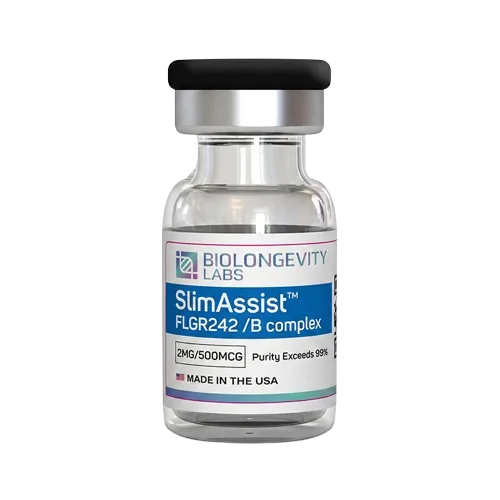
SlimAssist is a complex featuring a blend of our signature Follistatin (FLGR242) and a Vitamin B complex. A dual-component research blend combining selective myostatin inhibition with metabolic cofactor support.
≥99% Purity
Third-Party Tested
COA Available
U.S. Manufactured
Quantity
Third-Party Verified Quality
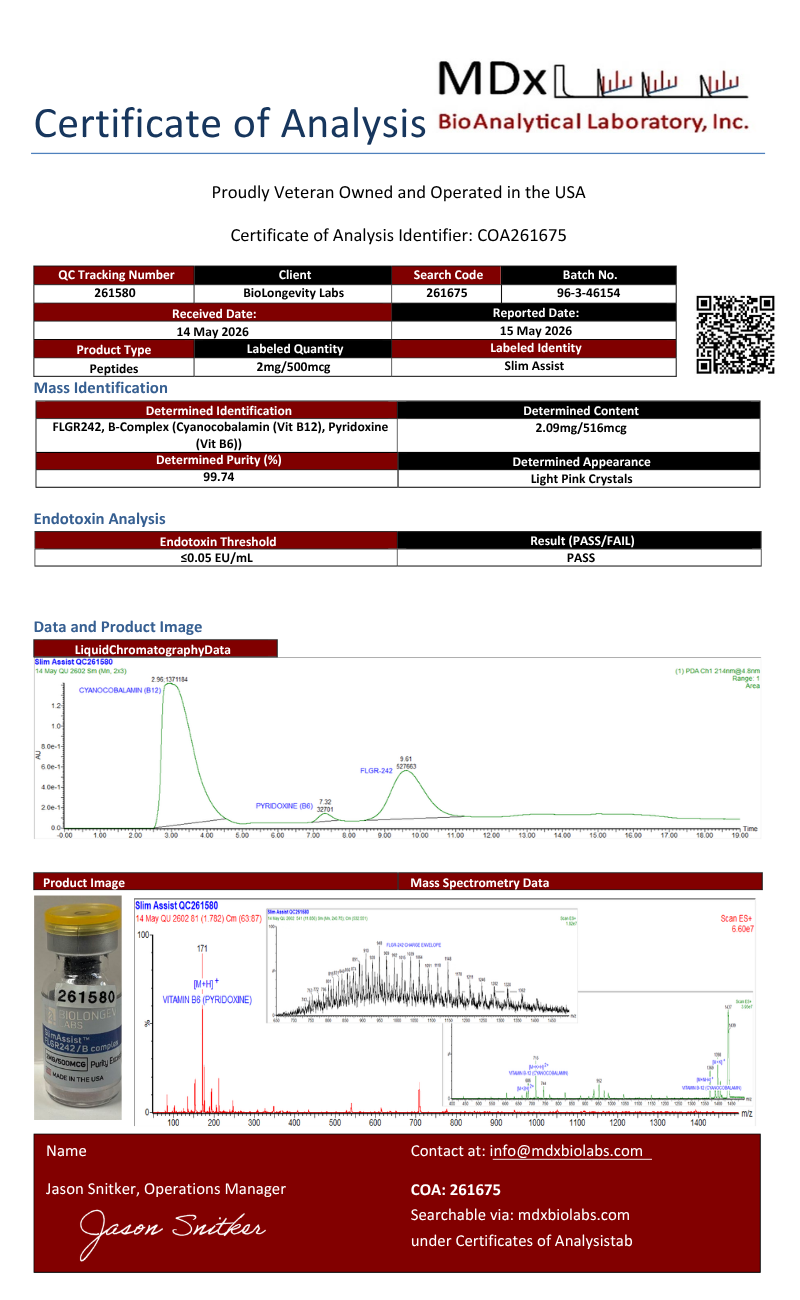
≥99% purity verified through independent UHPLC-MS testing. Certificates of Analysis are available before purchase.
COAs available before purchase
U.S.-manufactured research-grade
Same-business-day U.S. dispatch for in-stock orders placed before 12 PM PT
Secure Checkout · Free shipping on orders over $400
SlimAssist is a dual-component research compound formulated for in vitro and preclinical studies examining skeletal muscle preservation under conditions of concurrent metabolic intervention.
Each research vial contains two precisely characterized components.
Component 1 — FLGR242 (2mg)
FLGR242 is a fragmented, modified version of Follistatin-344 developed via recombinant technology. It selectively binds and inhibits myostatin activity without the off-target activin interactions typically observed with standard follistatin analogs in laboratory models.
A patented albumin-binding construct confers high-affinity serum albumin binding (Kd <20 nM), extending the compound’s serum persistence period to approximately 19 days. This extended serum residence makes FLGR242 well-suited for long-interval experimental protocols without compromising binding selectivity.
Component 2 — Vitamin B Complex (500mcg)
A research-grade B6, and B12 complex with Vitamin B6 as the primary constituent. This complex supports cofactor-dependent pathways in cellular energy metabolism and mitochondrial function models, including transaminase activity and NAD+ precursor availability in cell culture systems.
Together, these components are designed to support preclinical research protocols examining skeletal muscle preservation in models where accelerated muscle catabolism is observed alongside concurrent GLP-1 receptor agonist compound application.
US GMP-manufactured with triple third-party verification and comprehensive COAs for reproducible research outcomes.
These compounds are freeze-dried, a process that preserves purity and molecular integrity during storage. No fillers or additives are used in this process.
SlimAssist Research
SlimAssist combines two research-relevant components targeting complementary pathways in skeletal muscle catabolism and metabolic cofactor activity. The following summarizes supporting literature across both components.
Myostatin Inhibition and Skeletal Muscle Fiber Research
Myostatin (GDF-8) is a TGF-β superfamily member that suppresses muscle fiber development by activating SMAD2/3 signaling cascades. In laboratory models, elevated myostatin expression correlates with accelerated skeletal muscle catabolism during energy restriction and caloric deficit states [1].
Standard follistatin analogs bind both myostatin and activin, producing off-target cellular growth effects that complicate experimental interpretation. FLGR242 addresses this limitation by selectively inhibiting myostatin without co-inhibiting activin — yielding cleaner experimental protocols for TGF-β pathway research [2].
Research in laboratory models demonstrates that follistatin-based myostatin inhibition increases muscle fiber cross-sectional area and supports satellite cell activation in regeneration assays [3].
Albumin-Binding Construct and Extended Serum Persistence
The patented albumin-binding construct in FLGR242 uses a hydrophilic glycine-serine linker to achieve high-affinity binding to serum albumin (Kd <20 nM). This extends the compound’s serum persistence period to approximately 19 days.
Albumin-fusion strategies represent a validated approach in recombinant protein research for extending serum residence without altering primary biological activity [4]. This characteristic is particularly relevant for researchers designing multi-week experimental timelines with reduced compound application intervals.
Skeletal Muscle Preservation in GLP-1 Receptor Agonist Research Models
Translational and preclinical research models have identified accelerated lean mass reduction as a notable observation in study subjects alongside GLP-1 receptor agonist compound application combined with caloric restriction protocols [5].
Myostatin pathway modulation has been proposed as a contributing mechanism in these models. Research examining concomitant selective myostatin inhibition and GLP-1 pathway activity represents an active investigative area for researchers studying body composition dynamics under metabolic intervention conditions.
The selectivity and extended serum persistence period of FLGR242 position it as a candidate research tool for these protocol designs.
Vitamin B6 and Enzymatic Cofactor Activity
Vitamin B6 (pyridoxine) serves as an essential cofactor for more than 100 enzymatic reactions in cellular metabolism, including aminotransferases central to amino acid catabolism and gluconeogenesis pathways in cell line models [6].
In metabolic research models, sufficient B6 availability supports mitochondrial energy production and intracellular energy flux under conditions of substrate restriction [7]. These properties make B6 a relevant component in protocols examining cellular metabolic resilience alongside skeletal muscle preservation pathways.
Vitamin B3 and NAD+ Pathway Research
Niacin (Vitamin B3) is a biosynthetic precursor to NAD+ and NADP+ — coenzymes governing cellular redox reactions and mitochondrial respiration across mammalian cell types [8].
In vitro studies demonstrate that B3 availability supports NAD+ pool maintenance under conditions of increased metabolic demand. This cofactor role positions B3 as a relevant variable in protocols examining energy homeostasis alongside muscle catabolism research.
Vitamin B12 and Amino Acid Metabolism
Vitamin B12 (cobalamin) functions as a cofactor for methionine synthase and methylmalonyl-CoA mutase — enzymes central to amino acid and fatty acid metabolism in mammalian cell culture systems [9].
B12 activity in cellular models supports protein biosynthesis pathways relevant to skeletal muscle research protocols, particularly those examining anabolic signaling alongside myostatin inhibition.
In Vitro Research Applications
Research Application
Relevant Component
Selective myostatin inhibition assays
FLGR242
Skeletal muscle fiber preservation models
FLGR242
TGF-β / SMAD2/3 pathway modulation studies
FLGR242
Extended serum protein trafficking research
FLGR242 (albumin-binding construct)
GLP-1 concomitant muscle catabolism models
FLGR242 + B-Complex
Mitochondrial energy metabolism assays
Vitamin B Complex (B3, B6, B12)
NAD+ pathway and redox balance research
Vitamin B3
Aminotransferase and amino acid metabolism studies
Vitamin B6
Protein biosynthesis support in cell culture
Vitamin B12
References
McPherron AC, Lawler AM, Lee SJ. “Regulation of skeletal muscle mass in mice by a new TGF-beta superfamily member.” Nature. 1997;387(6628):83–90. doi: 10.1038/387083a0
Lee SJ et al. “Regulation of Muscle Mass by Follistatin and Activins.” Mol Endocrinol. 2010. doi: 10.1210/me.2010-0127
Zhu J et al. “Follistatin Improves Skeletal Muscle Healing after Injury and Disease through an Interaction with Muscle Regeneration, Angiogenesis, and Fibrosis.” Am J Pathol. 2011. doi: 10.1016/j.ajpath.2011.04.008
Kontermann RE. “Strategies for extended serum half-life of protein therapeutics.” Curr Opin Biotechnol. 2011;22(6):868–876. doi: 10.1016/j.copbio.2011.06.012
Wilding JPH et al. “Once-Weekly Semaglutide in Adults with Overweight or Obesity.” N Engl J Med. 2021;384:989–1002. doi: 10.1056/NEJMoa2032183
Percudani R, Peracchi A. “A genomic overview of pyridoxal-phosphate-dependent enzymes.” EMBO Rep. 2003;4(9):850–854. doi: 10.1038/sj.embor.embor914
Mooney S et al. “Vitamin B6: a long known compound of surprising complexity.” Molecules. 2009;14(1):329–351. doi: 10.3390/molecules14010329
Belenky P, Bogan KL, Brenner C. “NAD+ metabolism and its roles in cellular processes during ageing.” Cell. 2007;129(3):473–484. doi: 10.1016/j.cell.2007.02.010
Green R et al. “Vitamin B12 deficiency.” Nat Rev Dis Primers. 2017;3:17040. doi: 10.1038/nrdp.2017.40
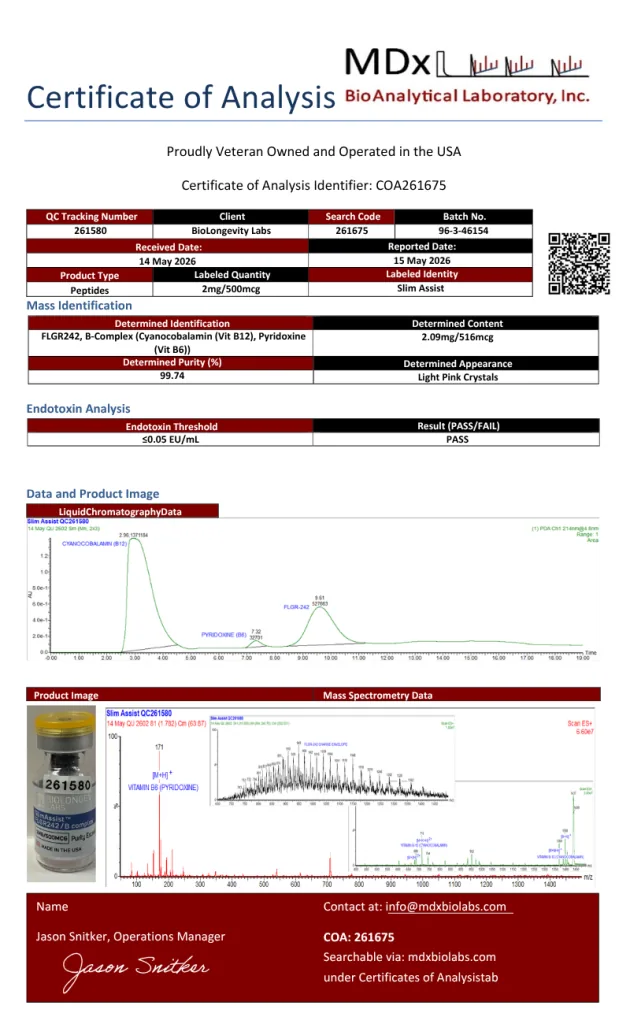
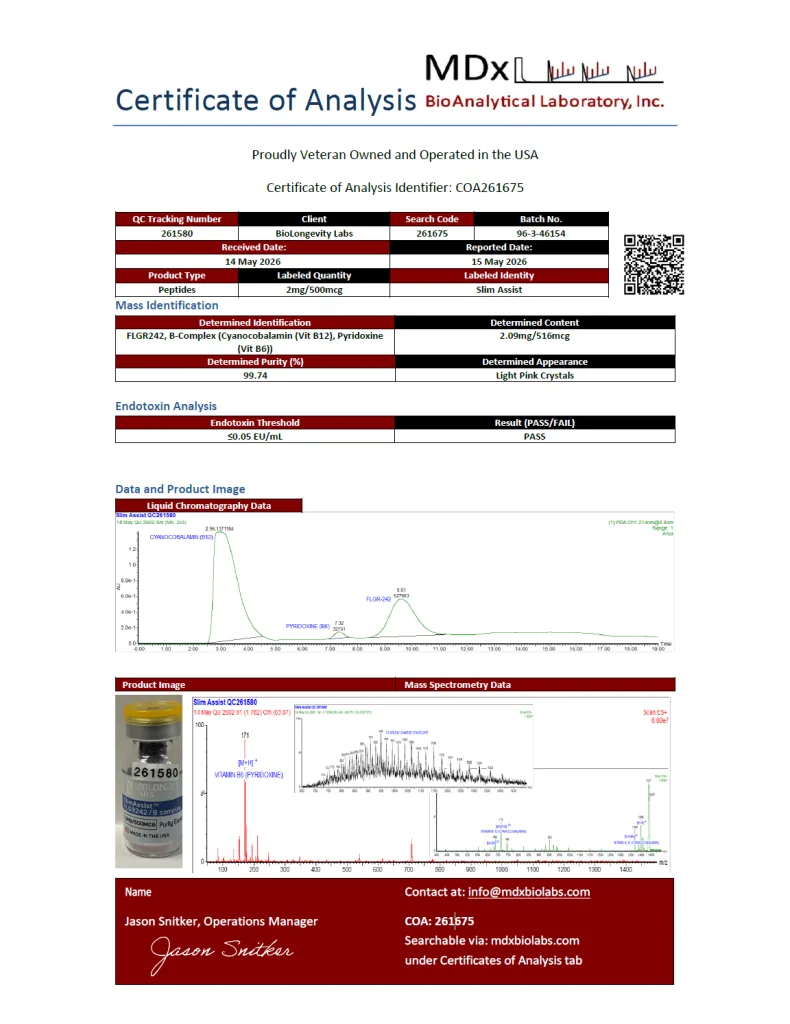
A Certificate of Analysis (COA) is a document that verifies a compound’s identity, purity and quality through independent laboratory testing. Every compound from BioLongevity Labs is third-party tested, and its COA is published here, so researchers can review the testing record before a compound enters a protocol.
Each COA reports results from third-party laboratory analysis, including:
Ultra-high-performance liquid chromatography with mass spectrometry (UHPLC-MS) for purity, measured against a 98% or 99% specification depending on the compound
Mass identification for molecular confirmation and content quantitation
Endotoxin testing by Limulus amebocyte lysate (LAL) or recombinant Factor C (rFC) assay, depending on the laboratory
Visual and physical characterization of the finished material
How to Verify a COA Independently
You can check every certificate against the issuing laboratory’s own records, not just the copy hosted here. Verification does not depend on BioLongevity Labs.
AV Analytics certificates carry a search code. Scan the QR code on the certificate to open the laboratory’s verification page, or enter the search code at avanalytical.com/coa-search to pull the official record.
BioRegen reports of analysis carry a Report ID and a Validation Key. Scan the QR code on the certificate to open the official record, or quote both identifiers when you contact the laboratory at the address printed on the report.
SafeCert Labs issued a number of earlier certificates. Each one carries a COA number and the signature of the reporting chemist. Quote that number when you ask the laboratory to confirm it.
Older certificates from other laboratories list their own verification details on the document.
When a batch is sent to more than one laboratory, each certificate resolves at its own issuing laboratory. A researcher can then check the results against two unrelated sources.
These COAs come from independent certified laboratories, not in-house testing. That gives researchers a verifiable record of molecular integrity for each compound. All compounds are supplied for research use only.
Scientifically reviewed by Dr. Ky H. Le, MD. Dr. Le is a board-certified family medicine physician with over 20 years of clinical experience. Dr. Le validates the scientific accuracy of all technical content and research citations.
Disclaimer: For Research Purposes Only
This content is provided strictly for research purposes and does not constitute an endorsement or recommendation for the non-laboratory application or improper handling of peptides designed for research. The information, including discussions about specific peptides and their researched benefits, is presented for informational purposes only and must not be construed as health, clinical, or legal guidance, nor an encouragement for non-research use. Peptides described here are solely for use in structured scientific study by authorized individuals. We advise consulting with research experts, medical practitioners, or legal counsel prior to any decisions about obtaining or utilizing these peptides. The expectation of responsible, ethical utilization of this information for legitimate investigative and scholarly objectives is paramount. This notice is dynamic and governs all provided content on research peptides.