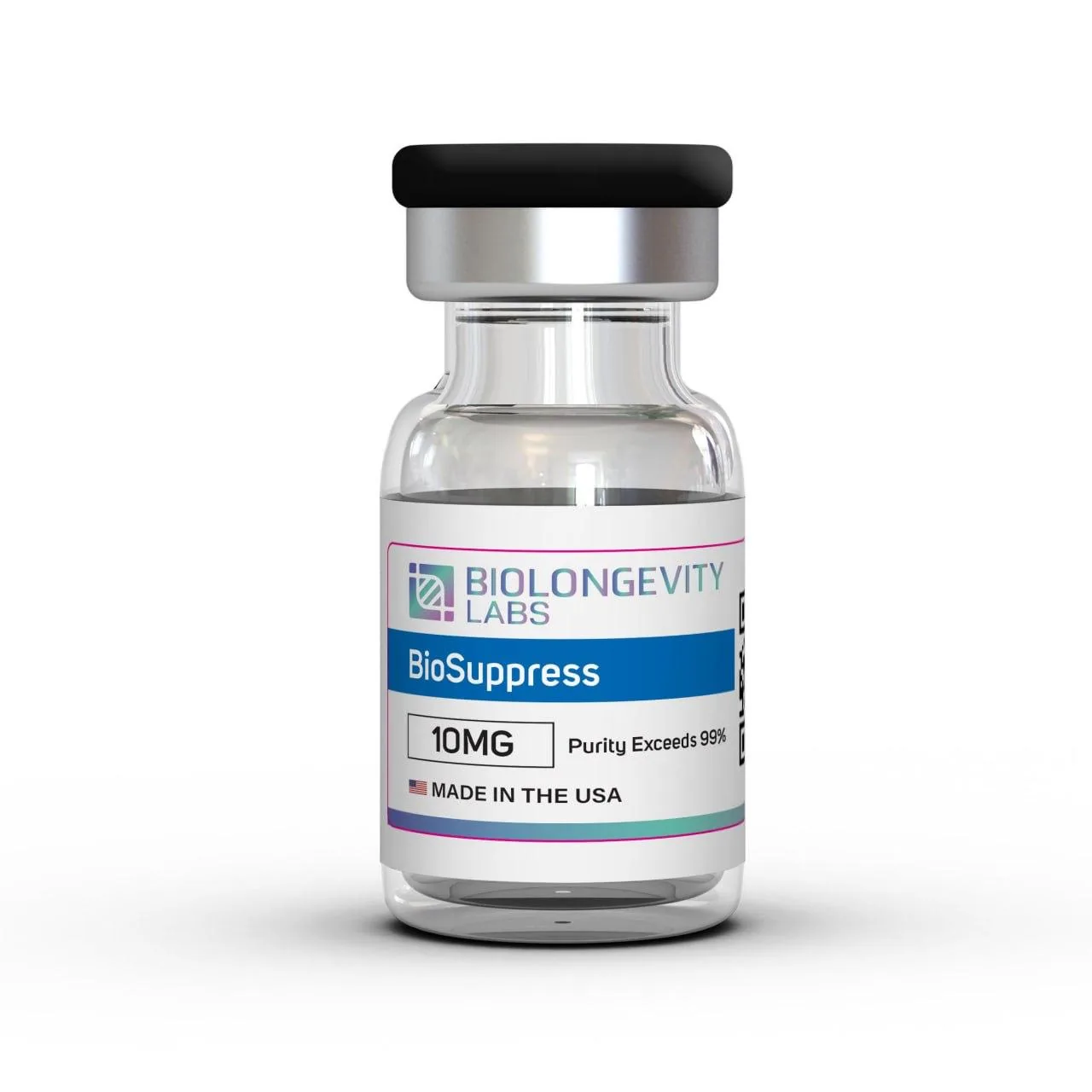
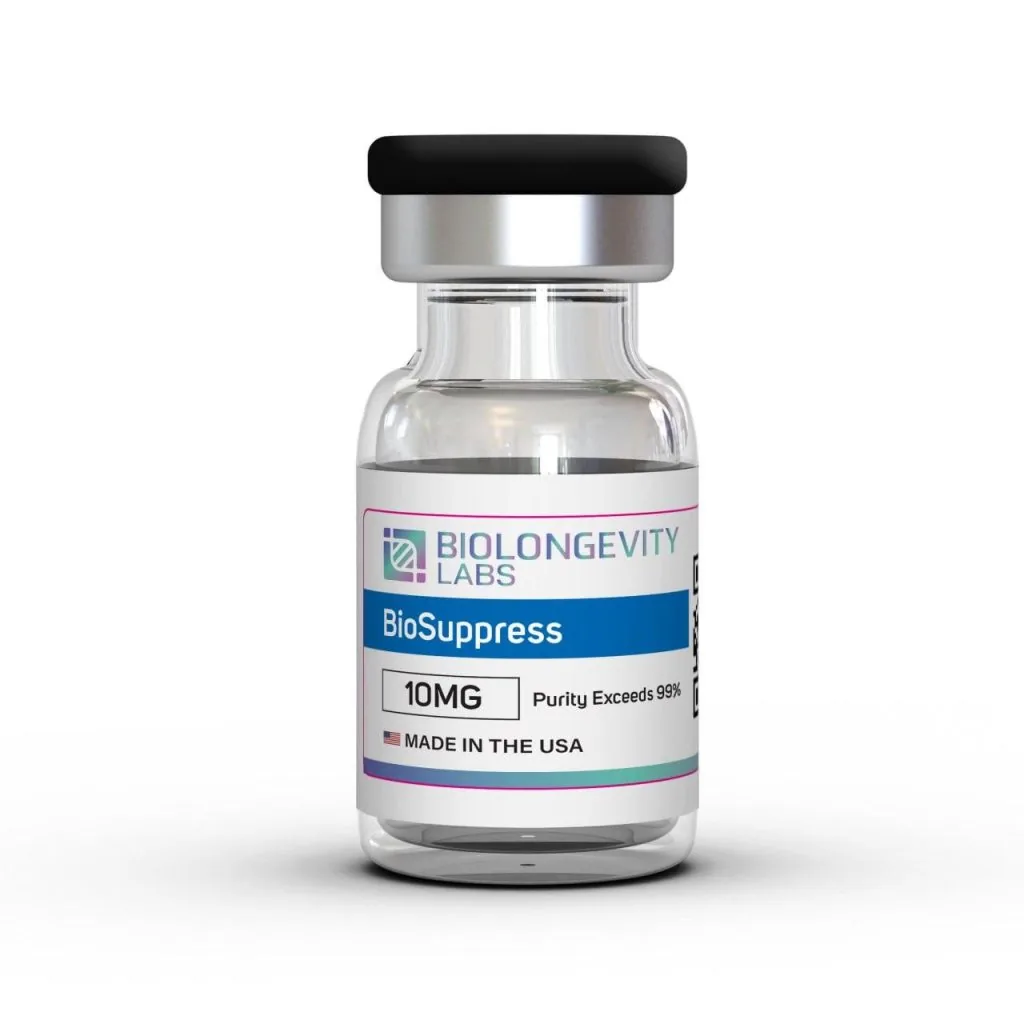
BioSuppress is a synthetic peptide of approximately 39 amino acids in length, possessing a linear structure. It functions as a dual receptor agonist that targets the glucagon-like peptide 1 (GLP-1) and glucose-dependent insulinotropic polypeptide (GIP) pathways.
This unique design of the peptide allows for protection against rapid degradation via DPP-4 mediated enzymatic cleavage, high bioavailability, and an extended biological half-life for less frequent administration in research settings. Notably, the GIP receptor agonism is believed to counteract the emetic effects known to arrive from GLP-1 receptor agonism in preclinical models.
Peptide Information:
| Peptide Sequence |
YXEGTFTSDYSIXLDKIAQKAFVQWLIAGGPSSGAPPPS |
| Molecular Formula |
C225H348N48O68 |
| Molecular Weight |
4813 g/mol |
| CAS Number |
2023788-19-2 |
| PubChem CID |
156588324 |
| Synonyms |
LY3298176 |
Lyophilized Peptides:
These peptides are freeze-dried, a process that not only extends shelf life but also preserves the purity and integrity of the peptides during storage. We do not use any fillers in this process.
BioSuppress possesses unique pharmacokinetic characteristics that separate it from other incretin receptor agonists. While its binding affinity for the GIP receptor is near equivalent to that achieved by native GIP, its binding for the GLP-1 receptor is 5 times weaker compared to native GLP-1. Additionally, it exerts a lower degree of beta-arrestin recruitment upon binding to the GLP-1 receptor compared to native GLP-1.
This allows for a reduction in side effects due to GIP’s anti-emetic properties, along with greater glucose-dependent insulin secretion due a combination of decreased GLP-1 receptor desensitization and prolonged activity at the GLP-1 receptor.
Additionally, there are some shared properties between GLP-1 receptor and GIP receptor agonism that allow for synergistic effects with respect to improving insulin sensitivity, reducing hunger, and decreasing glucagon secretion. While GLP-1 receptor agonism leads to delayed gastric emptying, GIP receptor agonism allows for glucose disposal in white adipose tissue and the regulation of bone metabolism.
This multi-receptor incretin activity allows for deeper exploration into metabolic signaling analysis, along with a reduction in body weight and blood sugar levels beyond what targeting either incretin receptor can achieve in isolation.
BioSuppress was designed to model dose-dependent pathway activation for controlled research environments within the following contexts:
Appetite Signaling & Weight Regulation: Central and peripheral mechanisms influencing satiety, caloric intake, energy balance, and feeding behavior
Glucose Regulation & Insulin Dynamics: Post-prandial glucose regulation, modulation of glucagon signaling, interactions between incretin pathways, glucose-dependent insulin responses.
Body Composition Dynamics & Metabolic Efficiency: Effects on fat mass, lean mass preservation, nutrient partitioning and metabolic adaptations.
Cardiometabolic Markers: Secondary pathways associated with lipid metabolism, inflammation, and metabolic health indicators.
Note: BioSuppress is supplied strictly for investigational research use only.
Certificate of Analysis (COA)
No COAs available for this product.
A Certificate of Analysis (COA) is a document that verifies a compound’s identity, purity and quality through independent laboratory testing. Every compound from BioLongevity Labs is third-party tested, and its COA is published here, so researchers can review the testing record before a compound enters a protocol.
Each COA reports results from third-party laboratory analysis, including:
- Ultra-high-performance liquid chromatography with mass spectrometry (UHPLC-MS) for purity, measured against a 98% or 99% specification depending on the compound
- Mass identification for molecular confirmation and content quantitation
- Endotoxin testing by Limulus amebocyte lysate (LAL) or recombinant Factor C (rFC) assay, depending on the laboratory
- Visual and physical characterization of the finished material
How to Verify a COA Independently
You can check every certificate against the issuing laboratory’s own records, not just the copy hosted here. Verification does not depend on BioLongevity Labs.
- AV Analytics certificates carry a search code. Scan the QR code on the certificate to open the laboratory’s verification page, or enter the search code at avanalytical.com/coa-search to pull the official record.
- BioRegen reports of analysis carry a Report ID and a Validation Key. Scan the QR code on the certificate to open the official record, or quote both identifiers when you contact the laboratory at the address printed on the report.
- SafeCert Labs issued a number of earlier certificates. Each one carries a COA number and the signature of the reporting chemist. Quote that number when you ask the laboratory to confirm it.
- Older certificates from other laboratories list their own verification details on the document.
When a batch is sent to more than one laboratory, each certificate resolves at its own issuing laboratory. A researcher can then check the results against two unrelated sources.
These COAs come from independent certified laboratories, not in-house testing. That gives researchers a verifiable record of molecular integrity for each compound. All compounds are supplied for research use only.
Review the latest COAs for this product below, or browse the full COA library.