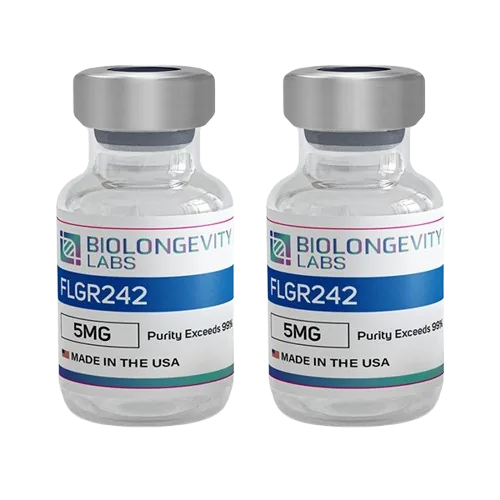
FLGR242, is a novel fragmented, modified version of Follistatin-344 (FST-344) that does not bind to the protein activin. Activin is responsible for the negative effects of myostatin inhibition such as unwanted cellular growth in laboratory models. It also contains a patented albumin binder.
Follistatin protein (FST) fused with an albumin-binding construct that uses a hydrophilic glycine-serine linker to achieve high-affinity binding to serum albumin (<20 nM Kd). This recombinant technology allows researchers to study follistatin-albumin interactions and protein trafficking in experimental systems.
Research applications include muscle mass development studies, activin neutralization assays, and TGF-β superfamily pathway modulation with albumin binding dynamics. The construct maintains biological activity while enabling investigation of albumin as a carrier protein.
US GMP-manufactured with third-party verification and comprehensive COAs for reproducible research outcomes.
These peptides are freeze-dried, a process that not only extends shelf life but also preserves the purity and integrity of the peptides during storage. We do not use any fillers in this process.
Product Usage:
This PRODUCT IS INTENDED AS A RESEARCH CHEMICAL ONLY. This designation allows the use of research chemicals strictly for in vitro testing and laboratory experimentation only. This product should only be handled by licensed, qualified professionals. This product is not a drug, food, or cosmetic and may not be misbranded, misused or mislabeled as a drug.
Follistatin Research
Follistatin is a secreted glycoprotein that binds and neutralizes members of the TGF-β superfamily, with research focusing on its interactions with myostatin and bone morphogenetic proteins across multiple tissue types.
Myostatin and Muscle Mass Regulation
Follistatin acts as a myostatin antagonist, binding and sequestering this growth inhibitor to prevent interaction with cellular receptors. This inhibition blocks SMAD signaling cascades that normally limit muscle fiber development[1].
Laboratory models show follistatin increases muscle mass through enhanced fiber size rather than fiber number[2]. The protein also promotes satellite cell activation during muscle regeneration protocols[3].
Research indicates follistatin expression is regulated by nitric oxide and cyclic GMP pathways during myoblast fusion in cell culture systems[4].
Metabolic and Adipose Tissue Research
Follistatin induces browning of white adipose tissue in laboratory models through upregulation of UCP1 and thermogenic markers[5]. The protein enhances mitochondrial biogenesis and shifts cellular metabolism toward fat oxidation[6].
Studies show follistatin reduces hepatic glucose production while improving peripheral glucose uptake in metabolic research protocols[7]. These effects appear linked to modulation of FoxO1 signaling pathways in hepatic cell lines[8].
Tissue Repair and Regeneration Models
In wound healing studies, follistatin regulates keratinocyte proliferation and migration during repair processes[9]. The protein reduces fibrosis formation while promoting neovascularization in muscle injury models[3].
Cardiovascular and Angiogenic Properties
Follistatin-like proteins promote endothelial cell function and stimulate revascularization through nitric oxide synthase-dependent pathways[10]. The protein enhances endothelial cell proliferation, migration, and tube formation in angiogenesis assays[11].
Research demonstrates follistatin activates Akt signaling pathways in cardiomyocyte survival studies[12].
Bone and Cartilage Development
Follistatin modulates BMP signaling pathways that control osteogenic differentiation in mesenchymal stem cell cultures. The protein enhances cell migration and vascular development in bone tissue engineering models[11].
Laboratory studies show varied effects on bone formation markers depending on cellular context and experimental conditions[11].
Reproductive and Developmental Biology
Follistatin functions downstream of Wnt4 signaling during ovarian development in animal models[13].
Gonadotropin-releasing hormone pulse frequency controls follistatin expression in reproductive tissue studies[14].
Hepatic Function Studies
In liver research, follistatin influences hepatic steatosis through mTOR-dependent pathways[15]. The protein acts as a hepatokine affecting systemic energy metabolism when expressed in hepatic cell lines[16].
Laboratory protocols examine how follistatin regulates glucose production and lipid synthesis in metabolic research models[8].
Neuroprotective Mechanisms
Follistatin-like proteins attenuate neuronal apoptosis through Akt pathway activation in ischemic injury models. The protein affects neurogenesis and synaptic development through TGF-β superfamily signaling modulation in neural cell cultures[17].
References
S.-J. Lee et al., “Regulation of Muscle Mass by Follistatin and Activins,” The Endocrine Society, Oct. 2010. doi: 10.1210/me.2010-0127. https://doi.org/10.1210/me.2010-0127
S. S. Gangopadhyay, “Systemic administration of Follistatin288 increases muscle mass and reduces fat accumulation in mice,” Springer Science and Business Media LLC, Aug. 2013. doi: 10.1038/srep02441. https://doi.org/10.1038/srep02441
J. Zhu et al., “Follistatin Improves Skeletal Muscle Healing after Injury and Disease through an Interaction with Muscle Regeneration, Angiogenesis, and Fibrosis,” Elsevier BV, Aug. 2011. doi: 10.1016/j.ajpath.2011.04.008. https://doi.org/10.1016/j.ajpath.2011.04.008
A. Pisconti et al., “Follistatin induction by nitric oxide through cyclic GMP: a tightly regulated signaling pathway that controls myoblast fusion,” Rockefeller University Press, Jan. 2013. doi: 10.1083/jcb.2005070832003r. https://doi.org/10.1083/jcb.2005070832003r
M. Braga et al., “Follistatin promotes adipocyte differentiation, browning, and energy metabolism,” Elsevier BV, Mar. 2014. doi: 10.1194/jlr.m039719. https://doi.org/10.1194/jlr.m039719
S. Pervin, S. T. Reddy, and R. Singh, “Novel Roles of Follistatin/Myostatin in Transforming Growth Factor-β Signaling and Adipose Browning: Potential for Therapeutic Intervention in Obesity Related Metabolic Disorders,” Frontiers Media SA, Apr. 2021. doi: 10.3389/fendo.2021.653179. https://doi.org/10.3389/fendo.2021.653179
X. Han et al., “Mechanisms involved in follistatin‐induced hypertrophy and increased insulin action in skeletal muscle,” Wiley, Aug. 2019. doi: 10.1002/jcsm.12474. https://doi.org/10.1002/jcsm.12474
R. Tao, O. Stöhr, C. Wang, W. Qiu, K. D. Copps, and M. F. White, “Hepatic follistatin increases basal metabolic rate and attenuates diet-induced obesity during hepatic insulin resistance,” Elsevier BV, May 2023. doi: 10.1016/j.molmet.2023.101703. https://doi.org/10.1016/j.molmet.2023.101703
M. Antsiferova et al., “Keratinocyte-derived follistatin regulates epidermal homeostasis and wound repair,” Elsevier BV, Feb. 2009. doi: 10.1038/labinvest.2008.120. https://doi.org/10.1038/labinvest.2008.120
N. Ouchi et al., “Follistatin-like 1, a Secreted Muscle Protein, Promotes Endothelial Cell Function and Revascularization in Ischemic Tissue through a Nitric-oxide Synthase-dependent Mechanism,” Elsevier BV, Nov. 2008. doi: 10.1074/jbc.m803440200. https://doi.org/10.1074/jbc.m803440200
S. Fahmy-Garcia et al., “Follistatin Effects in Migration, Vascularization, and Osteogenesis in vitro and Bone Repair in vivo,” Frontiers Media SA, Mar. 2019. doi: 10.3389/fbioe.2019.00038. https://doi.org/10.3389/fbioe.2019.00038
Y. Oshima, N. Ouchi, K. Sato, Y. Izumiya, D. R. Pimentel, and K. Walsh, “Follistatin-Like 1 Is an Akt-Regulated Cardioprotective Factor That Is Secreted by the Heart,” Ovid Technologies (Wolters Kluwer Health), Jun. 2008. doi: 10.1161/circulationaha.108.767673. https://doi.org/10.1161/circulationaha.108.767673
H. H. C. Yao et al., “Follistatin operates downstream of Wnt4 in mammalian ovary organogenesis,” Wiley, Apr. 2004. doi: 10.1002/dvdy.20042. https://doi.org/10.1002/dvdy.20042
S. E. Kirk, A. C. Dalkin, M. Yasin, D. J. Haisenleder, and J. C. Marshall, “Gonadotropin-releasing hormone pulse frequency regulates expression of pituitary follistatin messenger ribonucleic acid: a mechanism for differential gonadotrope function.,” The Endocrine Society, Sep. 1994. doi: 10.1210/endo.135.3.8070381. https://doi.org/10.1210/endo.135.3.8070381
J. Tong et al., “Follistatin Alleviates Hepatic Steatosis in NAFLD via the mTOR Dependent Pathway,” Informa UK Limited, Oct. 2022. doi: 10.2147/dmso.s380053. https://doi.org/10.2147/dmso.s380053
C. Schumann et al., “Increasing lean muscle mass in mice via nanoparticle-mediated hepatic delivery of follistatin mRNA,” Ivyspring International Publisher, 2018. doi: 10.7150/thno.27847. https://doi.org/10.7150/thno.27847
X. Liang et al., “Follistatin-Like 1 Attenuates Apoptosis via Disco-Interacting Protein 2 Homolog A/Akt Pathway After Middle Cerebral Artery Occlusion in Rats,” Ovid Technologies (Wolters Kluwer Health), Oct. 2014. doi: 10.1161/strokeaha.114.006092. https://doi.org/10.1161/strokeaha.114.006092
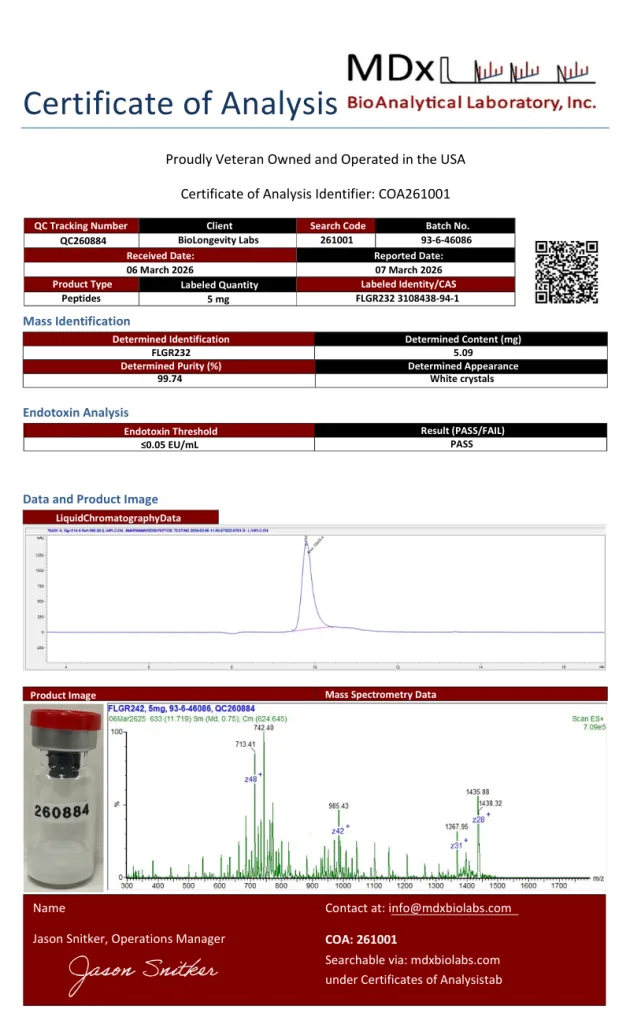
A Certificate of Analysis (COA) is a document that verifies a compound’s identity, purity and quality through independent laboratory testing. Every compound from BioLongevity Labs is third-party tested, and its COA is published here, so researchers can review the testing record before a compound enters a protocol.
Each COA reports results from third-party laboratory analysis, including:
Ultra-high-performance liquid chromatography with mass spectrometry (UHPLC-MS) for purity, measured against a 98% or 99% specification depending on the compound
Mass identification for molecular confirmation and content quantitation
Endotoxin testing by Limulus amebocyte lysate (LAL) or recombinant Factor C (rFC) assay, depending on the laboratory
Visual and physical characterization of the finished material
How to Verify a COA Independently
You can check every certificate against the issuing laboratory’s own records, not just the copy hosted here. Verification does not depend on BioLongevity Labs.
AV Analytics certificates carry a search code. Scan the QR code on the certificate to open the laboratory’s verification page, or enter the search code at avanalytical.com/coa-search to pull the official record.
BioRegen reports of analysis carry a Report ID and a Validation Key. Scan the QR code on the certificate to open the official record, or quote both identifiers when you contact the laboratory at the address printed on the report.
SafeCert Labs issued a number of earlier certificates. Each one carries a COA number and the signature of the reporting chemist. Quote that number when you ask the laboratory to confirm it.
Older certificates from other laboratories list their own verification details on the document.
When a batch is sent to more than one laboratory, each certificate resolves at its own issuing laboratory. A researcher can then check the results against two unrelated sources.
These COAs come from independent certified laboratories, not in-house testing. That gives researchers a verifiable record of molecular integrity for each compound. All compounds are supplied for research use only.
Scientifically reviewed by Dr. Ky H. Le, MD. Dr. Le is a board-certified family medicine physician with over 20 years of clinical experience. Dr. Le validates the scientific accuracy of all technical content and research citations.
Disclaimer: For Research Purposes Only
This content is provided strictly for research purposes and does not constitute an endorsement or recommendation for the non-laboratory application or improper handling of peptides designed for research. The information, including discussions about specific peptides and their researched benefits, is presented for informational purposes only and must not be construed as health, clinical, or legal guidance, nor an encouragement for non-research use. Peptides described here are solely for use in structured scientific study by authorized individuals. We advise consulting with research experts, medical practitioners, or legal counsel prior to any decisions about obtaining or utilizing these peptides. The expectation of responsible, ethical utilization of this information for legitimate investigative and scholarly objectives is paramount. This notice is dynamic and governs all provided content on research peptides.
FLGR242 (10mg)
Please select a variation
$299.00–$14,352.00Price range: $299.00 through $14,352.00