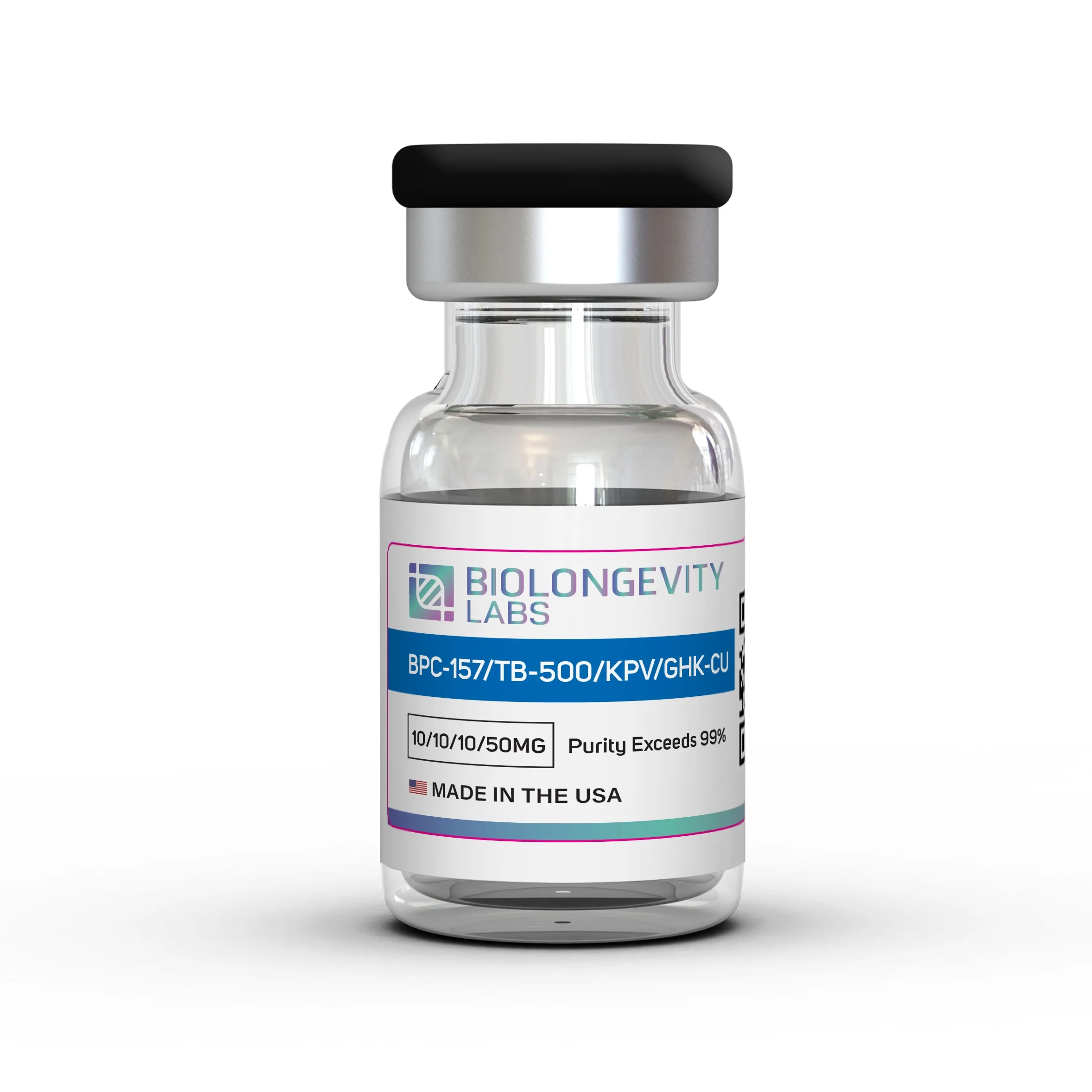
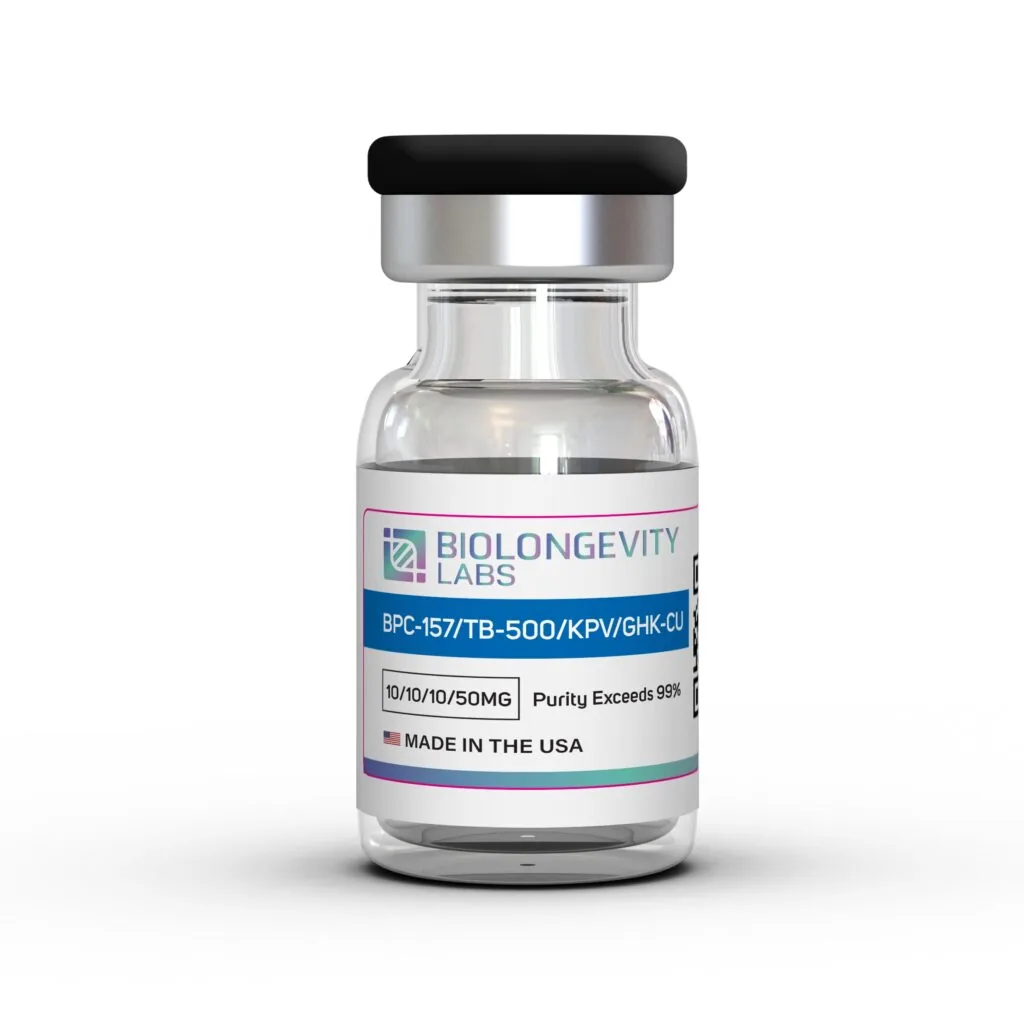
KLOW Blend is a four-component research preparation combining the copper-binding tripeptide GHK-Cu, the pentadecapeptide BPC-157, the 43-residue beta-thymosin polypeptide supplied under the TB-500 designation, and the melanocortin-derived tripeptide KPV. All four components are produced through controlled solid-phase peptide synthesis and combined into a single vial. The blend is supplied as a lyophilized powder at 80 mg total peptide content per vial, formulated as 50 mg GHK-Cu, 10 mg BPC-157, 10 mg TB-500, and 10 mg KPV.
≥99% Purity
Third-Party Tested
COA Available
U.S. Manufactured
Quantity
In stock
Third-Party Verified Quality
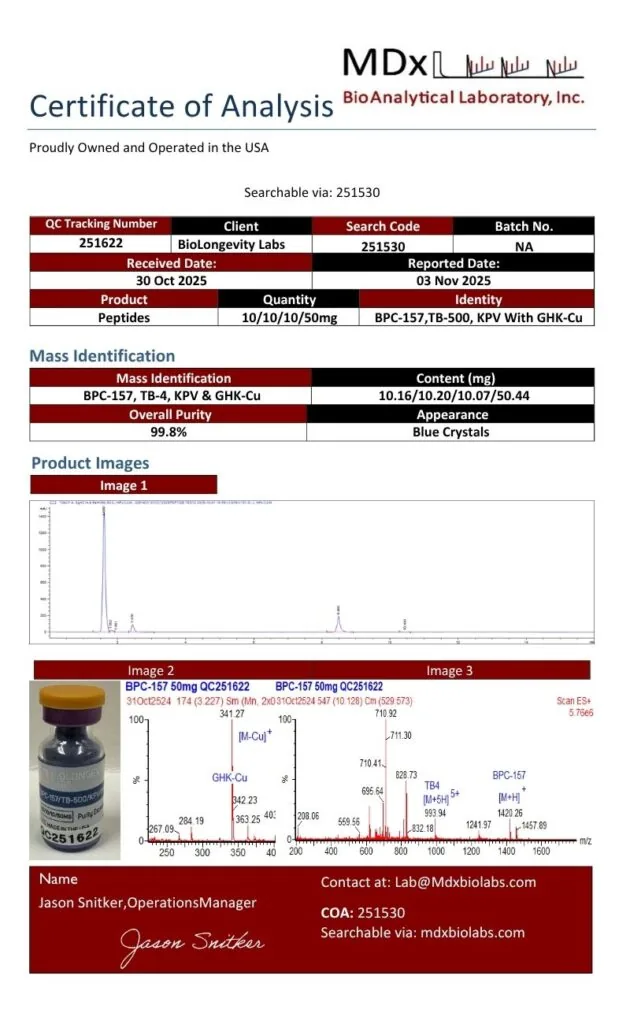
≥99% purity verified through independent UHPLC-MS testing. Certificates of Analysis are available before purchase.
COAs available before purchase
U.S.-manufactured research-grade
Same-business-day U.S. dispatch for in-stock orders placed before 12 PM PT
Secure Checkout · Free shipping on orders over $400
KLOW Blend is a co-formulated multi-peptide research article rather than a single chemical entity. Its name is an acronym assembled from the component designations, and each constituent retains its own CAS number, PubChem record, and published research literature. A blend of this kind is used in laboratory settings where more than one signaling pathway is being examined in parallel within the same experimental system.
The four components span three structural categories. GHK-Cu is a copper(II) coordination complex of the tripeptide glycyl-L-histidyl-L-lysine. BPC-157 and KPV are short linear peptides of fifteen and three residues respectively. The TB-500 component is a 43-residue acetylated polypeptide corresponding to the beta-thymosin sequence.
Because the components differ substantially in molecular weight, from 342 g/mol for KPV to roughly 4,963 g/mol for the beta-thymosin component, the specifications below are given per component rather than as a single averaged set of values. Researchers working with the blend should handle each constituent as a separate analyte for LC-MS and HPLC verification.
Compound Specifications
The blend-level summary applies to the vial as supplied. The four sub-tables below give verified identity data for each constituent as an individual chemical entity.
Store the lyophilized blend at -20°C or below, protected from light.
After reconstitution with a sterile laboratory solvent, store aliquots at -20°C or below and use promptly.
Aliquot before freezing to avoid repeated freeze-thaw cycles across the four components.
Maintain aseptic handling to preserve compound integrity.
Lyophilized Format
This compound ships in lyophilized (freeze-dried) form. Freeze-drying supports long-term storage stability and preserves compound integrity. No fillers are added.
Research Use Disclaimer
KLOW Blend is supplied for research use only. It is not a drug, food, cosmetic, or dietary supplement and has not been evaluated by the FDA. By purchasing, the buyer confirms the compound will be used solely for in vitro research.
Frequently Asked Questions
What Is KLOW Blend Made Of?
KLOW Blend contains four separately synthesized peptides in one vial: 50 mg GHK-Cu, 10 mg BPC-157, 10 mg TB-500, and 10 mg KPV, for 80 mg of total peptide content. Each component is supplied at ≥99% purity by HPLC and carries its own CAS number and PubChem record.
Which Entity Does the TB-500 Component Refer To?
The TB-500 component in KLOW Blend is the 43-residue acetylated beta-thymosin polypeptide, CAS 77591-33-4, PubChem CID 16132341. Its N-terminal tetrapeptide Ac-SDKP is a separate research entity that is generated from this sequence by prolyl oligopeptidase cleavage.
What Are the Molecular Weights of the KLOW Blend Components?
The four components range from 342.43 g/mol for KPV and 400.90 g/mol for GHK-Cu up to 1419.5 g/mol for BPC-157 and roughly 4,963 g/mol for the TB-500 component. Because the range is wide, each constituent is confirmed as a separate analyte during mass-spectrometric verification.
How Should KLOW Blend Be Stored in a Laboratory Setting?
KLOW Blend is stored lyophilized at -20°C or below and protected from light. Reconstituted material is aliquoted and kept at -20°C or below so that the four components are not subjected to repeated freeze-thaw cycles.
Why Is KLOW Blend Blue in Color?
The blue to blue-violet tint comes from the GHK-Cu component, which is a copper(II) coordination complex of the tripeptide glycyl-L-histidyl-L-lysine. The other three components are colorless peptides and do not contribute to the tint.
KLOW Blend Research Areas
GHK and its copper complex have been examined in laboratory work on extracellular matrix gene regulation. Reported observations in cultured fibroblast systems include modulation of collagen, decorin, and glycosaminoglycan synthesis alongside changes in metalloproteinase and metalloproteinase-inhibitor activity [1]. Broader transcriptional profiling work using connectivity-map methods has reported that GHK is associated with altered expression across large numbers of genes, including gene sets relevant to nervous-system function [2].
BPC-157 has been characterized in angiogenic signaling research. In endothelial cell culture and chorioallantoic membrane assays, BPC-157 exposure was associated with increased VEGFR2 expression and receptor internalization, together with activation of the VEGFR2-Akt-eNOS signaling axis; blocking endocytosis suppressed the observed tube-formation response [3]. A 2025 scoping review of the preclinical literature summarizes the same VEGFR2 and nitric oxide pathway involvement along with ERK1/2 signaling, while noting that controlled study data outside animal models remain limited [4].
The TB-500 component is studied primarily as an actin-sequestering polypeptide. Beta-thymosin binds monomeric G-actin and participates in cytoskeletal reorganization, a mechanism linked in cell-culture models to changes in migration behavior [5]. A second research thread concerns the Tβ4-POP-Ac-SDKP axis, in which prolyl oligopeptidase cleaves the parent sequence to release the N-terminal tetrapeptide Ac-SDKP, which is itself examined in fibrogenesis research models [6]. In TGF-β-stimulated lung fibroblast cultures, Ac-SDKP exposure was associated with reduced alpha-smooth muscle actin and collagen expression [7].
KPV corresponds to the C-terminal tripeptide of alpha-melanocyte-stimulating hormone. Laboratory work has reported that its observed inflammatory-signaling profile differs from that of the core melanocortin sequences and does not appear to require melanocortin receptor signaling, with interleukin-1 beta pathway involvement proposed instead [8].
Taken together, the four components map onto distinct and separately documented pathway sets, which is the reason the blend is used in multi-pathway in vitro designs.
Working With a Four-Component Blend Analytically
Because the constituents differ by more than an order of magnitude in molecular weight, purity and identity confirmation are performed per component rather than on the blend as a whole. Reversed-phase HPLC resolves the four peaks, and the InChIKey and monoisotopic mass values in the tables above allow each entity to be confirmed independently by LC-MS.
Research Area
In Vitro Application
Extracellular matrix gene regulation
Fibroblast culture models examining collagen, decorin, and metalloproteinase expression
Angiogenic signaling
Endothelial tube-formation assays examining VEGFR2, Akt, and eNOS pathway activity
Cytoskeletal dynamics
Cell-culture models of actin monomer sequestration and migration behavior
Fibrogenesis signaling
TGF-β-stimulated fibroblast models examining alpha-smooth muscle actin and collagen markers
Inflammatory signaling
Melanocortin and interleukin-1 beta pathway assays in cultured cell lines
Analytical method development
Multi-analyte HPLC and LC-MS separation and identity confirmation
References
Pickart L, Vasquez-Soltero JM, Margolina A. (2015). GHK Peptide as a Natural Modulator of Multiple Cellular Pathways in Skin Regeneration. BioMed Research International. https://pmc.ncbi.nlm.nih.gov/articles/PMC4508379/
Pickart L, Vasquez-Soltero JM, Margolina A. (2017). The Effect of the Human Peptide GHK on Gene Expression Relevant to Nervous System Function and Cognitive Decline. Brain Sciences. https://pmc.ncbi.nlm.nih.gov/articles/PMC5332963/
McGuire FP, Martinez R, Lenz A, Skinner L, Cushman DM. (2025). Regeneration or Risk? A Narrative Review of BPC-157 for Musculoskeletal Healing. Current Reviews in Musculoskeletal Medicine. https://pmc.ncbi.nlm.nih.gov/articles/PMC12446177/
Goldstein AL, Hannappel E, Sosne G, Kleinman HK. (2012). Thymosin β4: a multi-functional regenerative peptide. Basic properties and clinical applications. Expert Opinion on Biological Therapy. https://www.tandfonline.com/doi/abs/10.1517/14712598.2012.634793
Conte E, Iemmolo M, Fruciano M, et al. (2015). Effects of thymosin β4 and its N-terminal fragment Ac-SDKP on TGF-β-treated human lung fibroblasts and in the mouse model of bleomycin-induced lung fibrosis. Expert Opinion on Biological Therapy. https://www.tandfonline.com/doi/abs/10.1517/14712598.2015.1026804
Kannengiesser K, Maaser C, Heidemann J, et al. (2008). Melanocortin-derived tripeptide KPV has anti-inflammatory potential in murine models of inflammatory bowel disease. Inflammatory Bowel Diseases. https://academic.oup.com/ibdjournal/article/14/3/324/4653598
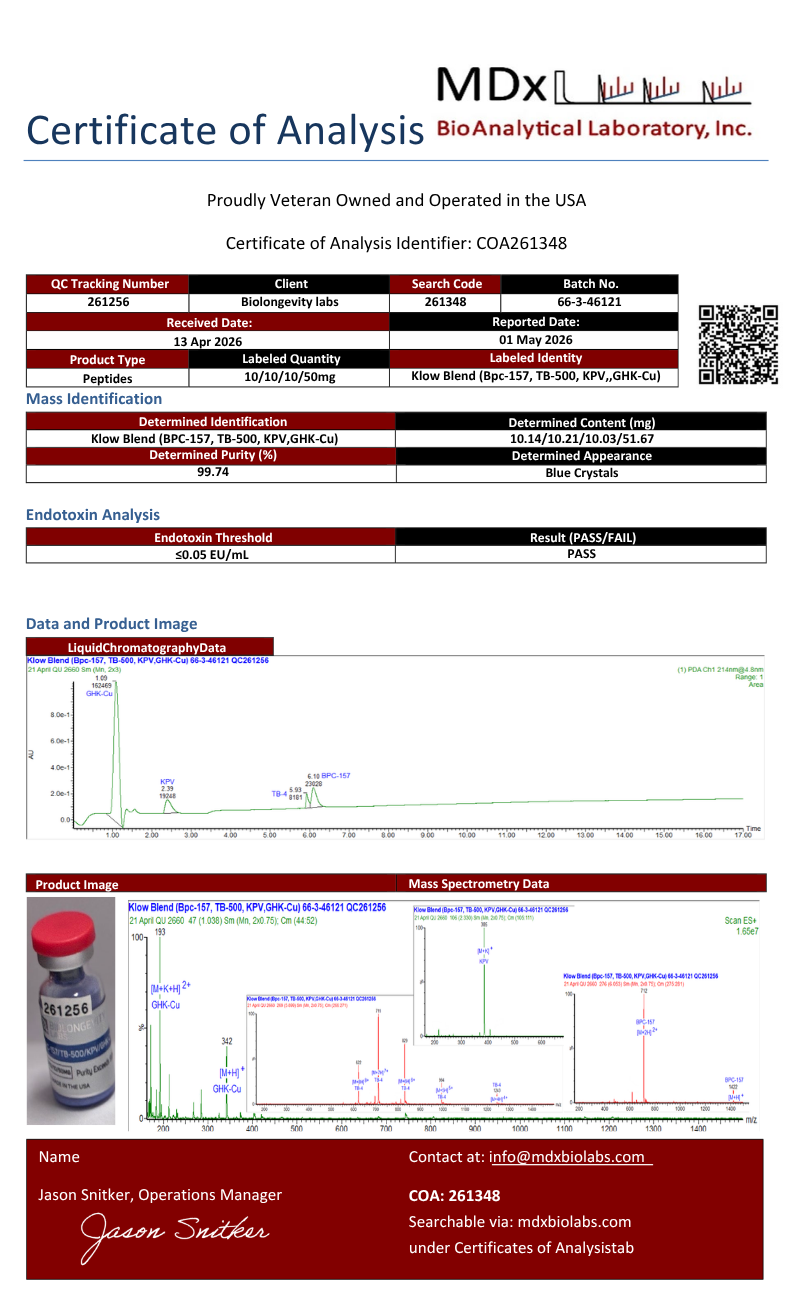
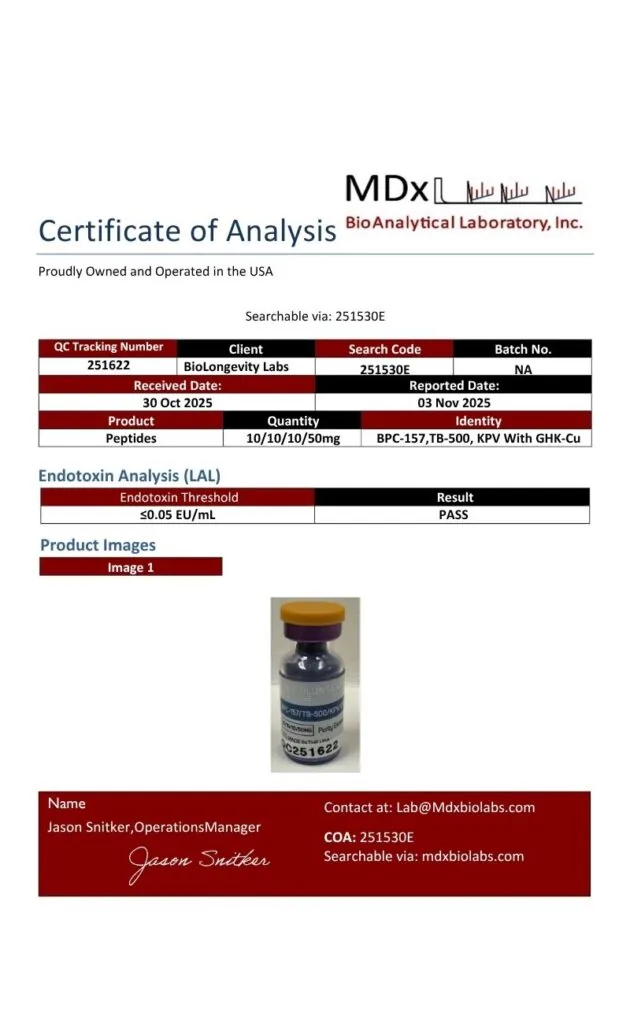
A Certificate of Analysis (COA) is a document that verifies a compound’s identity, purity and quality through independent laboratory testing. Every compound from BioLongevity Labs is third-party tested, and its COA is published here, so researchers can review the testing record before a compound enters a protocol.
Each COA reports results from third-party laboratory analysis, including:
Ultra-high-performance liquid chromatography with mass spectrometry (UHPLC-MS) for purity, measured against a 98% or 99% specification depending on the compound
Mass identification for molecular confirmation and content quantitation
Endotoxin testing by Limulus amebocyte lysate (LAL) or recombinant Factor C (rFC) assay, depending on the laboratory
Visual and physical characterization of the finished material
How to Verify a COA Independently
You can check every certificate against the issuing laboratory’s own records, not just the copy hosted here. Verification does not depend on BioLongevity Labs.
AV Analytics certificates carry a search code. Scan the QR code on the certificate to open the laboratory’s verification page, or enter the search code at avanalytical.com/coa-search to pull the official record.
BioRegen reports of analysis carry a Report ID and a Validation Key. Scan the QR code on the certificate to open the official record, or quote both identifiers when you contact the laboratory at the address printed on the report.
SafeCert Labs issued a number of earlier certificates. Each one carries a COA number and the signature of the reporting chemist. Quote that number when you ask the laboratory to confirm it.
Older certificates from other laboratories list their own verification details on the document.
When a batch is sent to more than one laboratory, each certificate resolves at its own issuing laboratory. A researcher can then check the results against two unrelated sources.
These COAs come from independent certified laboratories, not in-house testing. That gives researchers a verifiable record of molecular integrity for each compound. All compounds are supplied for research use only.
Scientifically reviewed by Dr. Ky H. Le, MD. Dr. Le is a board-certified family medicine physician with over 20 years of clinical experience. Dr. Le validates the scientific accuracy of all technical content and research citations.
Disclaimer: For Research Purposes Only
This content is provided strictly for research purposes and does not constitute an endorsement or recommendation for the non-laboratory application or improper handling of peptides designed for research. The information, including discussions about specific peptides and their researched benefits, is presented for informational purposes only and must not be construed as health, clinical, or legal guidance, nor an encouragement for non-research use. Peptides described here are solely for use in structured scientific study by authorized individuals. We advise consulting with research experts, medical practitioners, or legal counsel prior to any decisions about obtaining or utilizing these peptides. The expectation of responsible, ethical utilization of this information for legitimate investigative and scholarly objectives is paramount. This notice is dynamic and governs all provided content on research peptides.