Semax + Selank Blend Technical Overview
The Semax peptide is a seven-residue analog of the adrenocorticotropic hormone fragment ACTH(4-10). Its first four residues match ACTH(4-7), and a C-terminal Pro-Gly-Pro tail completes the sequence. It is also known as ACTH(4-7)PGP.
Selank, also known as TP-7, is a seven-residue analog of tuftsin, the tetrapeptide Thr-Lys-Pro-Arg. It carries the same Pro-Gly-Pro extension as Semax, so the two peptides share their last three residues while differing in their N-terminal sequences.
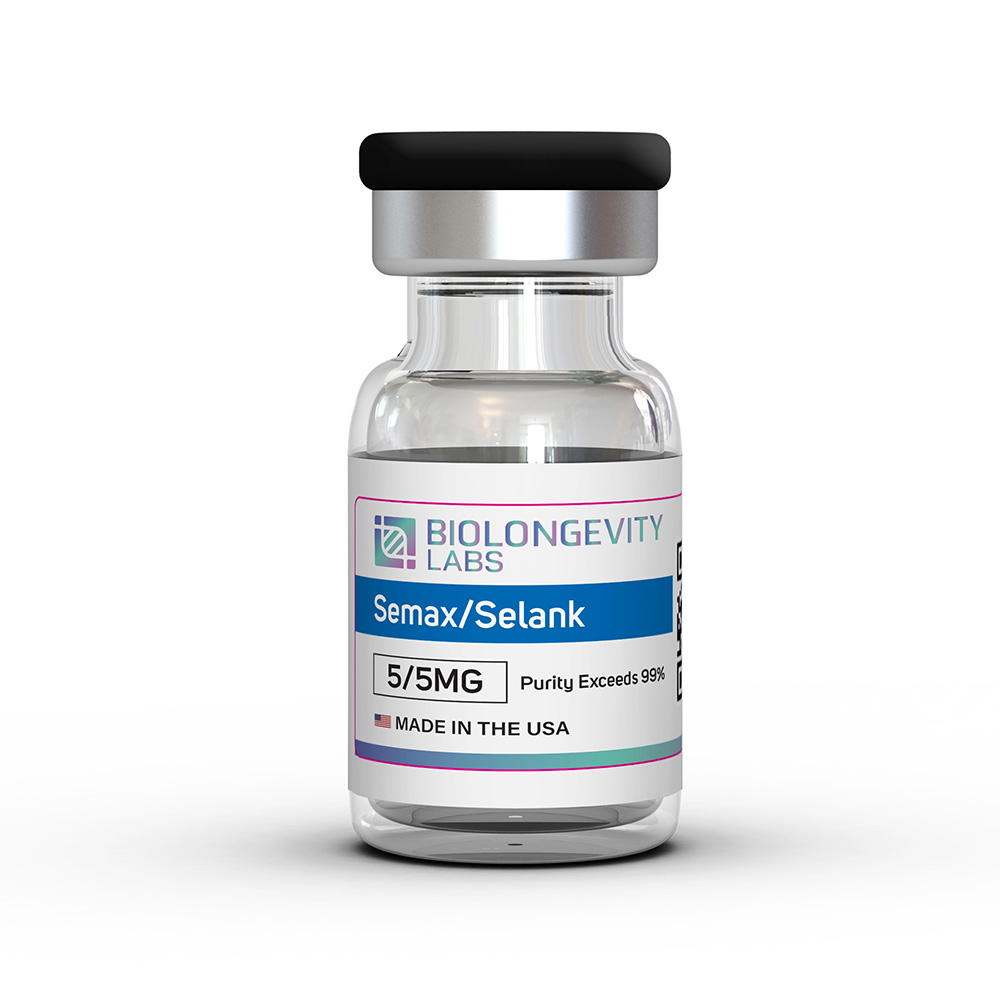
This Semax Selank peptide blend holds both sequences in one vial at equal mass and is offered for laboratory research use only.
Compound Specifications
| Property |
Semax |
Selank |
| CAS Number |
80714-61-0 |
129954-34-3 |
| PubChem CID |
9811102 |
11765600 |
| UNII |
I5FAL2585H |
TS9JR8EP1G |
| Molecular Formula |
C₃₇H₅₁N₉O₁₀S |
C₃₃H₅₇N₁₁O₉ |
| Molecular Weight |
813.9 g/mol |
751.9 g/mol |
| Monoisotopic Mass |
813.3480 Da |
751.4341 Da |
| InChIKey |
AFEHBIGDWIGTEH-AQRCPPRCSA-N |
JTDTXGMXNXBGBZ-YVHUGQOKSA-N |
| Amino Acid Sequence |
Met-Glu-His-Phe-Pro-Gly-Pro (MEHFPGP) |
Thr-Lys-Pro-Arg-Pro-Gly-Pro (TKPRPGP) |
| Sequence Length |
7 residues |
7 residues |
| Peptide Family |
ACTH(4-7) fragment with C-terminal Pro-Gly-Pro |
Tuftsin analog with C-terminal Pro-Gly-Pro |
| Synonyms |
ACTH(4-7)PGP, Pro-Gly-Pro-ACTH(4-7), MEHFPGP |
TP-7, Selanc, TKPRPGP |
| Source |
Synthetic |
Synthetic |
| Amount per Vial |
5mg |
5mg |
Blend Specifications
| Property |
Value |
| Total Peptide Content |
10mg per vial |
| Blend Ratio |
1:1 by mass (Semax:Selank) |
| Purity |
≥99% (HPLC) |
| Appearance |
White lyophilized powder |
| Storage |
-20°C, protect from light |
Storage and Handling
- Store the lyophilized blend at -20°C, sealed and protected from light.
- After reconstitution, store at 2 to 8°C and use promptly.
- Maintain aseptic handling to preserve compound integrity.
Lyophilized Format
This compound ships in lyophilized (freeze-dried) form. Freeze-drying supports long-term storage stability and preserves compound integrity. No fillers are added.
Research Use Disclaimer
The Semax / Selank Blend is supplied for research use only. It is not a drug, food, cosmetic, or dietary supplement and has not been evaluated by the FDA. By purchasing, the buyer confirms the compound will be used solely for in vitro research.
Frequently Asked Questions
What Is the Selank + Semax Blend?
The Selank + Semax Blend is a single lyophilized vial holding 5mg of Semax and 5mg of Selank, two synthetic seven-residue peptides, for 10mg of total peptide. BioLongevity Labs supplies it for research use only.
What Is the Difference Between Semax and Selank?
Semax (Met-Glu-His-Phe-Pro-Gly-Pro) is built on the ACTH(4-7) fragment and is studied mainly in BDNF and gene expression research, while Selank (Thr-Lys-Pro-Arg-Pro-Gly-Pro) is a tuftsin analog studied in GABAergic and immune gene research. Both peptides end in the same Pro-Gly-Pro sequence.
What Are the CAS Numbers and Molecular Weights of Semax and Selank?
Semax is listed under CAS number 80714-61-0 and PubChem CID 9811102, with a molecular formula of C37H51N9O10S and a molecular weight of 813.9 g/mol. Selank is listed under CAS number 129954-34-3 and PubChem CID 11765600, with a molecular formula of C33H57N11O9 and a molecular weight of 751.9 g/mol.
How Should the Semax + Selank Blend Be Stored?
The lyophilized Semax + Selank Blend should be stored at -20°C, sealed and protected from light. After reconstitution, the solution should be kept at 2 to 8°C and used promptly.
How Is Purity Verified for the Semax / Selank Blend?
Each Semax + Selank Blend batch is tested by an independent third-party laboratory to a ≥99% purity specification. The Certificate of Analysis for each batch is published online and can be reviewed before purchase.
Research Overview
Semax and Selank share a design. Each pairs a short native sequence with a C-terminal Pro-Gly-Pro tail, and each has its own body of research on neurotrophin signaling, gene expression and peptidase activity.
Most published work examines each peptide on its own, and one enzyme assay has tested both side by side.
Semax Research
In rats, a single Semax application was associated with a 1.4-fold rise in hippocampal BDNF protein and a 1.6-fold rise in trkB tyrosine phosphorylation [1]. The same study measured a 3-fold increase in exon III BDNF mRNA and a 2-fold increase in trkB mRNA, alongside more conditioned avoidance reactions in a learning task [1].
RNA sequencing of the rat hippocampus under an acute restraint stress model identified more than 1,500 differentially expressed genes after Semax application [2]. Many genes that shifted under restraint stress moved in the opposite direction with Semax, including genes linked to RNA biogenesis, translation, DNA replication and immune and nervous system function [2].
A genome-wide transcriptional study in a permanent middle cerebral artery occlusion (pMCAO) model in rats found that immune-related genes made up more than half of the genes Semax altered at 24 hours [3]. Immunoglobulin and chemokine genes formed the largest groups, and 24 vascular-system genes shifted at 3 hours [3].
Selank Research
In the rat frontal cortex, Selank changed the expression of 45 of 84 neurotransmission genes at 1 hour and 22 genes at 3 hours, with changes that correlated with those produced by GABA [4]. Radioligand binding work on brain cell membrane preparations reported that Selank affected [3H]GABA binding as a positive allosteric modulator [5].
In IMR-32 neuroblastoma cells, Selank alone did not change mRNA levels across an 84-gene GABAergic panel [6]. When combined with GABA, it nearly suppressed the expression changes that GABA produced on its own [6].
Outside the nervous system, a time-course study in mouse spleen tissue recorded a 3-fold drop in C3 complement mRNA 30 minutes after Selank, along with shifts in Casp1, Il2rg and Xcr1 expression [7]. The Gly-Pro fragment of Selank produced similar expression profiles for most of these genes [7].
Shared Enzyme Research
Semax and Selank were tested in the same assay of enkephalin-degrading enzymes in serum preparations, where both inhibited enzymatic activity in a concentration-dependent manner [8]. The reported IC50 values were 10 µM for Semax and 20 µM for Selank, and their pentapeptide fragments also showed inhibitory activity [8].
| Research Area |
In Vitro Application |
| BDNF and TrkB Signaling |
BDNF protein, trkB phosphorylation and mRNA measurement in hippocampal tissue |
| Transcriptome Profiling |
RNA sequencing and genome-wide expression analysis of brain tissue |
| GABAergic Gene Expression |
qPCR panels of neurotransmission genes in IMR-32 neuroblastoma cells |
| GABA Receptor Binding |
[3H]GABA radioligand binding on brain cell membrane preparations |
| Immune Gene Expression |
Time-course qPCR of inflammation-related genes in spleen tissue |
| Peptidase Inhibition |
Enkephalin-degrading enzyme assays in serum preparations |
References
- Dolotov OV, Karpenko EA, Inozemtseva LS, et al. (2006). Semax, an analog of ACTH(4-10) with cognitive effects, regulates BDNF and trkB expression in the rat hippocampus. Brain Research. https://doi.org/10.1016/j.brainres.2006.07.108
- Filippenkov IB, Stavchansky VV, Glazova NY, et al. (2021). Antistress Action of Melanocortin Derivatives Associated with Correction of Gene Expression Patterns in the Hippocampus of Male Rats Following Acute Stress. International Journal of Molecular Sciences. https://doi.org/10.3390/ijms221810054
- Medvedeva EV, Dmitrieva VG, Povarova OV, et al. (2014). The peptide semax affects the expression of genes related to the immune and vascular systems in rat brain focal ischemia: genome-wide transcriptional analysis. BMC Genomics. https://doi.org/10.1186/1471-2164-15-228
- Volkova A, Shadrina M, Kolomin T, et al. (2016). Selank Administration Affects the Expression of Some Genes Involved in GABAergic Neurotransmission. Frontiers in Pharmacology. https://doi.org/10.3389/fphar.2016.00031
- Vyunova TV, Andreeva L, Shevchenko K, et al. (2018). Peptide-based Anxiolytics: The Molecular Aspects of Heptapeptide Selank Biological Activity. Protein and Peptide Letters. https://doi.org/10.2174/0929866525666180925144642
- Filatova E, Kasian A, Kolomin T, et al. (2017). GABA, Selank, and Olanzapine Affect the Expression of Genes Involved in GABAergic Neurotransmission in IMR-32 Cells. Frontiers in Pharmacology. https://doi.org/10.3389/fphar.2017.00089
- Kolomin T, Morozova M, Volkova A, et al. (2013). The temporary dynamics of inflammation-related genes expression under tuftsin analog Selank action. Molecular Immunology. https://doi.org/10.1016/j.molimm.2013.11.002
- Kost NV, Sokolov OIu, Gabaeva MV, et al. (2001). Semax and selank inhibit the enkephalin-degrading enzymes from human serum. Bioorganicheskaia Khimiia. https://doi.org/10.1023/a:1011373002885
Certificate of Analysis (COA)
No COAs available for this product.
A Certificate of Analysis (COA) is a document that verifies a compound’s identity, purity and quality through independent laboratory testing. Every compound from BioLongevity Labs is third-party tested, and its COA is published here, so researchers can review the testing record before a compound enters a protocol.
Each COA reports results from third-party laboratory analysis, including:
- Ultra-high-performance liquid chromatography with mass spectrometry (UHPLC-MS) for purity, measured against a 98% or 99% specification depending on the compound
- Mass identification for molecular confirmation and content quantitation
- Endotoxin testing by Limulus amebocyte lysate (LAL) or recombinant Factor C (rFC) assay, depending on the laboratory
- Visual and physical characterization of the finished material
How to Verify a COA Independently
You can check every certificate against the issuing laboratory’s own records, not just the copy hosted here. Verification does not depend on BioLongevity Labs.
- AV Analytics certificates carry a search code. Scan the QR code on the certificate to open the laboratory’s verification page, or enter the search code at avanalytical.com/coa-search to pull the official record.
- BioRegen reports of analysis carry a Report ID and a Validation Key. Scan the QR code on the certificate to open the official record, or quote both identifiers when you contact the laboratory at the address printed on the report.
- SafeCert Labs issued a number of earlier certificates. Each one carries a COA number and the signature of the reporting chemist. Quote that number when you ask the laboratory to confirm it.
- Older certificates from other laboratories list their own verification details on the document.
When a batch is sent to more than one laboratory, each certificate resolves at its own issuing laboratory. A researcher can then check the results against two unrelated sources.
These COAs come from independent certified laboratories, not in-house testing. That gives researchers a verifiable record of molecular integrity for each compound. All compounds are supplied for research use only.
Review the latest COAs for this product below, or browse the full COA library.