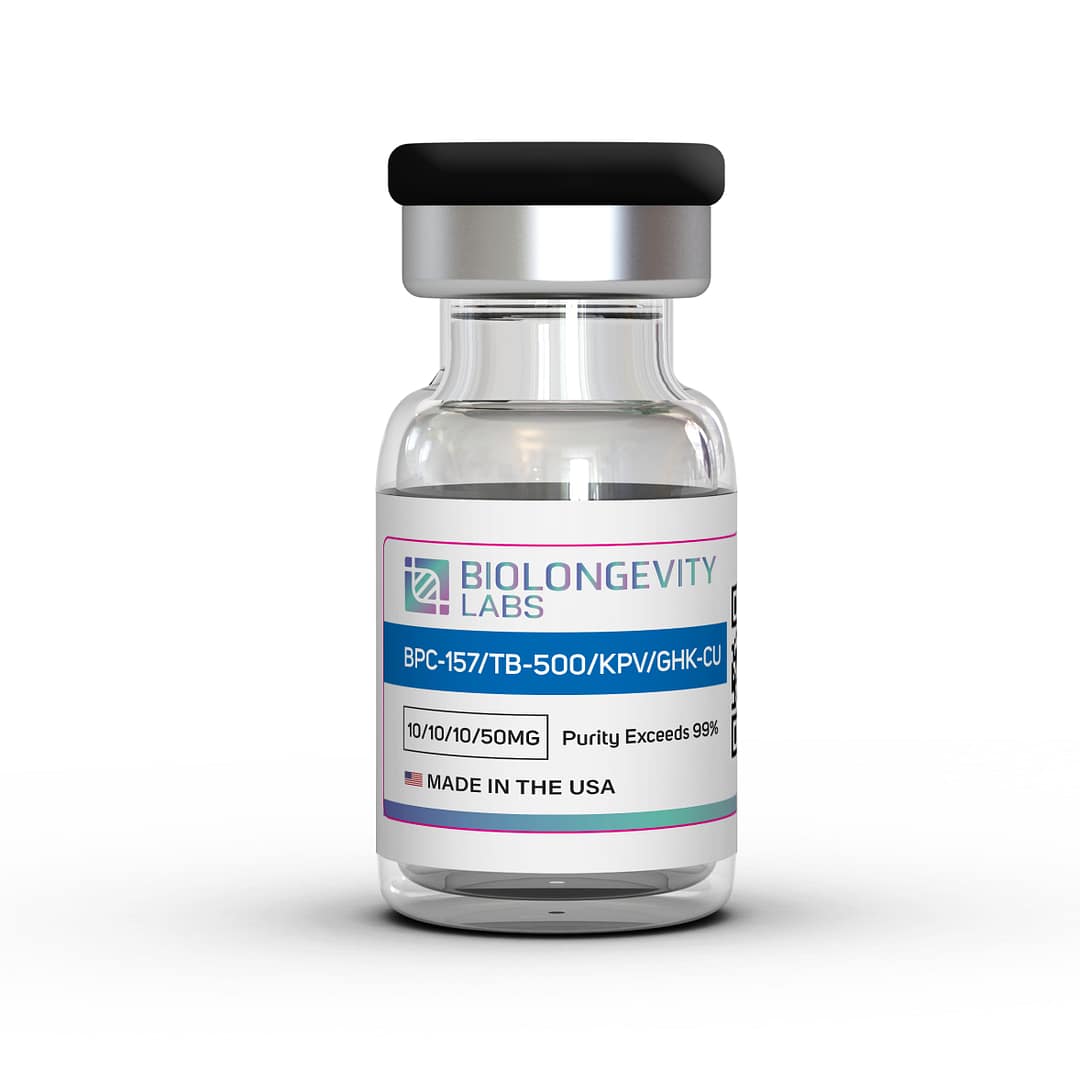
Research Overview: GHK-Cu, BPC-157, TB-500, and KPV
Laboratory investigations reveal synergistic mechanisms for cellular repair, vascular formation, and inflammatory modulation—valuable tools for in vitro research applications.
Angiogenesis and Vascular Formation
BPC-157 demonstrates a unique mechanism by upregulating VEGFR2 expression without affecting VEGF-A levels. This unusual pathway activates the VEGFR2-Akt-eNOS signaling cascade in vascular endothelial cell cultures[1].
GHK-Cu increased VEGF and bFGF expression by 230% in irradiated human dermal fibroblasts at nanomolar concentration[2]. Liposomal delivery systems showed 33.1% increased HUVEC proliferation rates with enhanced expression of cell cycle proteins[3].
TB-500 acts as a potent endothelial cell chemoattractant, stimulating 4-6-fold increases in HUVEC migration[4]. The peptide’s seven amino acid sequence LKKTET shows activity at approximately 50 nanomolar concentration.
Tissue Repair and Regeneration
The actions of the GHK-Cu peptide include modulating 31.2% of human genes (4,192 genes) with ≥50% expression changes[5]. The peptide binds to integrin-linked kinase on cell membranes, activating ILK-related pathways.
BPC-157 promotes tissue regeneration through FAK-paxillin pathway activation. This mechanism dramatically increases phosphorylation of focal adhesion kinase and paxillin proteins without changing total protein amounts[6].
TB-500’s regenerative effects stem from G-actin sequestration activity—binding monomeric G-actin in a 1:1 ratio. Rat wound healing models demonstrated 42-61% increased reepithelialization with enhanced collagen deposition[7].
Collagen Synthesis and Extracellular Matrix
GHK-Cu stimulates collagen synthesis at picomolar to nanomolar concentrations[8]. The peptide increased decorin production by 302% and stimulated glycosaminoglycan accumulation in skin fibroblasts.
BPC-157 enhances collagen formation across multiple tissue types in animal models. Studies show significantly increased collagen, reticulin, and blood vessel formation[9].
TB-500 demonstrates anti-fibrotic properties while promoting organized collagen deposition. Treated wounds show tightly organized mature collagen fibers with reduced myofibroblast formation[10].
Inflammatory Modulation
GHK-Cu works to reduce inflammation by inhibiting NF-κB p65 and p38 MAPK pathways. The peptide decreased ROS levels and reduced production of pro-inflammatory cytokines TNF-α and IL-6 in macrophage cell cultures[2].
BPC-157 decreased TNF-α, IL-6, and IL-1β levels in tissue samples. The peptide reduced COX-2 gene expression and myeloperoxidase activity in various inflammation models[11].
TB-500 exhibits biphasic regulation of the inflammatory response. The peptide downregulates TNF-α (6.2-fold reduction) and IL-6 (4.1-fold reduction) while upregulating anti-inflammatory IL-10 (8.1-fold increase)[12].
KPV inhibitsNF-κB activation at nanomolar concentrations through stabilization of IκB-α and prevention of p65RelA nuclear translocation[13]. The tripeptide enters cells via PepT1 transporter and reduces pro-inflammatory cytokine secretion in intestinal epithelial cells and macrophages[14].
Neuroprotection and Neural Mechanisms
GHK-Cu increases production of nerve growth factor and neurotrophins NT-3 and NT-4[15]. Delivery showed enhanced spatial memory and learning navigation in aging models.
BPC-157 demonstrates complex neurotransmitter system modulation[16]. The peptide interacts with dopaminergic systems without directly binding to dopamine receptors.
TB-500 provides neuroprotection through anti-apoptotic effects via caspase-3 inhibition. The peptide promotes oligodendrocyte progenitor cell proliferation and differentiation through p38 MAPKupregulation[17].
Cellular Migration and Proliferation
TB-500’s G-actin sequestration represents the primary mechanism for cellular migration[7]. Local photorelease of caged TB-500 causes directional cell turning in locomotingkeratocytes.
GHK-Cu acts as a potent chemoattractant for macrophages, mast cells, and capillary endothelial cells[18]. Irradiated fibroblasts treated with GHK showed growth dynamics similar to non-irradiated control cells.
BPC-157 regulates cellular migration through ERK1/2 phosphorylation[19]. Downstream transcription factors showed dramatic upregulation: c-Fos by 4.99-fold, c-Jun by 7.05-fold, and Egr-1 by 3.70-fold.
KPV promotes migration of keratinocytes and fibroblasts through modulation of collagen metabolism[20]. In corneal epithelial cell cultures, KPV increased cell viability at concentrations of 1-10 μM.
Wound Healing Mechanisms
BPC-157 demonstrates route-independent efficacy. The peptide accelerates cellular repair phases including inflammation, collagen deposition, angiogenesis, and epithelial repair[9].
GHK-Cu enhances wound healing through systemic effects and local tissue remodeling. Collagen dressing with incorporated GHK resulted in faster wound contraction and higher glutathione and ascorbic acid levels[5].
TB-500 promotes organized wound repair with anti-scarring properties. The peptide enhanced wound contraction by 11% and increased reepithelialization by 42-61% in full-thickness wound models[10].
KPV accelerates mucosal healing in dose-dependent manner[14]. In corneal epithelial wound models, KPV-treated tissue achieved complete re-epithelialization within 60 hours[20].
Oxidative Stress Response
GHK-Cu demonstrates potent ROS reduction in cell cultures[21]. The peptide increased superoxide dismutase activity and quenched hydroxyl and peroxyl radicals.
TB-500 provides targeted upregulation of antioxidant enzymes[11]. Pretreatment reduced intracellular ROS levels and upregulated Cu/Zn-SOD and catalase.
BPC-157 functions as a free radical scavenger. The peptide normalizes nitric oxide and malondialdehyde levels while increasing expression of antioxidant enzymes heme oxygenase-1 and NOS-3[11].
KPV inhibits reactive oxygen species production in keratinocytes exposed to oxidative stress[22]. The peptide modulates ERK and p38 MAPK pathways to protect cells from oxidative damage while maintaining cellular viability.
References
[1] M.-J. Hsieh et al., “Therapeutic potential of pro-angiogenic BPC157 is associated with VEGFR2 activation and up-regulation,” Springer Science and Business Media LLC, Nov. 2016. doi: 10.1007/s00109-016-1488-y. Available: https://doi.org/10.1007/s00109-016-1488-y
[2] Y. Dou, A. Lee, L. Zhu, J. Morton, and W. Ladiges, “The potential of GHK as an anti-aging peptide,” Ant Publishing, Mar. 2020. doi: 10.31491/apt.2020.03.014. Available: https://doi.org/10.31491/apt.2020.03.014
[3] X. Wang et al., “GHK‐Cu‐liposomes accelerate scald wound healing in mice by promoting cell proliferation and angiogenesis,” Wiley, Apr. 2017. doi: 10.1111/wrr.12520. Available: https://doi.org/10.1111/wrr.12520
[4] K. M. Malinda, A. L. Goldstein, and H. K. Kueinman, “Thymosin β 4 stimulates directional migration of human umbilical vein endothelial cells,” Wiley, May 1997. doi: 10.1096/fasebj.11.6.9194528. Available: https://doi.org/10.1096/fasebj.11.6.9194528
[5] L. Pickart and A. Margolina, “Regenerative and Protective Actions of the GHK-Cu Peptide in the Light of the New Gene Data,” MDPI AG, Jul. 2018. doi: 10.3390/ijms19071987. Available: https://doi.org/10.3390/ijms19071987
[6] C.-H. Chang, W.-C. Tsai, M.-S. Lin, Y.-H. Hsu, and J.-H. S. Pang, “The promoting effect of pentadecapeptide BPC 157 on tendon healing involves tendon outgrowth, cell survival, and cell migration,” American Physiological Society, Mar. 2011. doi: 10.1152/japplphysiol.00945.2010. Available: https://doi.org/10.1152/japplphysiol.00945.2010
[7] B. Xue, C. Leyrat, J. M. Grimes, and R. C. Robinson, “Structural basis of thymosin-β4/profilin exchange leading to actin filament polymerization,” Proceedings of the National Academy of Sciences, Oct. 2014. doi: 10.1073/pnas.1412271111. Available: https://doi.org/10.1073/pnas.1412271111
[8] F.-X. Maquart, L. Pickart, M. Laurent, P. Gillery, J.-C. Monboisse, and J.-P. Borel, “Stimulation of collagen synthesis in fibroblast cultures by the tripeptide‐copper complex glycyl‐L‐histidyl‐L‐lysine‐Cu2+,” Wiley, Oct. 1988. doi: 10.1016/0014-5793(88)80509-x. Available: https://doi.org/10.1016/0014-5793(88)80509-x
[9] S. Seiwerth et al., “Stable Gastric Pentadecapeptide BPC 157 and Wound Healing,” Frontiers Media SA, Jun. 2021. doi: 10.3389/fphar.2021.627533. Available: https://doi.org/10.3389/fphar.2021.627533
[10] K. M. Malinda et al., “Thymosin beta4 accelerates wound healing.,” Journal of Investigative Dermatology, vol. 113 3, pp. 364–8, 1999.
[11] H. Demirtaş, A. Özer, A. K. Yıldırım, A. D. Dursun, Ş. C. Sezen, and M. Arslan, “Protective Effects of BPC 157 on Liver, Kidney, and Lung Distant Organ Damage in Rats with Experimental Lower-Extremity Ischemia–Reperfusion Injury,” MDPI AG, Feb. 2025. doi: 10.3390/medicina61020291. Available: https://doi.org/10.3390/medicina61020291
[12] M. A. Evans et al., “Thymosin β4-sulfoxide attenuates inflammatory cell infiltration and promotes cardiac wound healing,” Springer Science and Business Media LLC, Jul. 2013. doi: 10.1038/ncomms3081. Available: https://doi.org/10.1038/ncomms3081
[13] G. Dalmasso, L. Charrier–Hisamuddin, H. T. Thu Nguyen, Y. Yan, S. Sitaraman, and D. Merlin, “PepT1-Mediated Tripeptide KPV Uptake Reduces Intestinal Inflammation,” Elsevier BV, Jan. 2008. doi: 10.1053/j.gastro.2007.10.026. Available: https://doi.org/10.1053/j.gastro.2007.10.026
[14] B. Xiao et al., “Orally Targeted Delivery of Tripeptide KPV via Hyaluronic Acid-Functionalized Nanoparticles Efficiently Alleviates Ulcerative Colitis,” Elsevier BV, Jul. 2017. doi: 10.1016/j.ymthe.2016.11.020. Available: https://doi.org/10.1016/j.ymthe.2016.11.020
[15] L. Pickart, J. M. Vasquez-Soltero, and A. Margolina, “The Human Tripeptide GHK-Cu in Prevention of Oxidative Stress and Degenerative Conditions of Aging: Implications for Cognitive Health,” Hindawi Limited, 2012. doi: 10.1155/2012/324832. Available: https://doi.org/10.1155/2012/324832
[16] J. Vukojevic et al., “Pentadecapeptide BPC 157 and the central nervous system,” Medknow, 2022. doi: 10.4103/1673-5374.320969. Available: https://doi.org/10.4103/1673-5374.320969
[17] S. Kim, J. Choi, and J. Kwon, “Thymosin Beta 4 Protects Hippocampal Neuronal Cells against PrP (106–126) via Neurotrophic Factor Signaling,” MDPI AG, May 2023. doi: 10.3390/molecules28093920. Available: https://doi.org/10.3390/molecules28093920
[18] L. Pickart, J. M. Vasquez-Soltero, and A. Margolina, “GHK Peptide as a Natural Modulator of Multiple Cellular Pathways in Skin Regeneration,” Wiley, 2015. doi: 10.1155/2015/648108. Available: https://doi.org/10.1155/2015/648108
[19] T. Huang et al., “Body protective compound-157 enhances alkali-burn wound healing in vivo and promotes proliferation, migration, and angiogenesis in vitro,” Informa UK Limited, Apr. 2015. doi: 10.2147/dddt.s82030. Available: https://doi.org/10.2147/dddt.s82030
[20] M. Böhm and T. Luger, “Are melanocortin peptides future therapeutics for cutaneous wound healing?,” Wiley, Feb. 2019. doi: 10.1111/exd.13887. Available: https://doi.org/10.1111/exd.13887
[21] S. Sharma, M. F. Anwar, A. Dinda, M. Singhal, and A. Malik, “In Vitro and in Vivo Studies of pH-Sensitive GHK-Cu-Incorporated Polyaspartic and Polyacrylic Acid Superabsorbent Polymer,” American Chemical Society (ACS), Nov. 2019. doi: 10.1021/acsomega.9b00655. Available: https://doi.org/10.1021/acsomega.9b00655
[22] J. Sung, S.-Y. Ju, S. Park, W.-K. Jung, J.-Y. Je, and S.-J. Lee, “Lysine-Proline-Valine peptide mitigates fine dust-induced keratinocyte apoptosis and inflammation by regulating oxidative stress and modulating the MAPK/NF-κB pathway,” Elsevier BV, Aug. 2025. doi: 10.1016/j.tice.2025.102837. Available: https://doi.org/10.1016/j.tice.2025.102837