Original price was: $94.97.$94.97Current price is: $94.97.$37.99
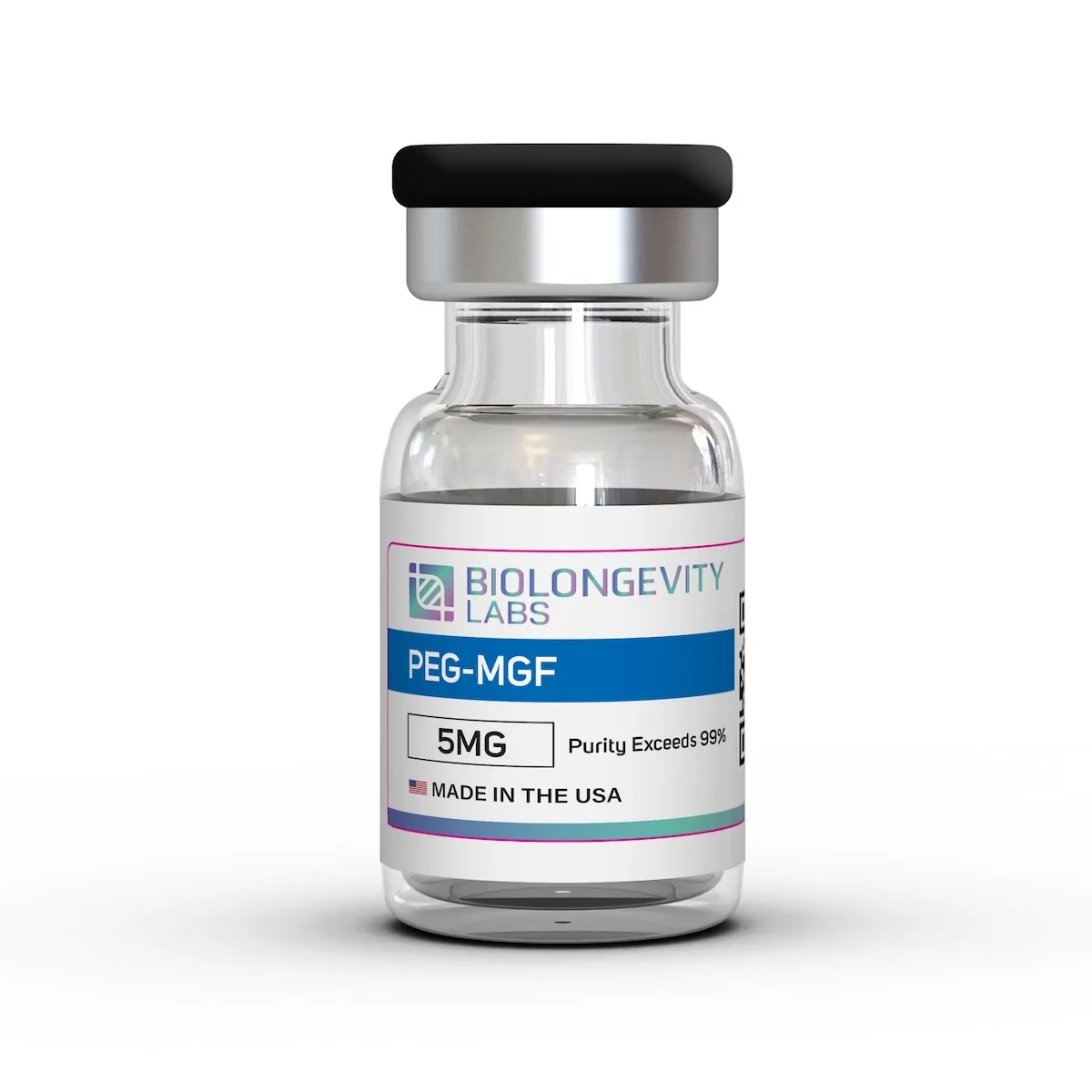
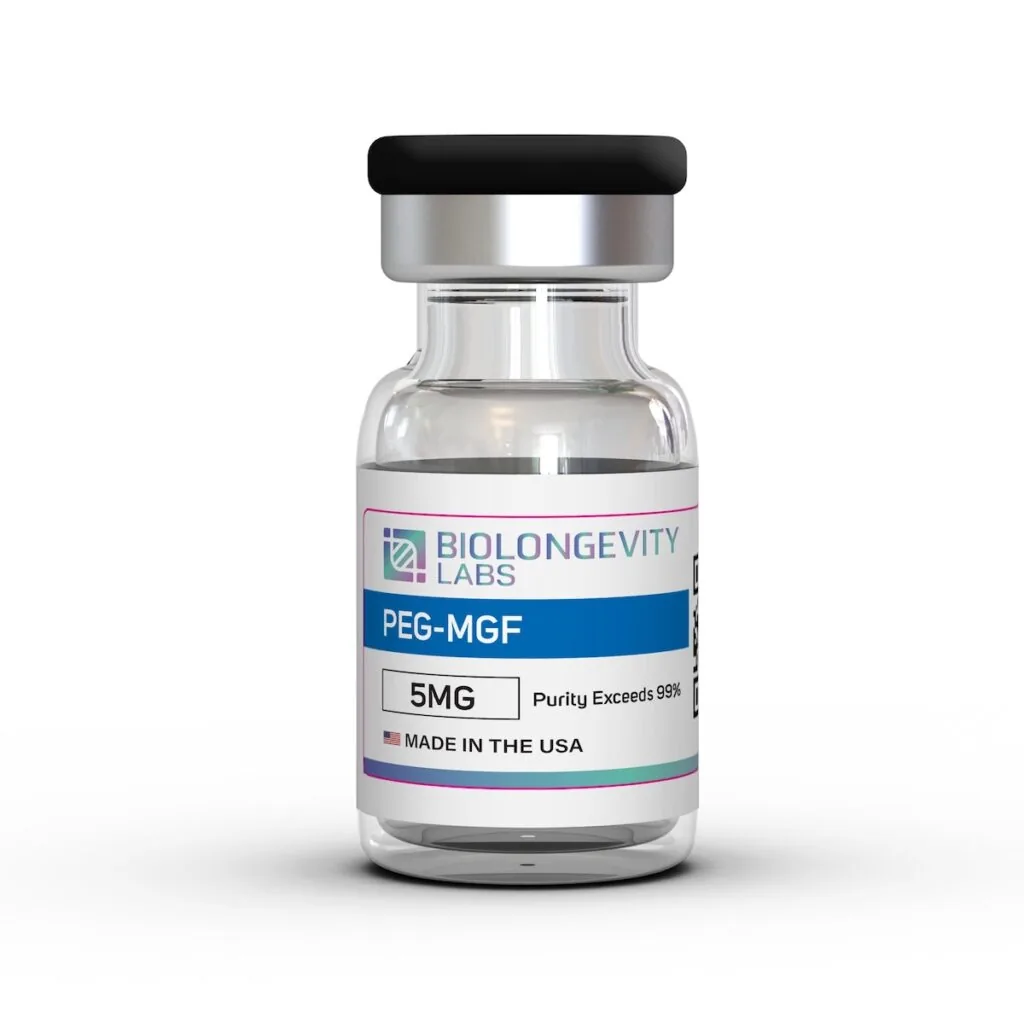
PEG-MGF is a PEGylated form of Mechano Growth Factor, a 24-residue synthetic peptide corresponding to the C-terminal segment of the E-domain of the IGF-1Ec splice variant. It is produced by solid-phase peptide synthesis and then conjugated to a polyethylene glycol chain. The compound is supplied as a lyophilized white powder in a 5mg vial with no fillers added. PEGylation increases the molecular size of the peptide and is used in peptide chemistry to lengthen the serum stability period of short sequences.
≥99% Purity
Third-Party Tested
COA Available
U.S. Manufactured
Quantity
Out of stock
Notify me when in stock
Third-Party Verified Quality
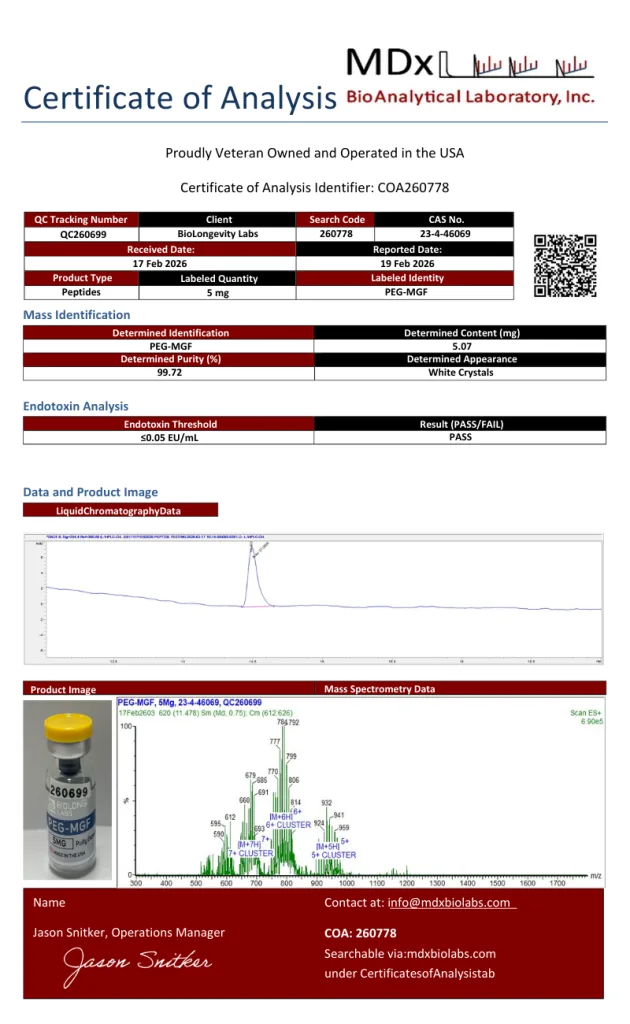
≥99% purity verified through independent UHPLC-MS testing. Certificates of Analysis are available before purchase.
COAs available before purchase
U.S.-manufactured research-grade
Same-business-day U.S. dispatch for in-stock orders placed before 12 PM PT
Secure Checkout · Free shipping on orders over $400
Alternative splicing of the IGF-1 gene produces several E-domain variants. The IGF-1Ec transcript carries an insert that shifts the reading frame at the 3′ end, and the final 24 residues of that E-domain are the sequence studied under the research designation Mechano Growth Factor.
The synthetic 24-residue peptide has been examined as a distinct entity from mature IGF-1, and the two behave differently in culture. Reviews of the literature note that no analogous peptide product of the Igf1 gene has been isolated from cultured cells or conditioned medium, so the material used in research is synthetic.
PEG-MGF applies a peptide modification step to that base sequence. The polyethylene glycol conjugate raises hydrodynamic radius and slows proteolytic clearance in solution, which is why PEGylated analogs are used where the unmodified sequence is short-lived. The material ships freeze-dried.
Compound Specifications
Note for laboratories: Identifier values below describe the base MGF (24-residue) peptide unless the row states otherwise. The PEGylated form has no single canonical registry entry because molecular weight varies with PEG chain length and attachment chemistry.
Property
Value
Compound Class
PEGylated synthetic peptide, IGF-1Ec E-domain C-terminal fragment
CAS Number (PEG-MGF)
[verify] no registry-verified CAS located for the PEGylated form
Synthetic, solid-phase peptide synthesis followed by PEG conjugation
Purity
≥99% (HPLC)
Appearance
Lyophilized white powder
Solubility
Soluble in water and in bacteriostatic water
Storage
-20°C, protect from light
Vial Size
5mg
Storage and Handling
Store the lyophilized compound at -20°C, protected from light.
After reconstitution, store at 2°C to 8°C and use promptly.
Maintain aseptic handling to preserve compound integrity.
Lyophilized Format
This compound ships in lyophilized (freeze-dried) form. Freeze-drying supports long-term storage stability and preserves compound integrity. No fillers are added.
PEG MGF Research
PEG-MGF demonstrates significant potential across multiple regenerative applications. The research explores its effectiveness in muscle repair and regeneration, bone and cartilage healing, stem cell regulation and protective effects in both neural and cardiac tissues.
Musculoskeletal Regeneration and Muscle Repair
MGF has been shown to enhance satellite cell activation, proliferation, and fusion in human muscle progenitor cells. The peptide can delay cellular senescence and improve muscle repair, suggesting potential for combating age-related muscle loss and improving myogenic precursor cell transplantation outcomes in conditions like Duchenne muscular dystrophy.[1]
Bone and Cartilage Repair
MGF promotes osteoblast proliferation, differentiation, and mineralization, and significantly enhance bone defect healing in animal models.[2]
In cartilage repair, MGF combined with TGF-β3 in silk fibroin scaffolds increases stem cell recruitment and chondrogenic differentiation, leading to improved articular cartilage regeneration and integration in rabbit models.[3]
Stem Cell Migration and Differentiation
MGF E peptides regulate the migration and differentiation of bone marrow mesenchymal stem cells (BMSCs). While they do not affect BMSC proliferation, they enhance migration and shift differentiation toward adipogenesis over osteogenesis, mediated via the IGF1 receptor and Erk1/2 signaling pathway.[4]
Neuroprotection and Cardiac Repair
The C-terminal peptide of MGF demonstrates strong neuroprotective effects in models of brain ischemia, functioning independently of the IGF-1 receptor and providing prolonged neuronal protection compared to full-length IGF-1.[5] In cardiac tissue, localized delivery of the MGF E-domain peptide via polymeric microstructures after myocardial infarction improves cardiac function, reduces mortality, and prevents adverse remodeling.[6]
References
Kandalla, P., Goldspink, G., Butler-Browne, G., & Mouly, V. (2011). Mechano Growth Factor E peptide (MGF-E), derived from an isoform of IGF-1, activates human muscle progenitor cells and induces an increase in their fusion potential at different ages. Mechanisms of Ageing and Development, 132, 154-162. https://doi.org/10.1016/j.mad.2011.02.007.
Wei, W., Liu, S., Song, J., Feng, T., Yang, R., Cheng, Y., Li, H., & Hao, L. (2020). MGF-19E peptide promoted proliferation, differentiation and mineralization of MC3T3-E1 cell and promoted bone defect healing.. Gene, 144703 . https://doi.org/10.1016/j.gene.2020.144703.
Cui, H., Yi, Q., Feng, J., Yang, L., & Tang, L. (2014). Mechano growth factor E peptide regulates migration and differentiation of bone marrow mesenchymal stem cells.. Journal of molecular endocrinology, 52 2, 111-20 . https://doi.org/10.1530/JME-13-0157.
Dłużniewska, J., Sarnowska, A., Beręsewicz, M., Johnson, I., Srai, S., Ramesh, B., Goldspink, G., Górecki, D., & Zabłocka, B. (2005). A strong neuroprotective effect of the autonomous C‐terminal peptide of IGF‐1 Ec (MGF) in brain ischemia. The FASEB Journal, 19. https://doi.org/10.1096/fj.05-3786fje.
Peña, J., Pinney, J., Ayala, P., Desai, T., & Goldspink, P. (2015). Localized delivery of mechano-growth factor E-domain peptide via polymeric microstructures improves cardiac function following myocardial infarction.. Biomaterials, 46, 26-34 . https://doi.org/10.1016/j.biomaterials.2014.12.050.
Certificate of Analysis (COA)
A Certificate of Analysis (COA) is a document that verifies a compound’s identity, purity and quality through independent laboratory testing. Every compound from BioLongevity Labs is third-party tested, and its COA is published here, so researchers can review the testing record before a compound enters a protocol.
Each COA reports results from third-party laboratory analysis, including:
Ultra-high-performance liquid chromatography with mass spectrometry (UHPLC-MS) for purity, measured against a 98% or 99% specification depending on the compound
Mass identification for molecular confirmation and content quantitation
Endotoxin testing by Limulus amebocyte lysate (LAL) or recombinant Factor C (rFC) assay, depending on the laboratory
Visual and physical characterization of the finished material
How to Verify a COA Independently
You can check every certificate against the issuing laboratory’s own records, not just the copy hosted here. Verification does not depend on BioLongevity Labs.
AV Analytics certificates carry a search code. Scan the QR code on the certificate to open the laboratory’s verification page, or enter the search code at avanalytical.com/coa-search to pull the official record.
BioRegen reports of analysis carry a Report ID and a Validation Key. Scan the QR code on the certificate to open the official record, or quote both identifiers when you contact the laboratory at the address printed on the report.
SafeCert Labs issued a number of earlier certificates. Each one carries a COA number and the signature of the reporting chemist. Quote that number when you ask the laboratory to confirm it.
Older certificates from other laboratories list their own verification details on the document.
When a batch is sent to more than one laboratory, each certificate resolves at its own issuing laboratory. A researcher can then check the results against two unrelated sources.
These COAs come from independent certified laboratories, not in-house testing. That gives researchers a verifiable record of molecular integrity for each compound. All compounds are supplied for research use only.
Scientifically reviewed by Dr. Ky H. Le, MD. Dr. Le is a board-certified family medicine physician with over 20 years of clinical experience. Dr. Le validates the scientific accuracy of all technical content and research citations.
Disclaimer: For Research Purposes Only
This content is provided strictly for research purposes and does not constitute an endorsement or recommendation for the non-laboratory application or improper handling of peptides designed for research. The information, including discussions about specific peptides and their researched benefits, is presented for informational purposes only and must not be construed as health, clinical, or legal guidance, nor an encouragement for non-research use. Peptides described here are solely for use in structured scientific study by authorized individuals. We advise consulting with research experts, medical practitioners, or legal counsel prior to any decisions about obtaining or utilizing these peptides. The expectation of responsible, ethical utilization of this information for legitimate investigative and scholarly objectives is paramount. This notice is dynamic and governs all provided content on research peptides.
PEG-MGF (5mg)
Please select a variation
Original price was: $94.97.$94.97Current price is: $94.97.$37.99