Vesilute Technical Overview
Vesilute is the product designation for L-α-glutamyl-L-aspartic acid, written H-Glu-Asp-OH and abbreviated ED in one-letter notation. The molecule carries CAS number 3918-84-1 and PubChem CID 99716, with the formula C₉H₁₄N₂O₇ and a molecular weight of 262.22 g/mol.
Vesilute is a distinct entity from Vesugen, which is the tripeptide Lys-Glu-Asp. The two carry different sequences, formulas, and registry numbers, and they are not interchangeable in a research protocol. Supplier documentation for the Khavinson bioregulator line lists the Vesilut component as an L-aspartic acid and L-glutamic acid construct, which matches the Glu-Asp dipeptide catalogued above.
Ultrashort peptides of this size are studied for membrane and nuclear permeability, for sequence-selective contacts with DNA and histone proteins, and for transporter-mediated cell entry. Vesilute is supplied to laboratories working in those areas as a reference-grade research material.
Compound Specifications
| Property |
Value |
| CAS Number |
3918-84-1 |
| PubChem CID |
99716 |
| Molecular Formula |
C₉H₁₄N₂O₇ |
| Molecular Weight |
262.22 g/mol |
| Monoisotopic Mass |
262.0800 Da |
| Amino Acid Sequence |
H-Glu-Asp-OH (one-letter: ED) |
| Sequence Length |
2 residues |
| InChIKey |
FYYSIASRLDJUNP-WHFBIAKZSA-N |
| Isomeric SMILES |
C(CC(=O)O)C@@HN |
| Synonyms |
Vesilut, Glu-Asp, H-Glu-Asp-OH, L-α-Glutamyl-L-aspartic acid, ED peptide |
| Source |
Synthetic |
| Purity |
≥99% (HPLC) |
| Appearance |
Lyophilized white powder |
| Storage |
-20°C, protect from light |
| Vial Size |
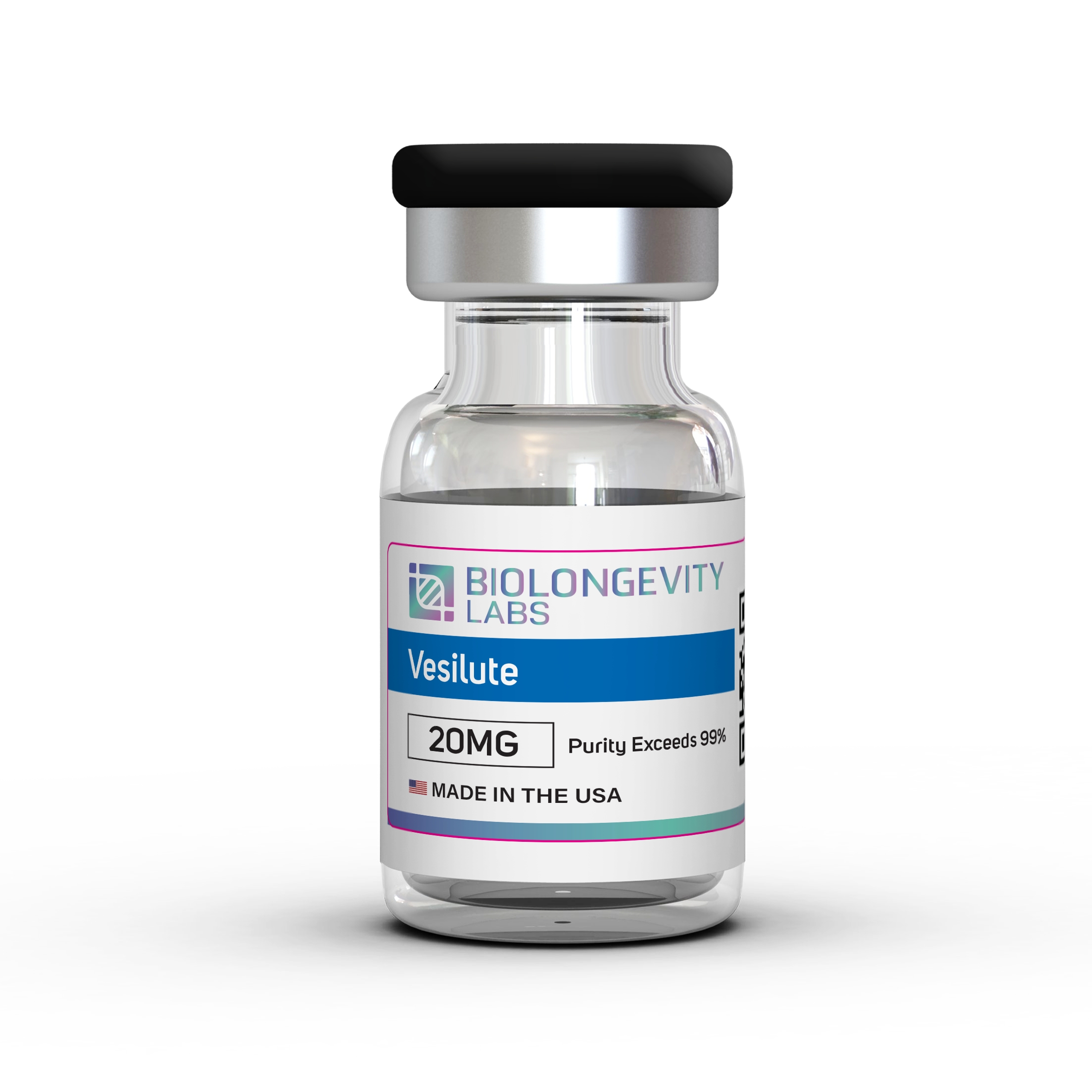
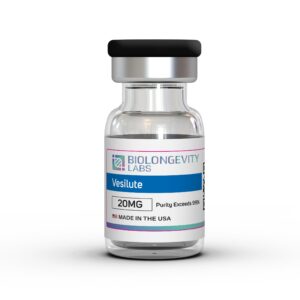
20mg |
Storage And Handling
- Store the sealed lyophilized vial at -20°C and protect it from light.
- After reconstitution, store at 2°C to 8°C and use promptly.
- Avoid repeated freeze-thaw cycles of reconstituted material.
- Maintain aseptic handling to preserve compound integrity.
Lyophilized Format
This compound ships in lyophilized (freeze-dried) form. Freeze-drying supports long-term storage stability and preserves compound integrity. No fillers are added.
Research Use Disclaimer
Vesilute is supplied for research use only. It is not a drug, food, cosmetic, or dietary supplement and has not been evaluated by the FDA. By purchasing, the buyer confirms the compound will be used solely for in vitro research.
Frequently Asked Questions
What Is Vesilute?
Vesilute is a synthetic dipeptide built from L-glutamic acid joined to L-aspartic acid, catalogued under CAS number 3918-84-1 and PubChem CID 99716. It belongs to the Khavinson family of ultrashort peptide bioregulators studied in cell-culture and molecular-modeling work.
What Is The Amino Acid Sequence Of Vesilute?
Vesilute has the sequence Glu-Asp, written H-Glu-Asp-OH and abbreviated ED, giving it two residues and a molecular weight of 262.22 g/mol.
Is Vesilute The Same As Vesugen?
No. Vesilute is the dipeptide Glu-Asp, while Vesugen is the tripeptide Lys-Glu-Asp, so the two differ in sequence, molecular formula, and CAS registry number.
How Is Vesilute Supplied And Stored?
Vesilute ships as 20mg of lyophilized white powder with no added fillers. Store the sealed vial at -20°C away from light and keep reconstituted material refrigerated for short-term laboratory work.
How Is The Purity Of Vesilute Verified?
Vesilute from BioLongevity Labs is assayed by HPLC to ≥99% purity, and third-party analytical documentation accompanies each production lot.
Vesilute Research Areas
Ultrashort peptides of two to four residues have been examined for their ability to cross cell and nuclear membranes and to make sequence-selective contacts with DNA, histone proteins, and non-coding RNA. A systematic review of that literature catalogued peptide interactions with promoter regions across plant, microbial, insect, avian, and rodent model systems, and framed those interactions as a route to altered gene expression in culture [1].
Molecular-modeling work names the Glu-Asp dipeptide directly. In a docking study of 26 biologically active ultrashort peptides against the LAT1, LAT2, and PEPT1 transporters, ED was among the sequences with the highest binding scores, alongside DS, DR, EDR, and EDG [2]. The authors grouped these together as peptides carrying a negatively charged Asp or Glu residue at the N-terminus, and proposed transporter-mediated uptake as a route into the cell for peptides of this class [2].
The peptide bond itself appears to matter in these models. A comparison of the Lys-Glu dipeptide against a mixture of its two free amino acids in organotypic spleen culture found opposite directions of effect on culture growth, and docking calculations placed the dipeptide in the DNA minor groove with a higher interaction energy than either amino acid alone [3]. That result is one reason Glu-Asp is studied as an intact dipeptide rather than as separate glutamic and aspartic acid inputs.
Cell-line work has extended the picture to signaling readouts. In the THP-1 monocytic cell line, five Khavinson peptides were reported to raise tyrosine phosphorylation of mitogen-activated cytoplasmic kinases, and to change TNF and IL-6 expression in cultures stimulated with bacterial lipopolysaccharide [4].
Two further research threads sit alongside the mechanistic work and are worth separating out.
Differentiation Models And Analytical Chemistry
Short peptides have been reviewed as inputs in cell-differentiation assays, with sequences including EDA grouped among those associated with changes in immune-cell differentiation in culture, and the direction of the observed change reported as dependent on peptide structure and concentration [5]. Separately, a UPLC-MS/MS panel quantified 33 dipeptides across paired biofluid samples, detecting 18 in cerebrospinal fluid and 20 in plasma [6]. That work establishes dipeptides as measurable analytes and gives method-development labs a published quantification framework to work from.
| Research Area |
In Vitro Application |
| Peptide transport |
Docking and uptake assays examining LAT1, LAT2, and PEPT1 as entry routes for ultrashort peptides |
| Gene expression regulation |
Promoter-binding and expression assays in cultured cell lines |
| Cell signaling |
Kinase phosphorylation and cytokine expression readouts in monocytic cell lines |
| Comparative peptide chemistry |
Culture models comparing intact dipeptides against free amino acid mixtures |
| Analytical method development |
LC-MS/MS reference standard work for dipeptide quantification |
References
- Khavinson VK, Popovich IG, Linkova NS, Mironova ES, Ilina AR (2021). Peptide Regulation of Gene Expression: A Systematic Review. Molecules, 26(22), 7053. https://pmc.ncbi.nlm.nih.gov/articles/PMC8619776/
- Khavinson VK, Linkova NS, Rudskoy AI, Petukhov MG (2023). Feasibility of Transport of 26 Biologically Active Ultrashort Peptides via LAT and PEPT Family Transporters. Biomolecules, 13(3), 552. https://pmc.ncbi.nlm.nih.gov/articles/PMC10046148/
- Khavinson VK, Tarnovskaya SI, Lin’kova NS, Chervyakova NA, Nichik TE, Elashkina EV, Chalisova NI (2015). Role of Peptide Bond in the Realization of Biological Activity of Short Peptides. Bulletin of Experimental Biology and Medicine, 158(4), 551-554. https://link.springer.com/article/10.1007/s10517-015-2805-0
- Avolio F, Martinotti S, Khavinson VK, Esposito JE, Giambuzzi G, Marino A, Mironova E, Pulcini R, Robuffo I, Bologna G, Simeone P, Lanuti P, Guarnieri S, Trofimova S, Procopio AD, Toniato E (2022). Peptides Regulating Proliferative Activity and Inflammatory Pathways in the Monocyte/Macrophage THP-1 Cell Line. International Journal of Molecular Sciences, 23(7), 3607. https://pmc.ncbi.nlm.nih.gov/articles/PMC8999041/
- Khavinson V, Linkova N, Diatlova A, Trofimova S (2020). Peptide Regulation of Cell Differentiation. Stem Cell Reviews and Reports, 16(1), 118-125. https://link.springer.com/article/10.1007/s12015-019-09938-8
- Küper K, Poschet G, Rossmann J, Garbade SF, Spiegelhalter A, Wen D, Hoffmann GF, Schmitt CP, Opladen T, Peters V (2024). Dipeptides in CSF and plasma: diagnostic and therapeutic potential in neurological diseases. Amino Acids, 57(1), 2. https://pmc.ncbi.nlm.nih.gov/articles/PMC11645304/
Certificate of Analysis (COA) for Every Batch
A Certificate of Analysis (COA) is a document that verifies a compound’s identity, purity, and batch quality through independent laboratory testing. Every compound from BioLongevity Labs ships with a COA tied to its specific batch, so researchers can confirm exactly what they received before it enters a protocol.
Each COA reports results from third-party laboratory analysis, including:
- Ultra-high-performance liquid chromatography with mass spectrometry (UHPLC-MS) for purity, typically confirmed at 99% or higher
- Mass identification for molecular confirmation and content quantitation
- Endotoxin quantitation by Limulus amebocyte lysate (LAL) assay where applicable
- Visual and physical characterization of the finished material
How to verify a COA independently
Every certificate can be checked against the issuing laboratory’s own records, not just the copy hosted here. Verification does not depend on BioLongevity Labs.
- MDx BioAnalytical Laboratory certificates carry a QC tracking number and a search code. Newer certificates also carry a QR code. Scan the code, or enter the search code at mdxbiolabs.com, to pull the official record.
- BioRegen reports of analysis carry a Report ID and a Validation Key. Scan the QR code on the certificate to open the official record, or reference both identifiers when contacting the laboratory at the address printed on the report.
- SafeCert Labs certificates, which appear on a number of earlier batches, carry a COA number and the signature of the reporting chemist. Reference that number when requesting confirmation from the laboratory directly.
Batches are frequently tested by both laboratories independently. When two certificates exist for the same lot, each one resolves at its own issuing laboratory, which lets a researcher confirm the same material twice through two unrelated sources.
COAs are sourced from independent certified labs rather than in-house testing alone, giving researchers a verifiable record of molecular integrity for each batch. All compounds are supplied for research use only.
Review the COAs for this batch below, or browse the full COA library.
No COAs available for this product.