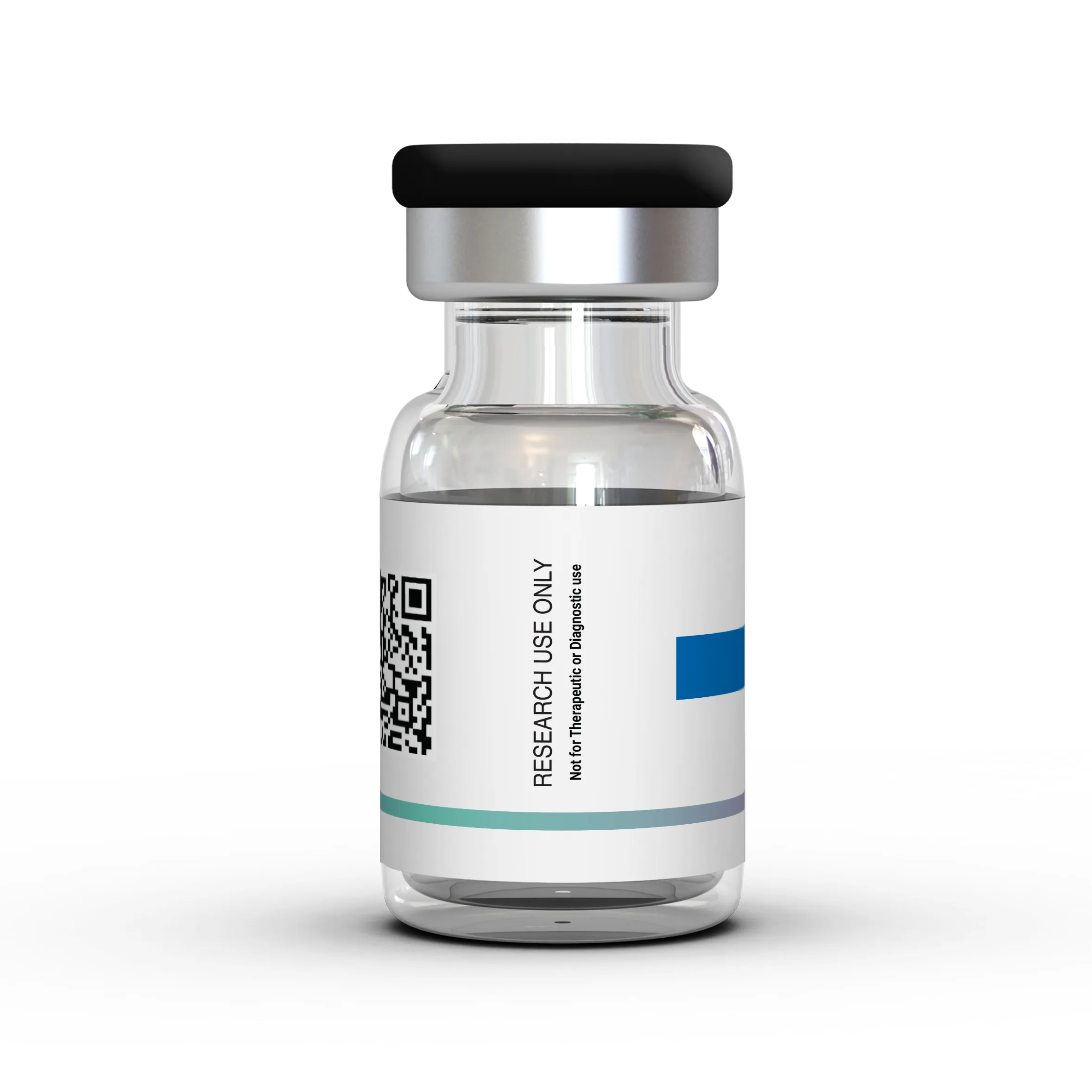
NAD+ MOTS-c 5-Amino-1MQ Blend Technical Overview
This blend brings together two small molecules and one peptide. NAD+ (nicotinamide adenine dinucleotide) is a dinucleotide coenzyme that carries electrons in redox reactions and serves as a substrate for sirtuins, CD38, and poly(ADP-ribose) polymerases [1].
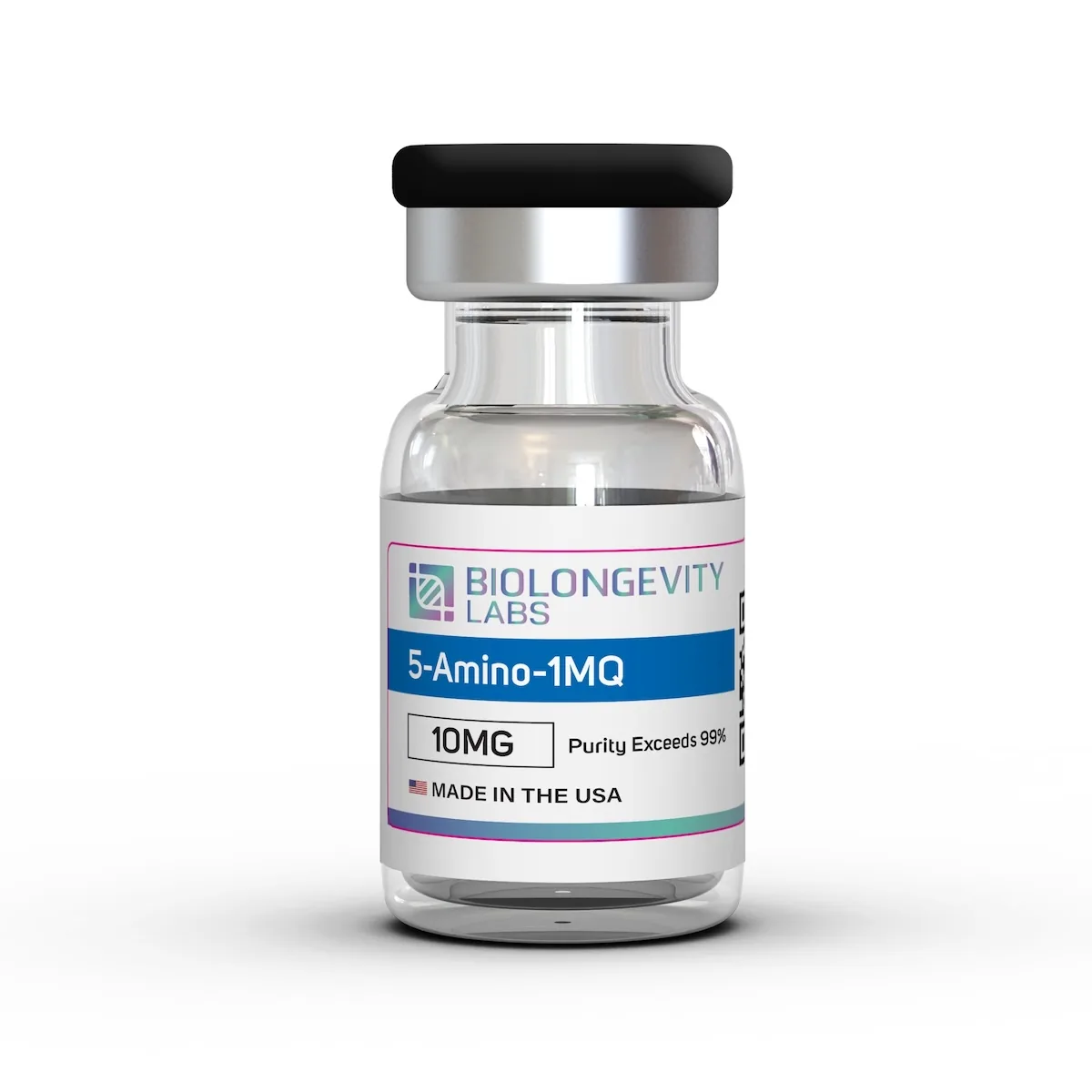
MOTS-c is a synthetic peptide matching a sequence encoded by a short open reading frame in the mitochondrial 12S rRNA gene [2]. 5-Amino-1MQ (5-amino-1-methylquinolinium) is a quaternary quinolinium compound, not a peptide, that binds the substrate site of NNMT [5].
The three compounds meet at one point in cell metabolism. NNMT uses nicotinamide, the salvage precursor of NAD+, and MOTS-c has been characterized in AMPK signaling under metabolic stress. That shared ground is why a NAD+, MOTS-c and 5-Amino-1MQ combination is of interest in metabolic and mitochondrial research models.
Compound Specifications
Each component carries its own identifiers, listed side by side below, followed by structure data for the two small molecules and the properties of the finished vial.
Component Identifiers
| Property | NAD+ | MOTS-c | 5-Amino-1MQ |
|---|---|---|---|
| Amount per Vial | 100mg | 10mg | 10mg |
| Compound Class | Dinucleotide coenzyme (small molecule) | Mitochondrial-derived peptide | Quinolinium derivative (small molecule) |
| CAS Number | 53-84-9 | 1627580-64-6 | 685079-15-6 [verify] |
| PubChem CID | 5892 | 146675088 | 950107 |
| Molecular Formula | C₂₁H₂₇N₇O₁₄P₂ | C₁₀₁H₁₅₂N₂₈O₂₂S₂ | C₁₀H₁₁N₂⁺ |
| Molecular Weight | 663.4 g/mol | 2174.6 g/mol | 159.21 g/mol |
| Monoisotopic / Exact Mass | 663.1091 Da | 2174.1111 Da | 159.0922 Da |
| InChIKey | BAWFJGJZGIEFAR-NNYOXOHSSA-N | WYTHCOXVWRKRAH-LOKRTKBUSA-N | ZMJBCEIHNOWCMC-UHFFFAOYSA-O |
| Amino Acid Sequence | Not applicable | MRWQEMGYIFYPRKLR (Met-Arg-Trp-Gln-Glu-Met-Gly-Tyr-Ile-Phe-Tyr-Pro-Arg-Lys-Leu-Arg) | Not applicable |
| Sequence Length | Not applicable | 16 residues | Not applicable |
| Source | Synthetic | Synthetic | Synthetic |
| UNII | 0U46U6E8UK | A5CV6JFB78 | PMX593N4N3 |
| ChEMBL ID | CHEMBL1234613 | Not listed | CHEMBL4116828 |
| Synonyms | Nadide, β-NAD, β-nicotinamide adenine dinucleotide, coenzyme I, diphosphopyridine nucleotide (DPN) | Mitochondrial open reading frame of the 12S rRNA-c, H-MRWQEMGYIFYPRKLR-OH | 5-Amino-1-methylquinolinium, 5-amino-1-methylquinolin-1-ium, 1-methylquinolin-1-ium-5-amine |
Small-Molecule Structure Data
| Property | NAD+ | 5-Amino-1MQ |
|---|---|---|
| Chemical Name (IUPAC) | [[(2R,3S,4R,5R)-5-(6-aminopurin-9-yl)-3,4-dihydroxyoxolan-2-yl]methoxy-hydroxyphosphoryl] [(2R,3S,4R,5R)-5-(3-carbamoylpyridin-1-ium-1-yl)-3,4-dihydroxyoxolan-2-yl]methyl phosphate | 1-methylquinolin-1-ium-5-amine |
| Canonical SMILES | C1=CC(=C[N+](=C1)C2C(C(C(O2)COP(=O)([O-])OP(=O)(O)OCC3C(C(C(O3)N4C=NC5=C(N=CN=C54)N)O)O)O)O)C(=O)N | C[N+]1=CC=CC2=C(C=CC=C21)N |
Blend Properties
| Property | Value |
|---|---|
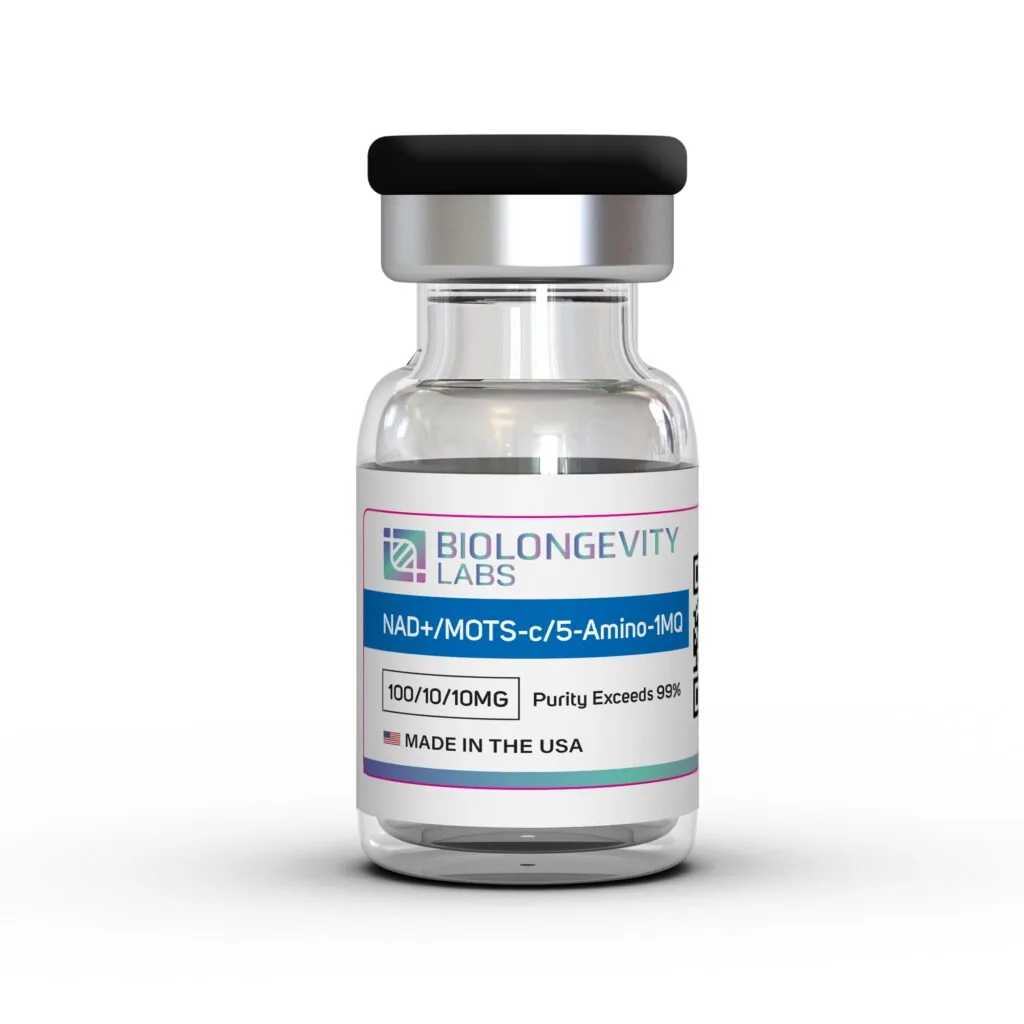
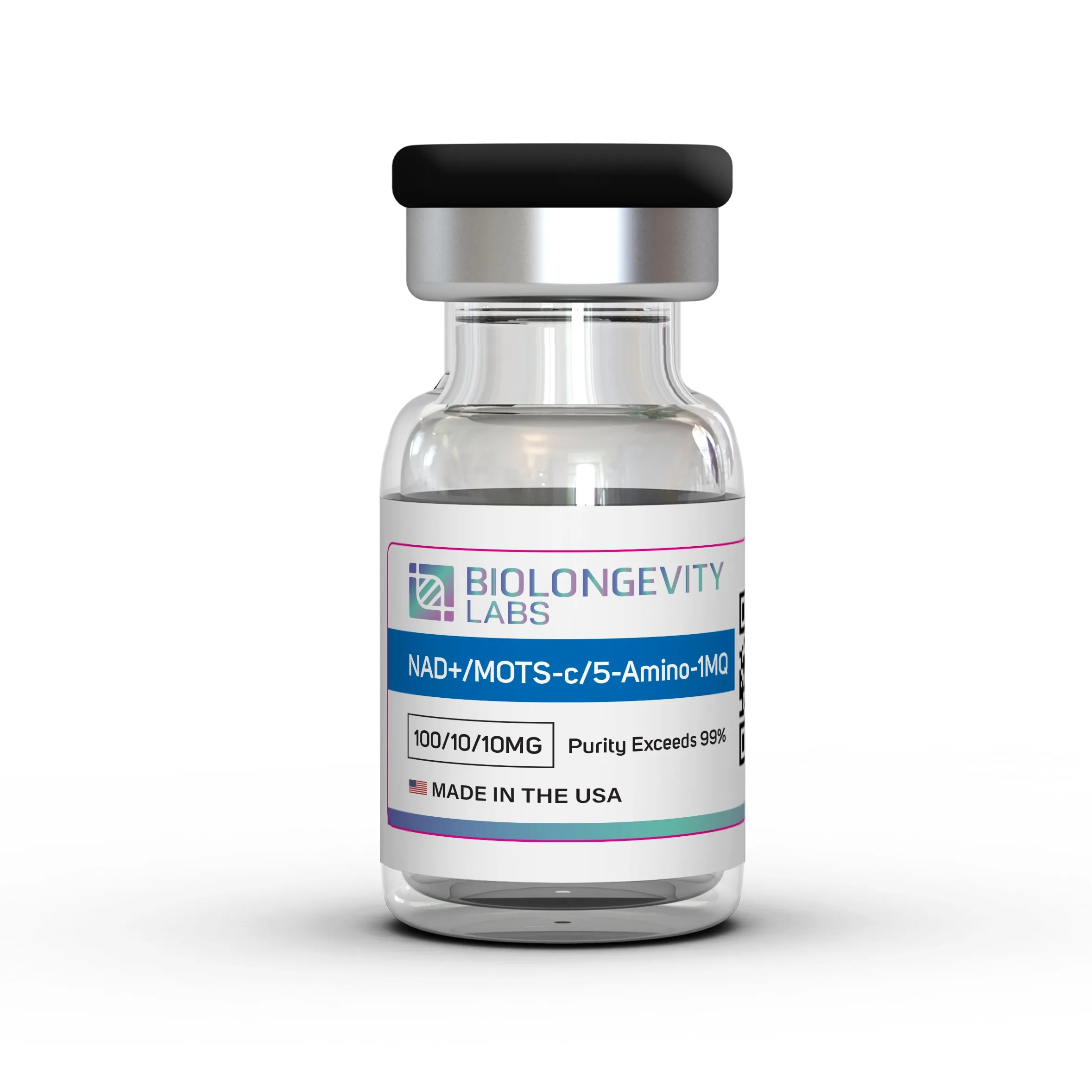
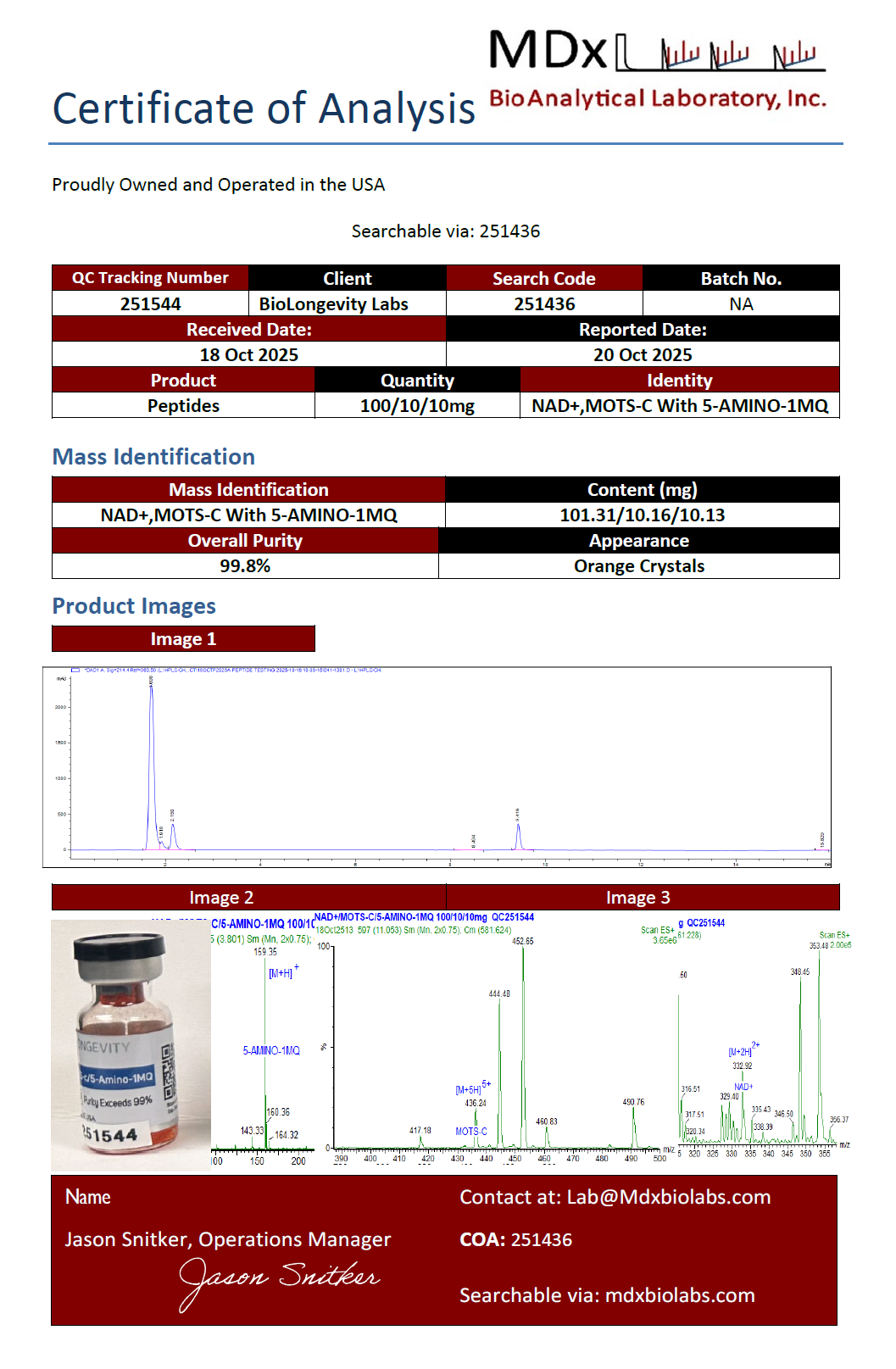
| Total Content | 120mg per vial (100mg NAD+, 10mg MOTS-c, 10mg 5-Amino-1MQ) |
| Format | Single co-lyophilized vial |
| Purity | ≥99% (HPLC) |
| Appearance | Lyophilized white to off-white powder |
| Solubility | Soluble in water |
| Storage | -20°C, protected from light and moisture |
Storage and Handling
- Store the lyophilized blend at -20°C, protected from light and moisture.
- After reconstitution, store at 2–8°C and use promptly.
- Maintain aseptic handling to preserve compound integrity.
Lyophilized Format
This compound ships in lyophilized (freeze-dried) form. Freeze-drying supports long-term storage stability and preserves compound integrity. No fillers are added.
Research Use Disclaimer
NAD+ / MOTS-c / 5-Amino-1MQ Blend is supplied for research use only. It is not a drug, food, cosmetic, or dietary supplement and has not been evaluated by the FDA. By purchasing, the buyer confirms the compound will be used solely for in vitro research.
Frequently Asked Questions
What Is the NAD+ MOTS-c 5-Amino-1MQ Blend?
The NAD+ MOTS-c 5-Amino-1MQ blend is a single lyophilized research vial that holds the coenzyme NAD+, the mitochondrial-derived peptide MOTS-c, and the NNMT inhibitor 5-Amino-1MQ. It is supplied for laboratory research on NAD+ metabolism, mitochondrial signaling, and NNMT activity.
How Much of Each Compound Is in the Vial?
Each vial of the blend contains 120mg in total: 100mg of NAD+, 10mg of MOTS-c, and 10mg of 5-Amino-1MQ. All three are co-lyophilized into one dry powder.
Is 5-Amino-1MQ a Peptide?
5-Amino-1MQ is not a peptide. It is a small-molecule quinolinium derivative (5-amino-1-methylquinolinium, PubChem CID 950107), while MOTS-c is the only peptide in the blend.
Why Are NAD+, MOTS-c and 5-Amino-1MQ Studied Together?
NAD+, MOTS-c and 5-Amino-1MQ each act on a linked part of cell metabolism: NAD+ redox and sirtuin chemistry, AMPK signaling, and NNMT, the enzyme that methylates the NAD+ precursor nicotinamide. Combining them lets researchers examine these connected pathways in one model system.
How Should the NAD+ MOTS-c 5-Amino-1MQ Blend Be Stored?
The lyophilized blend should be stored at -20°C, protected from light and moisture. After reconstitution, it should be kept at 2–8°C and used promptly.