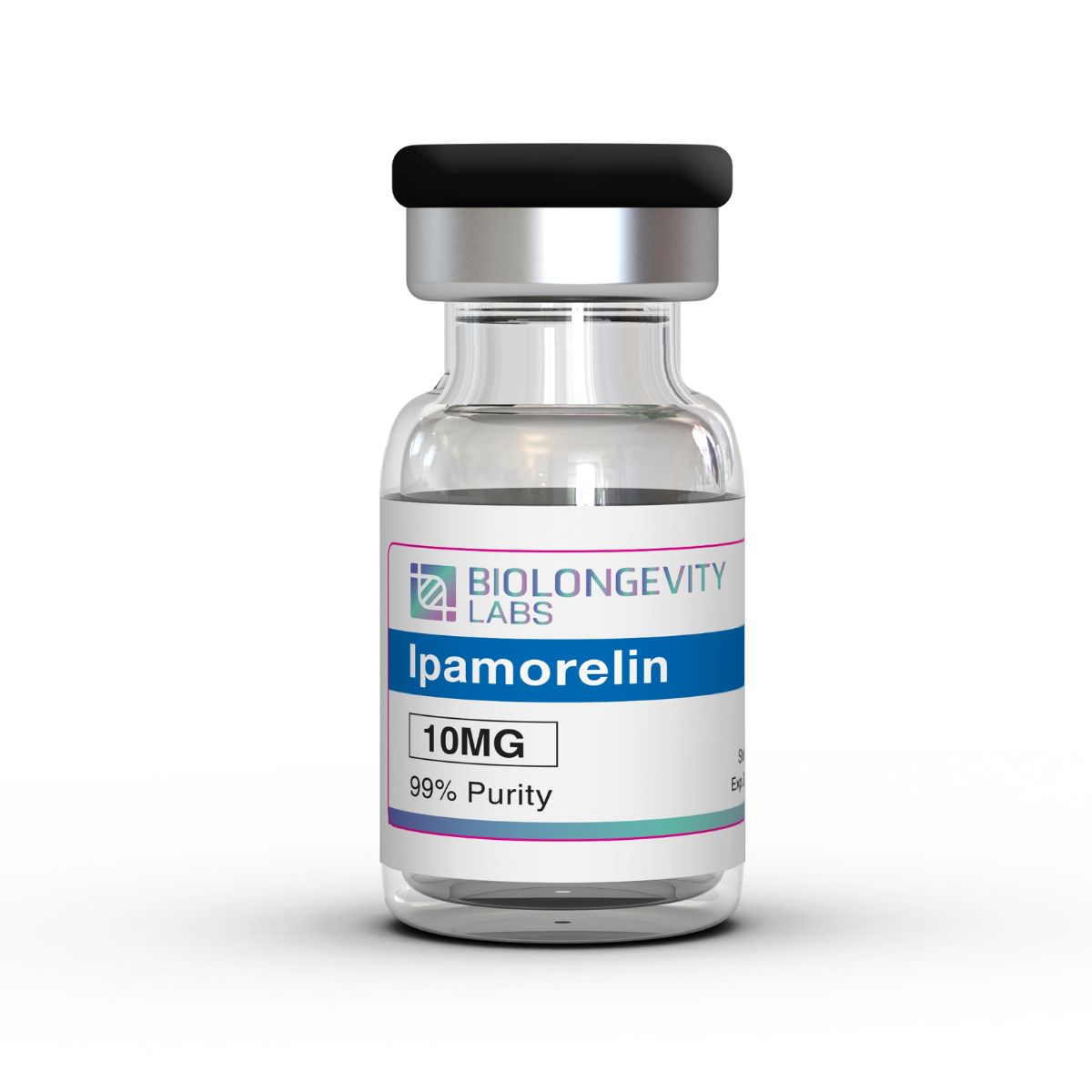
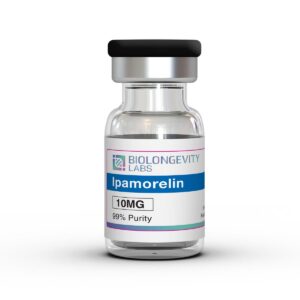
Ipamorelin Product Description
Ipamorelin belongs to the growth hormone-releasing peptide (GHRP) class and acts as a ghrelin mimetic in research models. It was identified in the 1990s from a series of compounds built around the GHRP scaffold and has since served as a reference tool for studying growth hormone secretagogue pharmacology.
The peptide is a five-residue chain capped with a C-terminal amide. Its structure engages the growth hormone secretagogue receptor subtype 1a (GHS-R1a), the same receptor bound by the endogenous ligand ghrelin.
Research on Ipamorelin centers on receptor-ligand interactions, pituitary somatotroph signaling, and downstream growth hormone pathways under controlled laboratory conditions. Its receptor selectivity makes it a frequent point of comparison in growth hormone secretagogue studies.
Compound Specifications
| Property |
Value |
| CAS Number |
170851-70-4 |
| PubChem CID |
9831659 |
| Molecular Formula |
C₃₈H₄₉N₉O₅ |
| Molecular Weight |
711.9 g/mol |
| Monoisotopic Mass |
711.3857 Da |
| Amino Acid Sequence |
Aib-His-D-2-Nal-D-Phe-Lys-NH₂ |
| Sequence Length |
5 residues (pentapeptide) |
| Source |
Synthetic |
| InChIKey |
NEHWBYHLYZGBNO-BVEPWEIPSA-N |
| UNII |
Y9M3S784Z6 |
| Purity |
≥99% (HPLC) |
| Appearance |
Lyophilized white to off-white powder |
| Solubility |
Soluble in water and DMSO |
| Storage |
-20°C, protect from light |
Storage and Handling
- Store the lyophilized compound at -20°C, protected from light and moisture.
- After reconstitution, store at 2-8°C and use promptly.
- Maintain aseptic handling to preserve compound integrity.
Lyophilized Format
This compound ships in lyophilized (freeze-dried) form. Freeze-drying supports long-term storage stability and preserves compound integrity. No fillers are added.
Research Use Disclaimer
Ipamorelin is supplied for research use only. It is not a drug, food, cosmetic, or dietary supplement and has not been evaluated by the FDA. By purchasing, the buyer confirms the compound will be used solely for in vitro research.
Ipamorelin Research
Ipamorelin was first characterized as a pentapeptide that releases growth hormone from primary rat pituitary cells with a receptor profile comparable to GHRP-6, while leaving ACTH, cortisol, prolactin, and thyroid-stimulating hormone levels largely unchanged in the models tested [1]. This receptor selectivity is the feature most often referenced when the compound is used as a research tool. Related work on the growth hormone axis has examined how secretagogues of this class interact with pituitary signaling.
In vitro analysis of pituitary cell cultures from young female rats reported changes in somatotroph populations and intracellular growth hormone content following chronic exposure to the peptide [2]. These cell-culture models remain a common setting for examining growth hormone synthesis and release pathways.
Metabolic research has examined the growth hormone-IGF-1 axis after repeated exposure to the peptide in rodent models, tracking IGF-1 levels and body-weight endpoints [6]. Skeletal research in an adult rat model reported increased periosteal bone formation when the secretagogue was studied alongside glucocorticoid exposure [5].
Ipamorelin is one of several compounds researchers pair conceptually with other growth hormone secretagogues, including CJC-1295 in comparative pathway studies.
Before reviewing the receptor-level work, it helps to note where the peptide sits relative to its target receptor.
Ghrelin Receptor Characterization
The GHS-R1a receptor is expressed in the pituitary and in the glandular stomach, and radiolabeled tracing studies have mapped secretagogue accumulation to these tissues [3]. This distribution has supported research linking the growth hormone-releasing peptides to the ghrelin signaling system.
Binding-affinity work using peptidomimetic secretagogue derivatives has characterized Ipamorelin and related structures at the ghrelin receptor, including their use as reference ligands in receptor-imaging probe design [4]. These assays position the compound as a defined reference point in GHS-R1a pharmacology.
| Research Area |
In Vitro Application |
| Receptor pharmacology |
GHS-R1a binding and activation assays in pituitary and transfected cell lines |
| Growth hormone signaling |
Somatotroph cell-culture models examining GH synthesis and release |
| Skeletal research |
Bone-tissue models examining periosteal formation pathways |
| Metabolic research |
GH-IGF-1 axis models tracking IGF-1 and body-composition endpoints |
References
- Raun K, Hansen BS, Johansen NL, et al. (1998). Ipamorelin, the first selective growth hormone secretagogue. European Journal of Endocrinology. DOI
- Jiménez-Reina L, Cañete R, de la Torre MJ, Bernal G (2002). Influence of chronic treatment with the growth hormone secretagogue Ipamorelin, in young female rats: somatotroph response in vitro. Histology and Histopathology. DOI
- Ahnfelt-Rønne I, Nowak J, Olsen UB (2001). Do growth hormone-releasing peptides act as ghrelin secretagogues? Endocrine. DOI
- Fowkes MM, Lalonde T, Yu L, Dhanvantari S, Kovacs MS, Luyt LG (2018). Peptidomimetic growth hormone secretagogue derivatives for positron emission tomography imaging of the ghrelin receptor. European Journal of Medicinal Chemistry. DOI
- Andersen NB, Malmlöf K, Johansen PB, Andreassen TT, Ørtoft G, Oxlund H (2001). The growth hormone secretagogue ipamorelin counteracts glucocorticoid-induced decrease in bone formation of adult rats. Growth Hormone & IGF Research. DOI
- Malmlöf K, Johansen PB, Haahr PM, Wilken M, Oxlund H (1999). Methylprednisolone does not inhibit the release of growth hormone after intravenous injection of a novel growth hormone secretagogue in rats. Growth Hormone & IGF Research. DOI
Certificate of Analysis (COA) for Every Batch
A Certificate of Analysis (COA) is a document that verifies a compound’s identity, purity, and batch quality through independent laboratory testing. Every compound from BioLongevity Labs ships with a COA tied to its specific batch, so researchers can confirm exactly what they received before it enters a protocol.
Each COA reports results from third-party laboratory analysis, including:
- Ultra-high-performance liquid chromatography with mass spectrometry (UHPLC-MS) for purity, typically confirmed at 99% or higher
- Mass identification for molecular confirmation and content quantitation
- Endotoxin quantitation by Limulus amebocyte lysate (LAL) assay where applicable
- Visual and physical characterization of the finished material
How to verify a COA independently
Every certificate can be checked against the issuing laboratory’s own records, not just the copy hosted here. Verification does not depend on BioLongevity Labs.
- MDx BioAnalytical Laboratory certificates carry a QC tracking number and a search code. Newer certificates also carry a QR code. Scan the code, or enter the search code at mdxbiolabs.com, to pull the official record.
- BioRegen reports of analysis carry a Report ID and a Validation Key. Scan the QR code on the certificate to open the official record, or reference both identifiers when contacting the laboratory at the address printed on the report.
- SafeCert Labs certificates, which appear on a number of earlier batches, carry a COA number and the signature of the reporting chemist. Reference that number when requesting confirmation from the laboratory directly.
Batches are frequently tested by both laboratories independently. When two certificates exist for the same lot, each one resolves at its own issuing laboratory, which lets a researcher confirm the same material twice through two unrelated sources.
COAs are sourced from independent certified labs rather than in-house testing alone, giving researchers a verifiable record of molecular integrity for each batch. All compounds are supplied for research use only.
Review the COAs for this batch below, or browse the full COA library.
Ipamorelin (260404)

Ipamorelin (12018)

Endotoxin Ipamorelin

Ipamorelin (11364)

Ipamorelin (251521)

Ipamorelin (251521E)

Ipamorelin(10448)

Ipamorelin(10169)

×
![]()