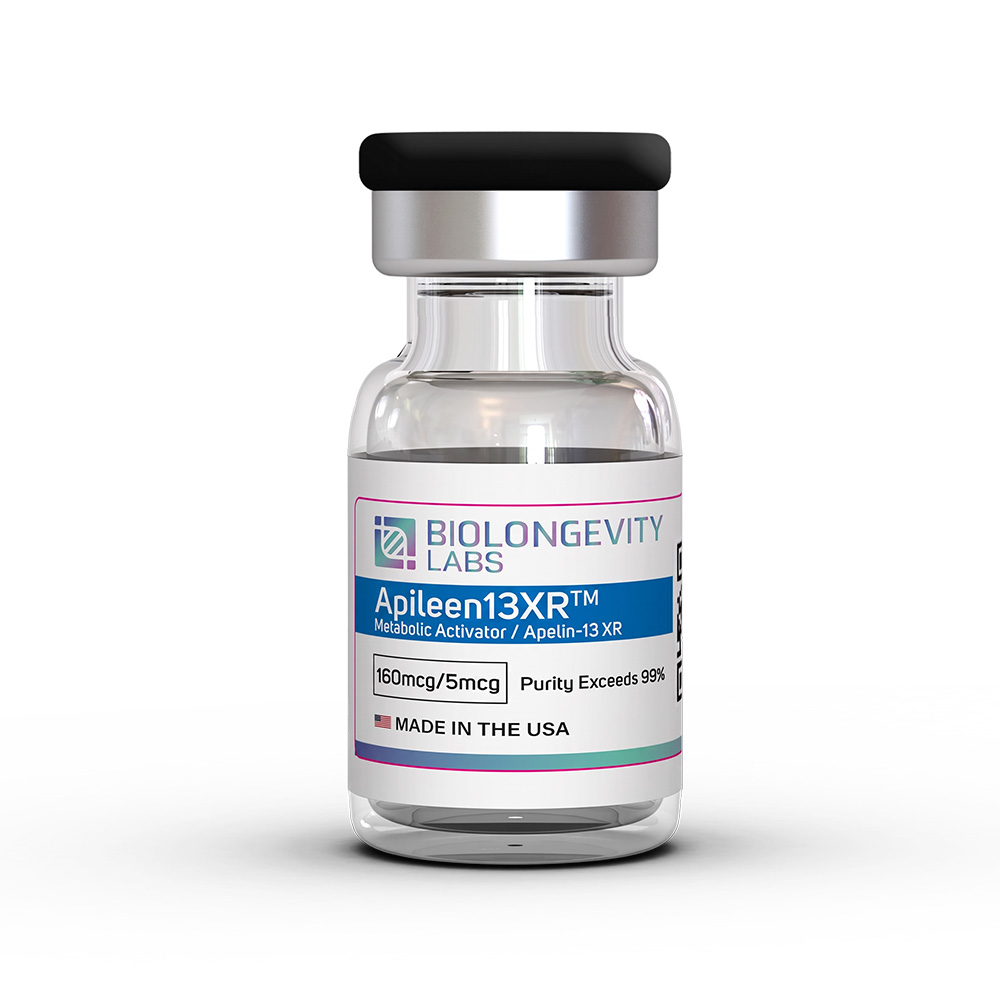
Apileen13XR combines two separate molecular structures in one vial: 160mcg of a modified peptide backbone and 5mcg of an albumin-bound Apelin-13 analog. The two peptides are blended, not chemically linked, and each carries its own albumin binder.
The backbone component is studied across three metabolic signaling pathways tied to nutrient sensing and energy balance. The Apelin-13 component adds a fourth pathway.
Apelin-13 is a naturally occurring adipokine, a signaling peptide secreted by fat tissue. Research models link it to glucose uptake, fatty acid oxidation, and mitochondrial biogenesis in muscle tissue [2][3].
Both components use albumin binding to extend their estimated serum stability period. That design choice placesApileen13XR in a growing class of research peptides built for longer persistence in laboratory models.
Compound Specifications
| Property |
Value |
| Compound Name |
Apileen13XR |
| Compound Class |
Synthetic two-component peptide blend (albumin-bound) |
| Component 1 |
Modified peptide backbone with albumin-binding peptide at position 17 (160mcg) |
| Component 2 |
Albumin-bound Apelin-13 analog (5mcg) |
| Molecular Weight (Component 1) |
7453.26 g/mol |
| Molecular Weight (Component 2) |
4472.76 g/mol |
| Synonyms |
Apileen13 XR, Apileen13XR, Apileen13-XR, Apileen-13XR |
| Source |
Synthetic, controlled peptide synthesis |
| Purity |
≥99% (UHPLC-MS) |
| Appearance |
Lyophilized white powder |
| Solubility |
Soluble in bacteriostatic water |
| Storage |
-20°C, protect from light |
| Vial Size |
2mL |
Storage and Handling
- Store the lyophilized compound at -20°C in the sealed vial, protected from light and moisture.
- Allow the vial to reach room temperature before opening so condensation does not settle on the powder.
- Reconstitute with bacteriostatic water only. Sterile water or saline shortens the solution’s usable life to under 24 hours.
- After reconstitution, store at 2°C to 8°C and use within 28 days. Avoid repeated freeze-thaw cycles.
- Maintain aseptic handling to preserve compound integrity.
Lyophilized Format
This compound ships in lyophilized (freeze-dried) form. Freeze-drying supports long-term storage stability and preserves compound integrity. No fillers are added.
Research Use Disclaimer
Apileen13XR is supplied for research use only. It is not a drug, food, cosmetic, or dietary supplement and has not been evaluated by the FDA. By purchasing, the buyer confirms the compound will be used solely for in vitro research.
Frequently Asked Questions
What Is Apileen13XR?
Apileen13XR is a synthetic research blend of two albumin-bound peptides: 160mcg of a modified peptide backbone and 5mcg of an Apelin-13 analog. It is supplied as a lyophilized powder for laboratory research use only.
What Are the Four Pathways Studied With Apileen13XR?
Apileen13XR is characterized across four metabolic signaling pathways. Three are linked to the modified backbone and relate to nutrient sensing and energy balance. The fourth is the Apelin-13 signaling pathway studied in glucose uptake and fatty acid oxidation research.
How Does the Albumin Binder in Apileen13XR Work?
Apileen13XR uses a modified SA21 peptide that binds serum albumin, which is associated with a longer estimated serum stability period in preclinical models. Each of the two components carries its own binder and attaches to a separate albumin molecule.
How Is Apileen13XR Stored?
Apileen13XR is stored at -20°C as a lyophilized powder in its sealed vial, protected from light. Laboratories reconstitute it with bacteriostatic water, hold it at 2°C to 8°C, use it within 28 days, and avoid repeated freeze-thaw cycles.
How Is the Purity of Apileen13XR Verified?
Apileen13XR purity is confirmed by UHPLC-MS at ≥99%. Each lot ships with a third-party certificate of analysis.
Research Overview
Research on structurally modified peptides has focused on three goals for the past two decades: stability, measured binding affinity, and longer application intervals in preclinical models. BioLean⁴XR carries three structural changes that separate it from comparable research compounds.
The first is its albumin-binding peptide. SA21 was identified through phage display at Genentech and binds serum albumin at a site distinct from known small-molecule binding sites. Surface plasmon resonance (SPR) placed its dissociation constant at 467 nM for albumin in the original work [1].
The modified SA21 used in BioLean⁴XR records an SPR reading of 10 to 20 nM in manufacturer characterization. In the original study, fusing a related SA21 sequence to an antibody fragment extended its serum stability period 37-fold in rabbit models [1].
The second change is the spacer. An oligo(ethylene glycol) and gamma-glutamic acid spacer joins the backbone to the albumin binder, a design associated with higher water solubility and lower steric hindrance than fatty acid chains [4][5].
The third change sits in the backbone itself. Alpha-aminoisobutyric acid at position 2 is intended to protect the peptide from cleavage by the dipeptidyl peptidase-4 (DPP-4) enzyme. The Apelin-13 component brings its own body of mechanistic research, covered below.
Apelin-13 Signaling in Research Models
In mouse models, apelin increased glucose uptake in soleus muscle through a pathway involving endothelial nitric oxide synthase (eNOS), AMP-activated protein kinase (AMPK), and Akt [2]. A four-week study in high-fat-diet mouse models recorded higher complete fatty acid oxidation, oxidative capacity, and mitochondrial biogenesis in muscle, all AMPK-dependent [3].
In 3T3-L1 adipocytes and isolated fat cells, apelin reduced stimulated free fatty acid and glycerol release through Gq, Gi, and AMPK-dependent mechanisms [6].
| Research Area |
In Vitro Application |
| Albumin-binding characterization |
SPR measurement of binding affinity to serum albumin |
| Serum stability |
Comparison of albumin-bound and unbound peptide persistence in serum assays |
| Enzymatic stability |
DPP-4 cleavage resistance assays on the Aib-modified backbone |
| Glucose uptake |
AMPK, eNOS, and Akt signaling in cultured muscle cell systems |
| Lipid metabolism |
Fatty acid oxidation and lipolysis assays in 3T3-L1 adipocytes |
| Mitochondrial research |
Oxidative capacity and mitochondrial biogenesis markers in muscle cell lines |
References
- Dennis MS, Zhang M, Meng YG, Kadkhodayan M, Kirchhofer D, Combs D, Damico LA (2002). Albumin binding as a general strategy for improving the pharmacokinetics of proteins. The Journal of Biological Chemistry, 277(38), 35035-35043. https://doi.org/10.1074/jbc.M205854200
- Dray C, Knauf C, Daviaud D, Waget A, Boucher J, Buléon M, Cani PD, Attané C, Guigné C, Carpéné C, Burcelin R, Castan-Laurell I, Valet P (2008). Apelin stimulates glucose utilization in normal and obese insulin-resistant mice. Cell Metabolism, 8(5), 437-445. https://doi.org/10.1016/j.cmet.2008.10.003
- Attané C, Foussal C, Le Gonidec S, et al. (2012). Apelin treatment increases complete fatty acid oxidation, mitochondrial oxidative capacity, and biogenesis in muscle of insulin-resistant mice. Diabetes, 61(2), 310-320. https://pmc.ncbi.nlm.nih.gov/articles/PMC3266414/
- Wang S, He W, Xiao C, Tao Y, Wang X (2019). Synthesis of Y-shaped OEGylated poly(amino acid)s: the impact of OEG architecture. Biomacromolecules, 20(4), 1655-1666. https://doi.org/10.1021/acs.biomac.9b00026
- Geng C, Wang S, Wang H (2021). Recent advances in thermoresponsive OEGylated poly(amino acid)s. Polymers, 13(11), 1813. https://pmc.ncbi.nlm.nih.gov/articles/PMC8198699/
- Yue P, Jin H, Xu S, Aillaud M, Deng AC, Azuma J, Kundu RK, Reaven GM, Quertermous T, Tsao PS (2011). Apelin decreases lipolysis via G(q), G(i), and AMPK-dependent mechanisms. Endocrinology, 152(1), 59-68. https://pmc.ncbi.nlm.nih.gov/articles/PMC3033059/
Certificate of Analysis (COA)
No COAs available for this product.
A Certificate of Analysis (COA) is a document that verifies a compound’s identity, purity and quality through independent laboratory testing. Every compound from BioLongevity Labs is third-party tested, and its COA is published here, so researchers can review the testing record before a compound enters a protocol.
Each COA reports results from third-party laboratory analysis, including:
- Ultra-high-performance liquid chromatography with mass spectrometry (UHPLC-MS) for purity, measured against a 98% or 99% specification depending on the compound
- Mass identification for molecular confirmation and content quantitation
- Endotoxin testing by Limulus amebocyte lysate (LAL) or recombinant Factor C (rFC) assay, depending on the laboratory
- Visual and physical characterization of the finished material
How to Verify a COA Independently
You can check every certificate against the issuing laboratory’s own records, not just the copy hosted here. Verification does not depend on BioLongevity Labs.
- AV Analytics certificates carry a search code. Scan the QR code on the certificate to open the laboratory’s verification page, or enter the search code at avanalytical.com/coa-search to pull the official record.
- BioRegen reports of analysis carry a Report ID and a Validation Key. Scan the QR code on the certificate to open the official record, or quote both identifiers when you contact the laboratory at the address printed on the report.
- SafeCert Labs issued a number of earlier certificates. Each one carries a COA number and the signature of the reporting chemist. Quote that number when you ask the laboratory to confirm it.
- Older certificates from other laboratories list their own verification details on the document.
When a batch is sent to more than one laboratory, each certificate resolves at its own issuing laboratory. A researcher can then check the results against two unrelated sources.
These COAs come from independent certified laboratories, not in-house testing. That gives researchers a verifiable record of molecular integrity for each compound. All compounds are supplied for research use only.
Review the latest COAs for this product below, or browse the full COA library.