Thymagen Technical Overview
Thymagen belongs to the short peptide bioregulator group associated with the work of V. Kh. Khavinson and colleagues, a family of two-to-four residue sequences originally separated from animal tissue homogenates and later reproduced synthetically. At two residues it is one of the shortest members of that group, with a free glutamate side chain at one end and an indole ring at the other.
Naming around this compound is inconsistent across suppliers, so the identity is worth stating plainly. Thymagen, Thymogen, Oglufanide, Timogen and the EW dipeptide are all names for the same L-α-glutamyl-L-tryptophan molecule. It is not Thymalin, which is a multi-component thymus peptide complex rather than a single defined sequence, and it is not Thymodepressin, which is built from the D-form amino acids and behaves differently in the same assay systems.
The compound is characterized in laboratory research covering peptide-DNA interaction modeling, cytokine expression in cultured cell lines, and enzyme activity assays. BioLongevity Labs supplies it strictly as a reference material for in vitro work.
Compound Specifications
| Property |
Value |
| CAS Number |
38101-59-6 |
| PubChem CID |
100094 |
| Molecular Formula |
C₁₆H₁₉N₃O₅ |
| Molecular Weight |
333.34 g/mol |
| Monoisotopic Mass |
333.13247 Da |
| Chemical Name (IUPAC) |
(4S)-4-amino-5-[[(1S)-1-carboxy-2-(1H-indol-3-yl)ethyl]amino]-5-oxopentanoic acid |
| Amino Acid Sequence |
Glu-Trp (one-letter: EW) |
| Sequence Length |
2 residues |
| Source |
Synthetic |
| InChIKey |
LLEUXCDZPQOJMY-AAEUAGOBSA-N |
| Canonical SMILES |
C1=CC=C2C(=C1)C(=CN2)CC@@HNC(=O)C@HN |
| ChEMBL ID |
CHEMBL2111029 |
| UNII |
4RHY598T5U |
| Synonyms |
Thymogen, Oglufanide, Timogen, EW dipeptide, H-Glu-Trp-OH, L-α-glutamyl-L-tryptophan, IM 862 dipeptide, NSC-334073 |
| Purity |
≥99% (HPLC) |
| Appearance |
Lyophilized white powder |
| Storage |
-20°C, protect from light |
Storage and Handling
- Store the lyophilized compound at -20°C, protected from light and moisture.
- After reconstitution, store at -20°C in single-use aliquots and use promptly. Avoid repeated freeze-thaw cycles.
- Allow sealed vials to equilibrate to room temperature before opening to limit condensation on the powder.
- Maintain aseptic handling throughout to preserve compound integrity.
Lyophilized Format
This compound ships in lyophilized (freeze-dried) form. Freeze-drying supports long-term storage stability and preserves compound integrity. No fillers are added.
Research Use Disclaimer
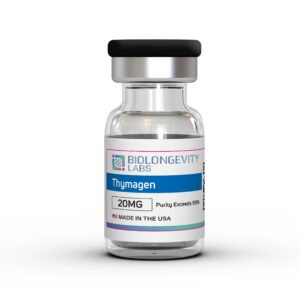
Thymagen 20mg is supplied for research use only. It is not a drug, food, cosmetic, or dietary supplement and has not been evaluated by the FDA. By purchasing, the buyer confirms the compound will be used solely for in vitro research.
Frequently Asked Questions
What Is Thymagen?
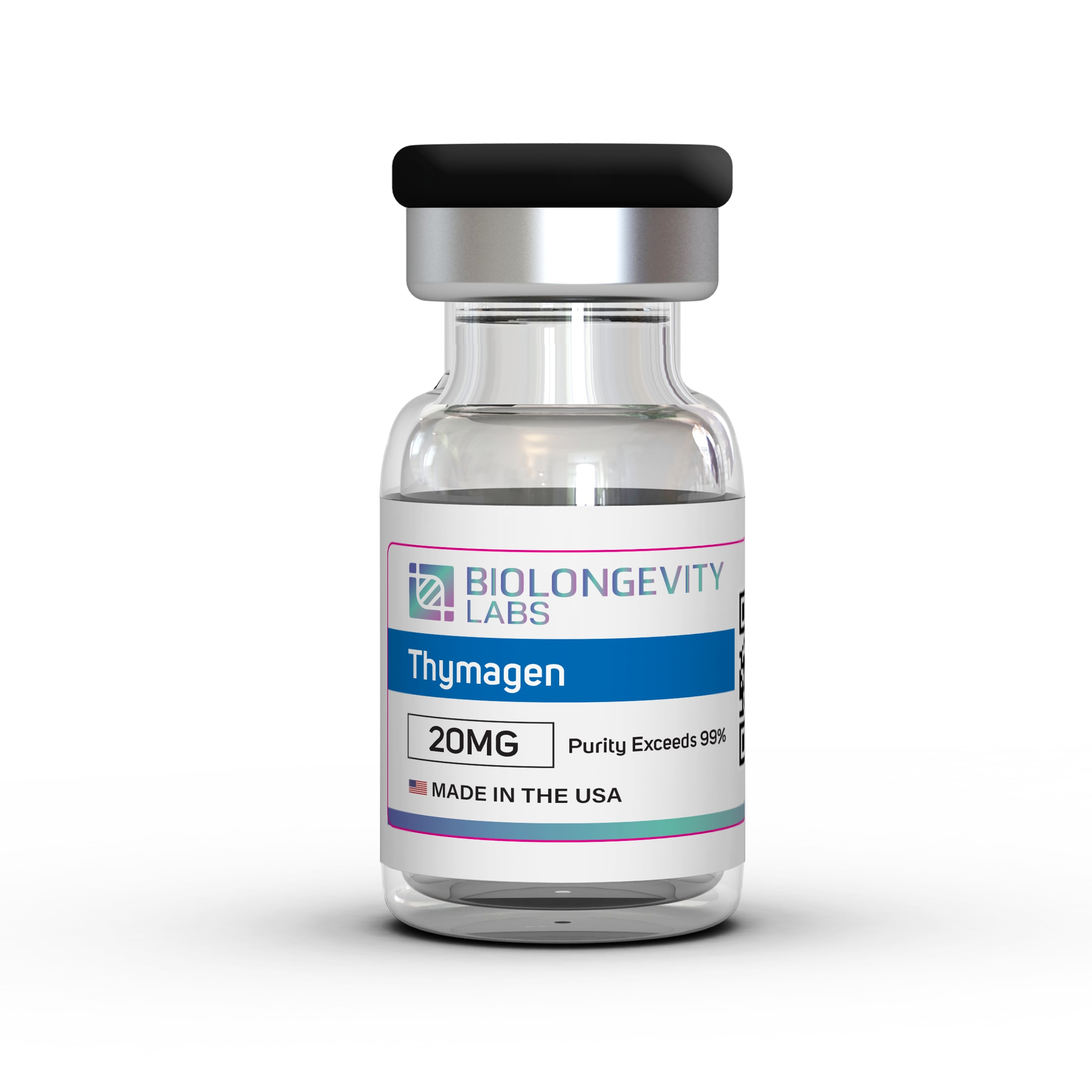
Thymagen 20mg is a vial containing 20 milligrams of the synthetic dipeptide L-glutamyl-L-tryptophan, supplied as a lyophilized powder for laboratory research. The same molecule is indexed under PubChem CID 100094 and CAS 38101-59-6.
Is Thymagen the Same Compound as Thymogen?
Yes. Thymagen and Thymogen are alternate spellings for the same L-α-glutamyl-L-tryptophan dipeptide, which also appears in the literature as Oglufanide and as the EW dipeptide. It is a different entity from Thymalin, a multi-component thymus peptide complex.
What Is the Molecular Weight and Sequence of Thymagen?
Thymagen has a molecular weight of 333.34 g/mol and a molecular formula of C₁₆H₁₉N₃O₅. The sequence is two residues, Glu-Trp, written EW in one-letter notation.
How Is Thymagen Purity Verified and What Documentation Ships With It?
Thymagen supplied by BioLongevity Labs is tested to ≥99% purity by HPLC, with mass confirmation against the compound’s monoisotopic mass of 333.13247 Da. A third-party Certificate of Analysis accompanies each lot.
How Should Thymagen 20mg Be Stored and Reconstituted?
Store the sealed lyophilized vial at -20°C away from light. Reconstitution solvent is chosen by the laboratory to suit the assay, noting that the free dipeptide has been reported as soluble in DMSO at 34 mg/mL with low aqueous solubility.
Thymagen Research Areas
Glu-Trp was identified in the 1980s as one of several dipeptides separated from thymus tissue homogenate, and the all-L form was subsequently produced synthetically under the name Thymogen [1]. Later structural work compared that L-form against its mirror-image D-form counterpart and reported opposite activity profiles for the two enantiomers across matched assay systems, which is an unusual result for a pair of stereoisomers and a recurring theme in the literature on this dipeptide [2].
Cell-culture work has looked at how the dipeptide behaves in a defined monocytic line. In the THP-1 monocyte and macrophage cell line, Thymogen was one of five short peptides examined for changes in tyrosine phosphorylation of mitogen-activated cytoplasmic kinases. Cultures stimulated with bacterial lipopolysaccharide showed lower measured expression of tumor necrosis factor and interleukin-6, alongside reduced adhesion of the exposed cells to an activated endothelial monolayer [3].
A separate line of work has modeled the dipeptide against nucleic acid rather than protein targets. Molecular docking placed the EW dipeptide against double-stranded DNA in the classical B-form and identified GGAG as the preferred binding sequence, with promoter database analysis used to shortlist candidate gene targets [4]. In the same study, peripheral blood mononuclear cell cultures stimulated with lipopolysaccharide showed lower measured IL-1β, IL-6 and TNF-α concentrations in the presence of the EW dipeptide compared with peptide-free control cultures [4].
Two further research threads sit outside cytokine assays and are worth separating out.
Vascular Enzymology and Angiogenesis Marker Research
In endothelial cell cultures and isolated rat aorta preparations, EW was among the tryptophan-containing dipeptides associated with inhibition of angiotensin-converting enzyme activity, and the peptides blocked angiotensin I induced vasoconstriction in the vessel preparations without altering basal vessel tone [5]. The same dipeptide appears in the published literature under the research designation IM862, in work where circulating vascular endothelial growth factor was tracked as an angiogenesis marker across an eight-week observation window [6].
Structure and Stability Research
Analogue work has compared Thymogen against modified versions carrying D-alanine attached at either the N-terminus or the C-terminus of the two-residue chain. Those comparisons reported differences between the parent dipeptide and its analogues in catalase activity and malondialdehyde concentration in rodent research models, with the C-terminal modification producing the larger separation from the unmodified sequence [7]. Work of this kind is typically used to map how terminal modification changes the stability of very short peptide chains.
| Research Area |
In Vitro Application |
| Monocyte and macrophage signaling |
Cytokine expression and kinase phosphorylation assays in THP-1 cultures |
| Peptide-DNA interaction |
Molecular docking and promoter sequence analysis against double-stranded DNA |
| Vascular enzymology |
Angiotensin-converting enzyme activity assays in endothelial cell cultures |
| Angiogenesis marker research |
Vascular endothelial growth factor measurement in culture and model systems |
| Peptide stereochemistry |
Side-by-side comparison of L- and D-form dipeptides in matched assay systems |
| Analytical method development |
HPLC and LC-MS identity and purity confirmation against a defined reference mass |
References
- Deigin V, Ksenofontova O, Yatskin O, Goryacheva A, Ignatova A, Feofanov A, Ivanov V. (2020). Novel platform for the preparation of synthetic orally active peptidomimetics with hemoregulating activity. II. Hemosuppressor activity of 2,5-diketopiperazine-based cyclopeptides. International Immunopharmacology, 81, 106185. https://www.sciencedirect.com/science/article/abs/pii/S1567576919323616
- Deigin V, Linkova N, Vinogradova J, Vinogradov D, Polyakova V, Medvedev D, Krasichkov A, Volpina O. (2024). The First Reciprocal Activities of Chiral Peptide Pharmaceuticals: Thymogen and Thymodepressin, as Examples. International Journal of Molecular Sciences, 25(9), 5042. https://www.mdpi.com/1422-0067/25/9/5042
- Avolio F, Martinotti S, Khavinson VK, Esposito JE, Giambuzzi G, Marino A, Mironova E, Pulcini R, Robuffo I, Bologna G, Simeone P, Lanuti P, Guarnieri S, Trofimova S, Procopio AD, Toniato E. (2022). Peptides Regulating Proliferative Activity and Inflammatory Pathways in the Monocyte/Macrophage THP-1 Cell Line. International Journal of Molecular Sciences, 23(7), 3607. https://www.mdpi.com/1422-0067/23/7/3607
- Linkova N, Khavinson V, Diatlova A, Petukhov M, Vladimirova E, Sukhareva M, Ilina A. (2023). The Influence of KE and EW Dipeptides in the Composition of the Thymalin Drug on Gene Expression and Protein Synthesis Involved in the Pathogenesis of COVID-19. International Journal of Molecular Sciences, 24(17), 13377. https://www.mdpi.com/1422-0067/24/17/13377
- Khedr S, Deussen A, Kopaliani I, Zatschler B, Martin M. (2017). Effects of tryptophan-containing peptides on angiotensin-converting enzyme activity and vessel tone ex vivo and in vivo. European Journal of Nutrition, 57(3), 907-915. https://link.springer.com/article/10.1007/s00394-016-1374-y
- Deplanque G, Madhusudan S, Jones PH, Wellmann S, Christodoulos K, Talbot DC, Ganesan TS, Blann A, Harris AL. (2004). Phase II trial of the antiangiogenic agent IM862 in metastatic renal cell carcinoma. British Journal of Cancer, 91(9), 1645-1650. https://pmc.ncbi.nlm.nih.gov/articles/PMC2409952/
- Chulanova AA, Smakhtin MY, Bobyntsev II, Mishina ES, Artyushkova EB, Smakhtina AM. (2023). Reparative and Antioxidant Effects of New Analogues of Immunomodulator Thymogen in Experimental Model of Liver Damage. Bulletin of Experimental Biology and Medicine, 175(5), 700-703. https://link.springer.com/article/10.1007/s10517-023-05929-5
Certificate of Analysis (COA) for Every Batch
A Certificate of Analysis (COA) is a document that verifies a compound’s identity, purity, and batch quality through independent laboratory testing. Every compound from BioLongevity Labs ships with a COA tied to its specific batch, so researchers can confirm exactly what they received before it enters a protocol.
Each COA reports results from third-party laboratory analysis, including:
- Ultra-high-performance liquid chromatography with mass spectrometry (UHPLC-MS) for purity, typically confirmed at 99% or higher
- Mass identification for molecular confirmation and content quantitation
- Endotoxin quantitation by Limulus amebocyte lysate (LAL) assay where applicable
- Visual and physical characterization of the finished material
How to verify a COA independently
Every certificate can be checked against the issuing laboratory’s own records, not just the copy hosted here. Verification does not depend on BioLongevity Labs.
- MDx BioAnalytical Laboratory certificates carry a QC tracking number and a search code. Newer certificates also carry a QR code. Scan the code, or enter the search code at mdxbiolabs.com, to pull the official record.
- BioRegen reports of analysis carry a Report ID and a Validation Key. Scan the QR code on the certificate to open the official record, or reference both identifiers when contacting the laboratory at the address printed on the report.
- SafeCert Labs certificates, which appear on a number of earlier batches, carry a COA number and the signature of the reporting chemist. Reference that number when requesting confirmation from the laboratory directly.
Batches are frequently tested by both laboratories independently. When two certificates exist for the same lot, each one resolves at its own issuing laboratory, which lets a researcher confirm the same material twice through two unrelated sources.
COAs are sourced from independent certified labs rather than in-house testing alone, giving researchers a verifiable record of molecular integrity for each batch. All compounds are supplied for research use only.
Review the COAs for this batch below, or browse the full COA library.
Thymogen (12086)

Thymogen (12087)

Thymagen (260398)

Thymagen (260266)

Endotoxin Thymagen

Thymagen (11379)

Thymagen (251543)

Thymagen (251543E)

×
![]()